

Rockingham Instructor Portal
Course Information
|
How Students are Set to Register for their OakesAcademy.com account |
School prepays for memberships
|
|
|
What Students See When They Login |
||
|
Your Requests We Have on File |
Quizzes: Times, limited to 2 attempts, explanations are not automatically sent (explanations are available on this Instructor page, or can be mailed to students on request. |
|
| How to get Assistance from OakesAcademy |
email: [email protected] |
We believe in continuous quality improvement. While we avoid upsetting the structure of the course (without lots of advance notice), we respond to all requests for clarification and continue to update this course often. Current list of changes:
- Catheters (A-line, Central Line, PA Catheter) - expanded/simplified format
- Thoracentesis - expanded/simplified
- Modifying Patient Positioning - expanded/simplified
- Cardiopulmonary Exercise Testing - expanded/simplified
- Withdrawal of Life Support - expanded/simplified
- Aerosolized Drugs: Modes of Administration - expanded/simplified format
- Sputum Induction - expanded/simplified
- Cardioversion - simplified
- V/Q Matching - expanded/simplified
- Ventilator Management - all sections rewritten, summarized, updated!
- Noninvasive Ventilation Management - all sections rewritten, summarized, updated!
- Oxygen Device Management - completely rewritten, summarized format!
- CPAP/NPPV Titration - expanded/simplified
- Procedural Sedation - expanded/simplified
- Evidence-Based Guidelines - expanded/simplified
- Intrahospital and Interhospital Transports - both updated/clarified
- Medical Emergency Teams - completely rewritten, summarized format!
- Disaster Management - completely rewritten, summarized format!
- Equations Page - we have simplified, colored, and given lots of sample problems
- Humidifiers - Equipment - rewritten, summarized format!
- Humidity - Managing - rewritten/simplified
- Speaking Valves - updated/clarified, new diagram
- Pulmonary Function Procedure (Spirometry) - expanded/simplified
- Pulmonary Function Testing (Quality Controls) - expanded/simplified
- ET Tubes/Cuff Pressure - completely rewritten
- LMA - completely rewritten
- Exhaled Gas Analysis - completely rewritten, summarized format!
- Smoking History - clarified
- Noninvasive Monitoring (Equipment) - completely rewritten, summarized format!
- Patient Circuits (Equipment) - completely rewritten, summarized format!
- Suctioning (Equipment) - completely rewritten, summarized format!
- Artificial Airways (Equipment) - completely rewritten, summarized format!
- Intubation (Equipment) - completely rewritten, summarized format!
- Ventilators (Equipment) - completely rewritten, summarized format!
- Manual Resuscitation Bags - Simplified, slightly expanded
- Nitric Oxide - rewritten, simplified
- Chest Tube Drainage - rewritten, simplified
- Gas Delivery and Metering - simplified
- Heliox - expanded/simplified
- O2 Administration Devices - redesigned/clarified
- Infection Control - all sections updated
- Noninvasive Monitors Quality Control updated/clarified
- POC Equipment Quality Control updated/clarified
- ABG Analyzers Quality Control updated/clarified
- Gas Analyzers Quality Control updated/clarified
- ABG Sampling completely rewritten/organized
- ABG Analysis completely rewritten/organized
- TMC Pt Assessment Flashcards updated, expanded
- Compliance and Resistance expanded/simplified
- Monitoring Trends expanded/simplified
- Auscultation (Breath Sounds) completely rewritten!
- Vital Signs Overview Page new page!
- Heart Sounds expanded/simplified
- Pediatric Ventilation basic clarifications
- Neonatal Ventilators expanded/simplified section!
- Neonatal Diseases new Oakes Academy Tip, slight updates
- Neonatal Assessments expanded/simplified
- Neo/Ped overview page - 3 new Oakes Academy Tips
- Pediatric Interventions expanded/simplified
- Pediatric Assessment expanded/simplified
- 12-Lessons UPDATED (content is in same order, but most topics have been rewritten)
- Pharmacology section completely rewritten/organized
- Inhaled Nitric Oxide completely rewritten, summarized
- Synchrony on Vent completely rewritten
- Overview of Oxygenation/Ventilation on Vent expanded/reorganized
- Gas Analyzers expanded/simplified
- Initial Settings expanded/simplified
- Minimizing Hypoxemia expanded/simplified
- Adjusting O2 expanded/simplified
- Chest Physiotherapy/Postural Drainage basic edits/clarifications
- Incentive Spirometry expanded/simplified
- Neonatal Interventions expanded/simplified
- Neonatal Diagnostics expanded/simplified
- Neonatal Assessment expanded/simplified
- Maternal Assessment basic edits
- Disease Table
- COPD
- Asthma
- Heart Failure
- Cardiovascular
- Post-Surg
- Geriatric
- Infectious
- Pulmonary Vascular (hypertension)
- Trauma
- Immunocompromised
- Neuro
- ARDS
- Pulmonary Embolism
- Shock
- Bariatric
- Neuromuscular
- Psych
- Inhalation Injuries
- Lung Transplantation
- Apnea
- Interstitial Lung Disease
- Drug Overdose
- Traumatic Brain Injury
- Sepsis
- Lung CA
- Lesson 11 Quiz has been fully updated/revised
- Lesson 10 Quiz has been fully updated/revised
- Ongoing changes to Disease Management
- Chest Radiographs have been simplified/expanded with new images
- Lesson 9 Quiz has been fully updated/revised
- Lesson 8 Quiz has been fully updated/revised
- Simplified/Expanded Pneumothorax Management
- Lesson 7 Quiz has been fully updated/revised
- Minor changes to 12-Lead ECG
- Lesson 6 Midterm has been fully updated/rewritten (40 all new questions!)
- Simplified/Expanded Suctioning
- Simplified/Expanded POC Quality Control
- Simplified/Expanded inhaled Nitric Oxide
- Simplified/Expanded 6-Minute Walk Test
- Simplified/Expanded Inspiratory Muscle Training
- Simplified/Expanded Myasthenia Gravis
- Lesson 5 Quiz has been fully updated/revised
- Simplified/Expanded Spontaneous Breathing Trial
- Simplified/Expanded Weaning
- Simplified/Expanded Extubation
- Lesson 4 Quiz has been fully updated/revised
- Lesson 3 Quiz has been fully updated/revised
- Lesson 2 Quiz has been fully updated/revised
- Simplified/Expanded Cardiac Biomarkers
- Simplified/Expanded Culture and Sensitivity
- Minor changes: Electrolytes
- Simplified/Expanded O2 Consumption/CO2 Production
- Simplified/Expanded Hematology: WBCs
- Simplified/Expanded Hematology: RBCs
- Minor adjustments/New Tip Box Other Imaging
- Simplified/Expanded Neck Radiograph
- All new Lines/Drains/Tubes page
- All new Physical Exam chart (from head to toe):
- New Design for section pages with more detailed question counts, easier navigation back to main page
- Split the first section into two to be more consistent with the NBRC Outline (Evaluate Data in the Patient Record and Perform Clinical Assessment)
- Expanded and Simplified: Dyspnea
- Getting started! Front page reorganized a bit, colors changes
Course Grades
Note: these are not in real-time. We have to hand submit these (keep costs low!) so please expect delays. We work to update grades daily, Mon-Fri.
The students take the NBRC test this lesson - this is not our test so scores can't be reported
- Some instructors require students to send the email/grade from their NBRC as a pretest score
- Other instructors treat this as an ungraded assignment
| Link name: | Rockingham Quiz 02 | ||||||||
| Test name: | TMC Lesson 02 Quiz | ||||||||
| First name | Last name | Percentage | Points received | Points available | Minutes | Seconds | Date started | Date finished | |
| Macy | Carter | [email protected] | 30% | 3 | 10 | 4 | 32 | Wed 14th Feb 2024 8:50am | Wed 14th Feb 2024 8:54am |
| Macy | Carter | [email protected] | 50% | 5 | 10 | 5 | 58 | Wed 14th Feb 2024 8:27am | Wed 14th Feb 2024 8:33am |
| Juaneisha | Tucker | [email protected] | 60% | 6 | 10 | 3 | 43 | Tue 13th Feb 2024 9:50pm | Tue 13th Feb 2024 9:54pm |
| Juaneisha | Tucker | [email protected] | 70% | 7 | 10 | 11 | 28 | Tue 13th Feb 2024 12:57pm | Tue 13th Feb 2024 1:08pm |
| Presley | Lovelace | [email protected] | 100% | 10 | 10 | 9 | 43 | Thu 8th Feb 2024 12:03am | Thu 8th Feb 2024 12:13am |
| Presley | Lovelace | [email protected] | 30% | 3 | 10 | 12 | 14 | Wed 7th Feb 2024 11:24pm | Wed 7th Feb 2024 11:50pm |
| Chris | Adams | [email protected] | 90% | 9 | 10 | 2 | 31 | Mon 5th Feb 2024 11:27am | Mon 5th Feb 2024 11:30am |
| Chris | Adams | [email protected] | 90% | 9 | 10 | 4 | 16 | Mon 5th Feb 2024 11:19am | Mon 5th Feb 2024 11:24am |
| Malika | Williams | [email protected] | 80% | 8 | 10 | 6 | 4 | Sun 4th Feb 2024 8:53pm | Sun 4th Feb 2024 8:59pm |
| Malika | Williams | [email protected] | 90% | 9 | 10 | 5 | 36 | Sun 4th Feb 2024 8:45pm | Sun 4th Feb 2024 8:50pm |
| Courtney | Curry | [email protected] | 60% | 6 | 10 | 5 | 46 | Sun 4th Feb 2024 4:05pm | Sun 4th Feb 2024 4:10pm |
| Courtney | Curry | [email protected] | 70% | 7 | 10 | 11 | 54 | Sun 4th Feb 2024 3:50pm | Sun 4th Feb 2024 4:02pm |
| Taariq | Songster | [email protected] | 100% | 10 | 10 | 4 | 56 | Sun 4th Feb 2024 2:32pm | Sun 4th Feb 2024 2:37pm |
| Aimee | Nguyen | [email protected] | 100% | 10 | 10 | 1 | 14 | Sun 4th Feb 2024 12:51pm | Sun 4th Feb 2024 12:52pm |
| Aimee | Nguyen | [email protected] | 90% | 9 | 10 | 1 | 51 | Sun 4th Feb 2024 12:48pm | Sun 4th Feb 2024 12:50pm |
| Edris | Hussein | [email protected] | 100% | 10 | 10 | 7 | 22 | Sat 3rd Feb 2024 9:39pm | Sat 3rd Feb 2024 9:47pm |
| Ekhra | Hussein | [email protected] | 100% | 10 | 10 | 19 | 13 | Sat 3rd Feb 2024 9:16pm | Sat 3rd Feb 2024 9:35pm |
| Ekhra | Hussein | [email protected] | 70% | 7 | 10 | 12 | 24 | Sat 3rd Feb 2024 8:59pm | Sat 3rd Feb 2024 9:12pm |
| Edris | Hussein | [email protected] | 80% | 8 | 10 | 12 | 39 | Sat 3rd Feb 2024 5:50pm | Sat 3rd Feb 2024 6:03pm |
| Shannon | Watlington | [email protected] | 50% | 5 | 10 | 3 | 41 | Sat 3rd Feb 2024 5:03pm | Sat 3rd Feb 2024 5:07pm |
| Shannon | Watlington | [email protected] | 60% | 6 | 10 | 6 | 16 | Sat 3rd Feb 2024 4:52pm | Sat 3rd Feb 2024 4:58pm |
| Brenda | Joyce | [email protected] | 50% | 5 | 10 | 8 | 20 | Sat 3rd Feb 2024 12:22pm | Sat 3rd Feb 2024 12:30pm |
| Brenda | Joyce | [email protected] | 40% | 4 | 10 | 7 | 54 | Sat 3rd Feb 2024 11:11am | Sat 3rd Feb 2024 11:19am |
| Aimee | Nguyen | [email protected] | 90% | 9 | 10 | 2 | 19 | Sat 3rd Feb 2024 10:16am | Sat 3rd Feb 2024 10:18am |
| Hanson | White | [email protected] | 90% | 9 | 10 | 1 | 49 | Sat 3rd Feb 2024 10:05am | Sat 3rd Feb 2024 10:07am |
| Hanson | White | [email protected] | 90% | 9 | 10 | 9 | 28 | Sat 3rd Feb 2024 9:29am | Sat 3rd Feb 2024 9:38am |
| Taariq | Songster | [email protected] | 90% | 9 | 10 | 10 | 27 | Sat 3rd Feb 2024 2:46am | Sat 3rd Feb 2024 2:56am |
| Aimee | Nguyen | [email protected] | 60% | 6 | 10 | 8 | 47 | Fri 2nd Feb 2024 11:13am | Fri 2nd Feb 2024 11:22am |
| Rachel | Rickerson | [email protected] | 70% | 7 | 10 | 5 | 45 | Tue 30th Jan 2024 9:42pm | Tue 30th Jan 2024 9:48pm |
| Rachel | Rickerson | [email protected] | 90% | 9 | 10 | 11 | 17 | Tue 30th Jan 2024 9:06pm | Tue 30th Jan 2024 9:18pm |
| Average percentage: | 74.70% | ||||||||
| Average points scored: | 7.5 | ||||||||
| Link name: | Rockingham Lesson 03 Quiz | |||||||||
| Test name: | TMC Lesson 03 Quiz | |||||||||
| First name | Last name | Percentage | Points received | Points available | Minutes | Seconds | Date started | Date finished | Requires grading | |
| Chris | Adams | [email protected] | 90% | 9 | 10 | 1 | 29 | Thu 8th Feb 2024 8:05pm | Thu 8th Feb 2024 8:06pm | Completed |
| Chris | Adams | [email protected] | 90% | 9 | 10 | 5 | 41 | Thu 8th Feb 2024 7:58pm | Thu 8th Feb 2024 8:03pm | Completed |
| Macy | Carter | [email protected] | 70% | 7 | 10 | 1 | 36 | Wed 14th Feb 2024 9:13am | Wed 14th Feb 2024 9:15am | Completed |
| Macy | Carter | [email protected] | 70% | 7 | 10 | 4 | 54 | Wed 14th Feb 2024 9:07am | Wed 14th Feb 2024 9:12am | Completed |
| Courtney | Curry | [email protected] | 100% | 10 | 10 | 3 | 37 | Wed 7th Feb 2024 12:27pm | Wed 7th Feb 2024 12:31pm | Completed |
| Courtney | Curry | [email protected] | 70% | 7 | 10 | 15 | 49 | Wed 7th Feb 2024 12:10pm | Wed 7th Feb 2024 12:26pm | Completed |
| Edris | Hussein | [email protected] | 100% | 10 | 10 | 6 | 36 | Sun 11th Feb 2024 9:29pm | Sun 11th Feb 2024 9:35pm | Completed |
| Ekhra | Hussein | [email protected] | 100% | 10 | 10 | 3 | 54 | Sun 11th Feb 2024 6:59pm | Sun 11th Feb 2024 7:03pm | Completed |
| Ekhra | Hussein | [email protected] | 90% | 9 | 10 | 5 | 18 | Sun 11th Feb 2024 6:53pm | Sun 11th Feb 2024 6:58pm | Completed |
| Edris | Hussein | [email protected] | 60% | 6 | 10 | 14 | 43 | Sun 11th Feb 2024 6:13am | Sun 11th Feb 2024 6:28am | Completed |
| Brenda | Joyce | [email protected] | 70% | 7 | 10 | 6 | 21 | Sat 2nd Mar 2024 11:12am | Sat 2nd Mar 2024 11:18am | Completed |
| Brenda | Joyce | [email protected] | Sat 17th Feb 2024 12:00pm | In Progress | ||||||
| Brenda | Joyce | [email protected] | 80% | 8 | 10 | 3 | 9 | Sun 11th Feb 2024 4:17pm | Sun 11th Feb 2024 4:20pm | Completed |
| Brenda | Joyce | [email protected] | 90% | 9 | 10 | 18 | 25 | Sun 11th Feb 2024 3:29pm | Sun 11th Feb 2024 3:48pm | Completed |
| Presley | Lovelace | [email protected] | 90% | 9 | 10 | 16 | 4 | Sat 17th Feb 2024 4:16pm | Sat 17th Feb 2024 4:32pm | Completed |
| Presley | Lovelace | [email protected] | 80% | 8 | 10 | 6 | 22 | Sat 17th Feb 2024 4:08pm | Sat 17th Feb 2024 4:14pm | Completed |
| Aimee | Nguyen | [email protected] | 100% | 10 | 10 | 1 | 45 | Sun 11th Feb 2024 12:46am | Sun 11th Feb 2024 12:47am | Completed |
| Aimee | Nguyen | [email protected] | 90% | 9 | 10 | 4 | 48 | Sun 11th Feb 2024 12:35am | Sun 11th Feb 2024 12:40am | Completed |
| rachel | rickerson | [email protected] | 80% | 8 | 10 | 5 | 9 | Sun 11th Feb 2024 8:03pm | Sun 11th Feb 2024 8:08pm | Completed |
| rachel | rickerson | [email protected] | 80% | 8 | 10 | 11 | 44 | Sun 11th Feb 2024 7:19pm | Sun 11th Feb 2024 7:31pm | Completed |
| Taariq | Songster | [email protected] | 100% | 10 | 10 | 7 | 48 | Sun 11th Feb 2024 4:04pm | Sun 11th Feb 2024 4:12pm | Completed |
| Taariq | Songster | [email protected] | 70% | 7 | 10 | 19 | 57 | Sat 10th Feb 2024 7:19pm | Sat 10th Feb 2024 7:39pm | Completed |
| Juaneisha | Tucker | [email protected] | 60% | 6 | 10 | 20 | 0 | Wed 14th Feb 2024 10:22am | Wed 14th Feb 2024 10:42am | Completed |
| Juaneisha | Tucker | [email protected] | 70% | 7 | 10 | 10 | 40 | Tue 20th Feb 2024 3:50pm | Tue 20th Feb 2024 4:01pm | Completed |
| Shannon | Watlington | [email protected] | 70% | 7 | 10 | 18 | 57 | Fri 16th Feb 2024 11:57pm | Sat 17th Feb 2024 12:16am | Completed |
| Hanson | White | [email protected] | 80% | 8 | 10 | 9 | 6 | Mon 12th Feb 2024 1:04pm | Mon 12th Feb 2024 1:13pm | Completed |
| Hanson | White | [email protected] | 70% | 7 | 10 | 10 | 56 | Mon 12th Feb 2024 12:53pm | Mon 12th Feb 2024 1:04pm | Completed |
| Malika | Williams | [email protected] | 100% | 10 | 10 | 3 | 53 | Sun 11th Feb 2024 10:58pm | Sun 11th Feb 2024 11:02pm | Completed |
| Malika | Williams | [email protected] | 50% | 5 | 10 | 20 | 0 | Sun 11th Feb 2024 6:23pm | Sun 11th Feb 2024 6:43pm | Completed |
| Average percentage: | 81.10% | |||||||||
| Average points scored: | 8.1 | |||||||||
| Link name: | Rockingham Lesson 04 Quiz | |||||||||
| Test name: | TMC Lesson 04 Quiz | |||||||||
| First name | Last name | Percentage | Points received | Points available | Minutes | Seconds | Date started | Date finished | Requires grading | |
| Presley | Lovelace | [email protected] | 80% | 8 | 10 | 6 | 55 | Fri 15th Mar 2024 9:54pm | Fri 15th Mar 2024 10:01pm | Completed |
| Presley | Lovelace | [email protected] | 90% | 9 | 10 | 12 | 46 | Fri 15th Mar 2024 9:41pm | Fri 15th Mar 2024 9:53pm | Completed |
| Presley | Lovelace | [email protected] | 100% | 10 | 10 | 4 | 57 | Mon 26th Feb 2024 10:18am | Mon 26th Feb 2024 10:23am | Completed |
| Presley | Lovelace | [email protected] | 40% | 4 | 10 | 5 | 30 | Mon 26th Feb 2024 10:12am | Mon 26th Feb 2024 10:17am | Completed |
| Brenda | Joyce | [email protected] | 70% | 7 | 10 | 5 | 48 | Sun 25th Feb 2024 6:25pm | Sun 25th Feb 2024 6:30pm | Completed |
| Taariq | Songster | [email protected] | 90% | 9 | 10 | 5 | 10 | Fri 23rd Feb 2024 3:23pm | Fri 23rd Feb 2024 3:28pm | Completed |
| Shannon | Watlington | [email protected] | 100% | 10 | 10 | 8 | 55 | Wed 21st Feb 2024 5:46pm | Wed 21st Feb 2024 5:55pm | Completed |
| Aimee | Nguyen | [email protected] | 90% | 9 | 10 | 3 | 16 | Wed 21st Feb 2024 4:08pm | Wed 21st Feb 2024 4:11pm | Completed |
| Aimee | Nguyen | [email protected] | 80% | 8 | 10 | 13 | 33 | Wed 21st Feb 2024 3:05pm | Wed 21st Feb 2024 3:18pm | Completed |
| Brenda | Joyce | [email protected] | 90% | 9 | 10 | 3 | 8 | Wed 21st Feb 2024 1:41pm | Wed 21st Feb 2024 1:44pm | Completed |
| Juaneisha | Tucker | [email protected] | 90% | 9 | 10 | 12 | 44 | Wed 21st Feb 2024 1:26pm | Wed 21st Feb 2024 1:39pm | Completed |
| Juaneisha | Tucker | [email protected] | 50% | 5 | 10 | 11 | 44 | Tue 20th Feb 2024 6:27pm | Tue 20th Feb 2024 6:39pm | Completed |
| Edris | Hussein | [email protected] | 100% | 10 | 10 | 6 | 50 | Sun 18th Feb 2024 9:50pm | Sun 18th Feb 2024 9:57pm | Completed |
| Ekhra | Hussein | [email protected] | 100% | 10 | 10 | 7 | 22 | Sun 18th Feb 2024 9:42pm | Sun 18th Feb 2024 9:49pm | Completed |
| Ekhra | Hussein | [email protected] | 60% | 6 | 10 | 8 | 31 | Sun 18th Feb 2024 9:31pm | Sun 18th Feb 2024 9:40pm | Completed |
| Taariq | Songster | [email protected] | 60% | 6 | 10 | 1 | 23 | Sun 18th Feb 2024 9:17pm | Sun 18th Feb 2024 9:18pm | Completed |
| Taariq | Songster | [email protected] | 80% | 8 | 10 | 9 | 33 | Sun 18th Feb 2024 9:04pm | Sun 18th Feb 2024 9:13pm | Completed |
| Chris | Adams | [email protected] | 100% | 10 | 10 | 2 | 51 | Sun 18th Feb 2024 7:36pm | Sun 18th Feb 2024 7:39pm | Completed |
| Chris | Adams | [email protected] | 90% | 9 | 10 | 4 | 49 | Sun 18th Feb 2024 7:28pm | Sun 18th Feb 2024 7:32pm | Completed |
| Rachel | Rickerson | [email protected] | 90% | 9 | 10 | 3 | 28 | Sun 18th Feb 2024 4:07pm | Sun 18th Feb 2024 4:10pm | Completed |
| Malika | Williams | [email protected] | 90% | 9 | 10 | 12 | 36 | Sun 18th Feb 2024 4:03pm | Sun 18th Feb 2024 4:16pm | Completed |
| Malika | Williams | [email protected] | 60% | 6 | 10 | 20 | 0 | Sun 18th Feb 2024 3:21pm | Sun 18th Feb 2024 3:41pm | Completed |
| Rachel | Rickerson | [email protected] | 40% | 4 | 10 | 10 | 11 | Sun 18th Feb 2024 2:21pm | Sun 18th Feb 2024 2:31pm | Completed |
| Brenda | Joyce | [email protected] | 70% | 7 | 10 | 3 | 55 | Sat 17th Feb 2024 12:01pm | Sat 17th Feb 2024 12:05pm | Completed |
| Brenda | Joyce | [email protected] | 40% | 4 | 10 | 14 | 1 | Sat 17th Feb 2024 10:37am | Sat 17th Feb 2024 10:51am | Completed |
| Shannon | Watlington | [email protected] | 30% | 3 | 10 | 2 | 44 | Fri 16th Feb 2024 11:45pm | Fri 16th Feb 2024 11:48pm | Completed |
| Shannon | Watlington | [email protected] | 50% | 5 | 10 | 15 | 39 | Fri 16th Feb 2024 11:28pm | Fri 16th Feb 2024 11:43pm | Completed |
| Edris | Hussein | [email protected] | 80% | 8 | 10 | 12 | 19 | Fri 16th Feb 2024 10:15pm | Fri 16th Feb 2024 10:27pm | Completed |
| Macy | Carter | [email protected] | 70% | 7 | 10 | 2 | 17 | Wed 14th Feb 2024 9:37am | Wed 14th Feb 2024 9:40am | Completed |
| Macy | Carter | [email protected] | 50% | 5 | 10 | 7 | 26 | Wed 14th Feb 2024 9:29am | Wed 14th Feb 2024 9:36am | Completed |
| Hanson | White | [email protected] | 90% | 9 | 10 | 3 | 45 | Mon 12th Feb 2024 2:11pm | Mon 12th Feb 2024 2:15pm | Completed |
| Hanson | White | [email protected] | 50% | 5 | 10 | 5 | 29 | Mon 12th Feb 2024 1:19pm | Mon 12th Feb 2024 1:25pm | Completed |
| Courtney | Curry | [email protected] | 100% | 10 | 10 | 9 | 38 | Fri 9th Feb 2024 2:58pm | Fri 9th Feb 2024 3:08pm | Completed |
| Courtney | Curry | [email protected] | 60% | 6 | 10 | 18 | 57 | Fri 9th Feb 2024 2:35pm | Fri 9th Feb 2024 2:54pm | Completed |
| Average percentage: | 74.40% | |||||||||
| Average points scored: | 7.4 | |||||||||
| Link name: | Rockingham Lesson 05 Quiz | |||||||||
| Test name: | TMC Lesson 05 Quiz | |||||||||
| First name | Last name | Percentage | Points received | Points available | Minutes | Seconds | Date started | Date finished | Requires grading | |
| Chris | Adams | [email protected] | 100% | 10 | 10 | 5 | 40 | Thu 22nd Feb 2024 6:01pm | Thu 22nd Feb 2024 6:06pm | Completed |
| macy | carter | [email protected] | 100% | 10 | 10 | 5 | 5 | Sun 3rd Mar 2024 8:59pm | Sun 3rd Mar 2024 9:04pm | Completed |
| macy | carter | [email protected] | 90% | 9 | 10 | 1 | 43 | Sun 25th Feb 2024 11:46pm | Sun 25th Feb 2024 11:48pm | Completed |
| Macy | Carter | [email protected] | 40% | 4 | 10 | 10 | 2 | Sun 25th Feb 2024 11:30pm | Sun 25th Feb 2024 11:40pm | Completed |
| Courtney | Curry | [email protected] | 90% | 9 | 10 | 2 | 14 | Tue 20th Feb 2024 7:34pm | Tue 20th Feb 2024 7:37pm | Completed |
| Courtney | Curry | [email protected] | 90% | 9 | 10 | 14 | 58 | Tue 20th Feb 2024 7:18pm | Tue 20th Feb 2024 7:33pm | Completed |
| Ekhra | Hussein | [email protected] | 90% | 9 | 10 | 13 | 12 | Sun 25th Feb 2024 10:45pm | Sun 25th Feb 2024 10:59pm | Completed |
| Edris | Hussein | [email protected] | 100% | 10 | 10 | 20 | 0 | Fri 23rd Feb 2024 5:38am | Fri 23rd Feb 2024 5:58am | Completed |
| Brenda | Joyce | [email protected] | 90% | 9 | 10 | 6 | 5 | Sat 2nd Mar 2024 12:59pm | Sat 2nd Mar 2024 1:06pm | Completed |
| Brenda | Joyce | [email protected] | 90% | 9 | 10 | 4 | 13 | Sun 25th Feb 2024 6:16pm | Sun 25th Feb 2024 6:20pm | Completed |
| Brenda | Joyce | [email protected] | 80% | 8 | 10 | 16 | 58 | Sun 25th Feb 2024 4:57pm | Sun 25th Feb 2024 5:14pm | Completed |
| Presley | Lovelace | [email protected] | 70% | 7 | 10 | 11 | 0 | Mon 4th Mar 2024 10:00am | Mon 4th Mar 2024 10:11am | Completed |
| Presley | Lovelace | [email protected] | 70% | 7 | 10 | 15 | 51 | Mon 4th Mar 2024 9:44am | Mon 4th Mar 2024 10:00am | Completed |
| Aimee | Nguyen | [email protected] | 100% | 10 | 10 | 11 | 9 | Thu 22nd Feb 2024 5:43pm | Thu 22nd Feb 2024 5:54pm | Completed |
| rachel | rickerson | [email protected] | 70% | 7 | 10 | 18 | 56 | Sat 24th Feb 2024 9:08pm | Sat 24th Feb 2024 9:27pm | Completed |
| rachel | rickersonr | [email protected] | 100% | 10 | 10 | 4 | 16 | Sun 25th Feb 2024 6:21pm | Sun 25th Feb 2024 6:25pm | Completed |
| Taariq | Songster | [email protected] | 100% | 10 | 10 | 5 | 31 | Fri 23rd Feb 2024 3:35pm | Fri 23rd Feb 2024 3:40pm | Completed |
| Juaneisha | Tucker | [email protected] | 100% | 10 | 10 | 4 | 44 | Sun 25th Feb 2024 6:50pm | Sun 25th Feb 2024 6:55pm | Completed |
| Shannon | Watlington | [email protected] | 90% | 9 | 10 | 14 | 41 | Wed 21st Feb 2024 5:55pm | Wed 21st Feb 2024 6:10pm | Completed |
| Hanson | White | [email protected] | 80% | 8 | 10 | 3 | 45 | Thu 22nd Feb 2024 2:06pm | Thu 22nd Feb 2024 2:10pm | Completed |
| Hanson | White | [email protected] | 90% | 9 | 10 | 6 | 35 | Thu 22nd Feb 2024 1:59pm | Thu 22nd Feb 2024 2:05pm | Completed |
| malika | williams | [email protected] | 100% | 10 | 10 | 5 | 59 | Sun 3rd Mar 2024 7:03pm | Sun 3rd Mar 2024 7:09pm | Completed |
| Malika | Williams | [email protected] | 100% | 10 | 10 | 6 | 36 | Sun 25th Feb 2024 6:51pm | Sun 25th Feb 2024 6:58pm | Completed |
| Average percentage: | 88.30% | |||||||||
| Average points scored: | 8.8 | |||||||||
| Link name: | Rockingham Lesson 06 Midterm | |||||||||
| Test name: | TMC Lesson 06 Midterm | |||||||||
| First name | Last name | Percentage | Points received | Points available | Minutes | Seconds | Date started | Date finished | Requires grading | |
| Presley | Lovelace | [email protected] | 92.50% | 37 | 40 | 25 | 29 | Fri 5th Apr 2024 11:16pm | Fri 5th Apr 2024 11:42pm | Completed |
| Hanson | White | [email protected] | 92.50% | 37 | 40 | 17 | 56 | Sat 23rd Mar 2024 2:45pm | Sat 23rd Mar 2024 3:02pm | Completed |
| Malika | Williams | [email protected] | 85% | 34 | 40 | 52 | 50 | Mon 4th Mar 2024 8:58pm | Mon 4th Mar 2024 9:51pm | Completed |
| Presley | Lovelace | [email protected] | 92.50% | 37 | 40 | 25 | 53 | Mon 4th Mar 2024 2:35pm | Mon 4th Mar 2024 3:01pm | Completed |
| Ekhra | Hussein | [email protected] | 92.50% | 37 | 40 | 31 | 0 | Sun 3rd Mar 2024 10:04pm | Sun 3rd Mar 2024 10:35pm | Completed |
| Taariq | Songster | [email protected] | 95% | 38 | 40 | 39 | 32 | Sun 3rd Mar 2024 8:59pm | Sun 3rd Mar 2024 9:39pm | Completed |
| Macy | Carter | [email protected] | 92.50% | 37 | 40 | 45 | 1 | Sun 3rd Mar 2024 8:12pm | Sun 3rd Mar 2024 8:57pm | Completed |
| Chris | Adams | [email protected] | 92.50% | 37 | 40 | 26 | 6 | Sun 3rd Mar 2024 8:10pm | Sun 3rd Mar 2024 8:36pm | Completed |
| Juaneisha | Tucker | [email protected] | 92.50% | 37 | 40 | 59 | 20 | Sun 3rd Mar 2024 8:00pm | Sun 3rd Mar 2024 8:59pm | Completed |
| Brenda | Joyce | [email protected] | 57.50% | 23 | 40 | 59 | 34 | Sun 3rd Mar 2024 1:34pm | Sun 3rd Mar 2024 2:34pm | Completed |
| Edris | Hussein | [email protected] | 95% | 38 | 40 | 43 | 58 | Sun 3rd Mar 2024 11:24am | Sun 3rd Mar 2024 12:08pm | Completed |
| Rachel | Rickerson | [email protected] | 77.50% | 31 | 40 | 50 | 3 | Sat 2nd Mar 2024 9:44pm | Sat 2nd Mar 2024 10:34pm | Completed |
| Aimee | Nguyen | [email protected] | 95% | 38 | 40 | 45 | 6 | Wed 28th Feb 2024 9:24pm | Wed 28th Feb 2024 10:09pm | Completed |
| Courtney | Curry | [email protected] | 55% | 22 | 40 | 60 | 0 | Tue 27th Feb 2024 2:49pm | Tue 27th Feb 2024 3:49pm | Completed |
| Shannon | Watlington | [email protected] | 75% | 30 | 40 | 32 | 1 | Mon 26th Feb 2024 5:58pm | Mon 26th Feb 2024 6:30pm | Completed |
| Average percentage: | 85.50% | |||||||||
| Average points scored: | 34.2 | |||||||||
| Link name: | Rockingham Lesson 07 Quiz | |||||||||
| Test name: | TMC Lesson 07 Quiz | |||||||||
| First name | Last name | Percentage | Points received | Points available | Minutes | Seconds | Date started | Date finished | Requires grading | |
| Macy | Carter | [email protected] | 80% | 8 | 10 | 2 | 0 | Fri 15th Mar 2024 10:13am | Fri 15th Mar 2024 10:15am | Completed |
| Macy | Carter | [email protected] | 70% | 7 | 10 | 13 | 45 | Fri 15th Mar 2024 9:58am | Fri 15th Mar 2024 10:12am | Completed |
| Presley | Lovelace | [email protected] | 70% | 7 | 10 | 9 | 24 | Tue 12th Mar 2024 5:35pm | Tue 12th Mar 2024 5:45pm | Completed |
| Presley | Lovelace | [email protected] | 60% | 6 | 10 | 13 | 26 | Tue 12th Mar 2024 5:16pm | Tue 12th Mar 2024 5:29pm | Completed |
| Malika | Williams | [email protected] | 80% | 8 | 10 | 14 | 43 | Sun 10th Mar 2024 10:26pm | Sun 10th Mar 2024 10:40pm | Completed |
| Taariq | Songster | [email protected] | 100% | 10 | 10 | 4 | 3 | Sun 10th Mar 2024 10:21pm | Sun 10th Mar 2024 10:25pm | Completed |
| Taariq | Songster | [email protected] | 80% | 8 | 10 | 8 | 4 | Sun 10th Mar 2024 10:11pm | Sun 10th Mar 2024 10:19pm | Completed |
| Malika | Williams | [email protected] | 50% | 5 | 10 | 7 | 34 | Sun 10th Mar 2024 9:19pm | Sun 10th Mar 2024 9:27pm | Completed |
| Edris | Hussein | [email protected] | 100% | 10 | 10 | 9 | 10 | Sun 10th Mar 2024 6:58pm | Sun 10th Mar 2024 7:07pm | Completed |
| Chris | Adams | [email protected] | 100% | 10 | 10 | 7 | 22 | Sun 10th Mar 2024 6:55pm | Sun 10th Mar 2024 7:02pm | Completed |
| Shannon | Watlington | [email protected] | 90% | 9 | 10 | 19 | 43 | Sun 10th Mar 2024 5:57pm | Sun 10th Mar 2024 6:16pm | Completed |
| Ekhra | Hussein | [email protected] | 70% | 7 | 10 | 14 | 50 | Sun 10th Mar 2024 5:37pm | Sun 10th Mar 2024 5:52pm | Completed |
| Shannon | Watlington | [email protected] | 40% | 4 | 10 | 13 | 56 | Sun 10th Mar 2024 5:35pm | Sun 10th Mar 2024 5:49pm | Completed |
| Ekhra | Hussein | [email protected] | 80% | 8 | 10 | 14 | 51 | Sun 10th Mar 2024 5:19pm | Sun 10th Mar 2024 5:34pm | Completed |
| Edris | Hussein | [email protected] | 80% | 8 | 10 | 16 | 53 | Sun 10th Mar 2024 4:42pm | Sun 10th Mar 2024 4:59pm | Completed |
| Chris | Adams | [email protected] | 70% | 7 | 10 | 7 | 31 | Sat 9th Mar 2024 8:44pm | Sat 9th Mar 2024 8:51pm | Completed |
| Brenda | Joyce | [email protected] | 100% | 10 | 10 | 1 | 50 | Sat 9th Mar 2024 10:46am | Sat 9th Mar 2024 10:48am | Completed |
| Brenda | Joyce | [email protected] | 100% | 10 | 10 | 14 | 29 | Sat 9th Mar 2024 10:30am | Sat 9th Mar 2024 10:44am | Completed |
| Juaneisha | Tucker | [email protected] | 70% | 7 | 10 | 5 | 0 | Thu 7th Mar 2024 8:47pm | Thu 7th Mar 2024 8:52pm | Completed |
| Juaneisha | Tucker | [email protected] | 60% | 6 | 10 | 3 | 12 | Thu 7th Mar 2024 8:30pm | Thu 7th Mar 2024 8:33pm | Completed |
| Courtney | Curry | [email protected] | 80% | 8 | 10 | 2 | 4 | Thu 7th Mar 2024 6:45pm | Thu 7th Mar 2024 6:47pm | Completed |
| Courtney | Curry | [email protected] | 70% | 7 | 10 | 18 | 52 | Thu 7th Mar 2024 6:19pm | Thu 7th Mar 2024 6:38pm | Completed |
| Aimee | Nguyen | [email protected] | 50% | 5 | 10 | 7 | 2 | Wed 6th Mar 2024 4:55pm | Wed 6th Mar 2024 5:02pm | Completed |
| Aimee | Nguyen | [email protected] | 60% | 6 | 10 | 13 | 47 | Wed 6th Mar 2024 3:51pm | Wed 6th Mar 2024 4:05pm | Completed |
| Rachel | Rickerson | [email protected] | 100% | 10 | 10 | 4 | 36 | Wed 6th Mar 2024 3:10pm | Wed 6th Mar 2024 3:14pm | Completed |
| Rachel | Rickerson | [email protected] | 90% | 9 | 10 | 15 | 7 | Wed 6th Mar 2024 2:20pm | Wed 6th Mar 2024 2:36pm | Completed |
| Average percentage: | 76.90% | |||||||||
| Average points scored: | 7.7 | |||||||||
| Link name: | Rockingham Lesson 08 Quiz | |||||||||
| Test name: | TMC Lesson 08 Quiz | |||||||||
| First name | Last name | Percentage | Points received | Points available | Minutes | Seconds | Date started | Date finished | Requires grading | |
| presley | lovelace | [email protected] | 70% | 7 | 10 | 20 | 0 | Sun 17th Mar 2024 11:31pm | Sun 17th Mar 2024 11:51pm | Completed |
| Presley | Lovelace | [email protected] | 40% | 4 | 10 | 20 | 0 | Sun 17th Mar 2024 11:01pm | Sun 17th Mar 2024 11:21pm | Completed |
| Taariq | Songster | [email protected] | 100% | 10 | 10 | 2 | 51 | Sun 17th Mar 2024 7:54pm | Sun 17th Mar 2024 7:57pm | Completed |
| Taariq | Songster | [email protected] | 90% | 9 | 10 | 11 | 46 | Sun 17th Mar 2024 7:41pm | Sun 17th Mar 2024 7:52pm | Completed |
| Edris | Hussein | [email protected] | 100% | 10 | 10 | 1 | 17 | Sun 17th Mar 2024 6:43pm | Sun 17th Mar 2024 6:44pm | Completed |
| Ekhra | Hussein | [email protected] | 80% | 8 | 10 | 1 | 17 | Sun 17th Mar 2024 2:40pm | Sun 17th Mar 2024 2:41pm | Completed |
| Ekhra | Hussein | [email protected] | 80% | 8 | 10 | 17 | 3 | Sun 17th Mar 2024 2:21pm | Sun 17th Mar 2024 2:38pm | Completed |
| Juaneisha | Tucker | [email protected] | 100% | 10 | 10 | 5 | 34 | Sun 17th Mar 2024 11:59am | Sun 17th Mar 2024 12:05pm | Completed |
| Chris | Adams | [email protected] | 100% | 10 | 10 | 3 | 1 | Sat 16th Mar 2024 10:21pm | Sat 16th Mar 2024 10:24pm | Completed |
| Chris | Adams | [email protected] | 90% | 9 | 10 | 8 | 10 | Sat 16th Mar 2024 10:03pm | Sat 16th Mar 2024 10:11pm | Completed |
| Juaneisha | Tucker | [email protected] | 70% | 7 | 10 | 8 | 9 | Sat 16th Mar 2024 8:27pm | Sat 16th Mar 2024 8:35pm | Completed |
| Edris | Hussein | [email protected] | 90% | 9 | 10 | 15 | 40 | Sat 16th Mar 2024 3:06pm | Sat 16th Mar 2024 3:22pm | Completed |
| Shannon | Watlington | [email protected] | 90% | 9 | 10 | 14 | 14 | Sat 16th Mar 2024 11:05am | Sat 16th Mar 2024 11:20am | Completed |
| Brenda | Joyce | [email protected] | 100% | 10 | 10 | 1 | 48 | Sat 16th Mar 2024 10:47am | Sat 16th Mar 2024 10:49am | Completed |
| Shannon | Watlington | [email protected] | 70% | 7 | 10 | 17 | 31 | Sat 16th Mar 2024 10:44am | Sat 16th Mar 2024 11:02am | Completed |
| Brenda | Joyce | [email protected] | 60% | 6 | 10 | 17 | 44 | Sat 16th Mar 2024 9:55am | Sat 16th Mar 2024 10:13am | Completed |
| Malika | Williams | [email protected] | 80% | 8 | 10 | 1 | 14 | Fri 15th Mar 2024 1:41pm | Fri 15th Mar 2024 1:42pm | Completed |
| Malika | Williams | [email protected] | 90% | 9 | 10 | 19 | 43 | Fri 15th Mar 2024 12:33pm | Fri 15th Mar 2024 12:52pm | Completed |
| Macy | Carter | [email protected] | 70% | 7 | 10 | 6 | 12 | Fri 15th Mar 2024 9:34am | Fri 15th Mar 2024 9:40am | Completed |
| Macy | Carter | [email protected] | 60% | 6 | 10 | 10 | 1 | Fri 15th Mar 2024 9:22am | Fri 15th Mar 2024 9:32am | Completed |
| Aimee | Nguyen | [email protected] | 90% | 9 | 10 | 17 | 59 | Thu 14th Mar 2024 3:20pm | Thu 14th Mar 2024 3:38pm | Completed |
| Rachel | Rickerson | [email protected] | 100% | 10 | 10 | 1 | 46 | Thu 14th Mar 2024 11:36am | Thu 14th Mar 2024 11:38am | Completed |
| courtney | curry | [email protected] | 90% | 9 | 10 | 8 | 57 | Thu 14th Mar 2024 11:24am | Thu 14th Mar 2024 11:33am | Completed |
| courtney | curry | [email protected] | 80% | 8 | 10 | 20 | 0 | Thu 14th Mar 2024 11:04am | Thu 14th Mar 2024 11:24am | Completed |
| Rachel | Rickerson | [email protected] | 90% | 9 | 10 | 20 | 0 | Thu 14th Mar 2024 11:00am | Thu 14th Mar 2024 11:20am | Completed |
| Average percentage: | 83.20% | |||||||||
| Average points scored: | 8.3 | |||||||||
| Link name: | Rockingham Lesson 09 Quiz | |||||||||
| Test name: | TMC Lesson 09 Quiz | |||||||||
| First name | Last name | Percentage | Points received | Points available | Minutes | Seconds | Date started | Date finished | Requires grading | |
| Chris | Adams | [email protected] | 100% | 10 | 10 | 4 | 15 | Thu 21st Mar 2024 9:40pm | Thu 21st Mar 2024 9:44pm | Completed |
| Macy | Carter | [email protected] | 70% | 7 | 10 | 7 | 16 | Tue 2nd Apr 2024 6:42pm | Tue 2nd Apr 2024 6:49pm | Completed |
| Macy | Carter | [email protected] | 60% | 6 | 10 | 11 | 51 | Tue 2nd Apr 2024 6:28pm | Tue 2nd Apr 2024 6:39pm | Completed |
| courtney | curry | [email protected] | 70% | 7 | 10 | 2 | 21 | Mon 18th Mar 2024 5:45pm | Mon 18th Mar 2024 5:47pm | Completed |
| courtney | curry | [email protected] | 80% | 8 | 10 | 15 | 19 | Mon 18th Mar 2024 5:29pm | Mon 18th Mar 2024 5:44pm | Completed |
| Ekhra | Hussein | [email protected] | 90% | 9 | 10 | 5 | 6 | Sun 24th Mar 2024 10:30pm | Sun 24th Mar 2024 10:35pm | Completed |
| Edris | Hussein | [email protected] | 90% | 9 | 10 | 8 | 20 | Sun 24th Mar 2024 8:55pm | Sun 24th Mar 2024 9:03pm | Completed |
| Edris | Hussein | [email protected] | 80% | 8 | 10 | 11 | 17 | Sun 24th Mar 2024 8:42pm | Sun 24th Mar 2024 8:54pm | Completed |
| Ekhra | Hussein | [email protected] | 50% | 5 | 10 | 19 | 26 | Sun 24th Mar 2024 5:06pm | Sun 24th Mar 2024 5:25pm | Completed |
| Brenda | Joyce | [email protected] | 70% | 7 | 10 | 3 | 27 | Sat 23rd Mar 2024 3:45pm | Sat 23rd Mar 2024 3:49pm | Completed |
| Brenda | Joyce | [email protected] | 40% | 4 | 10 | 19 | 22 | Thu 21st Mar 2024 7:37pm | Thu 21st Mar 2024 7:56pm | Completed |
| Presley | Lovelace | [email protected] | 90% | 9 | 10 | 3 | 11 | Sat 6th Apr 2024 1:08am | Sat 6th Apr 2024 1:11am | Completed |
| Presley | Lovelace | [email protected] | 80% | 8 | 10 | 19 | 11 | Sun 24th Mar 2024 9:12pm | Sun 24th Mar 2024 9:31pm | Completed |
| Presley | Lovelace | [email protected] | 60% | 6 | 10 | 12 | 35 | Sun 24th Mar 2024 8:57pm | Sun 24th Mar 2024 9:10pm | Completed |
| Presley | Lovelae | [email protected] | 90% | 9 | 10 | 8 | 4 | Sat 6th Apr 2024 12:59am | Sat 6th Apr 2024 1:07am | Completed |
| Aimee | Nguyen | [email protected] | 90% | 9 | 10 | 17 | 10 | Sun 17th Mar 2024 9:56pm | Sun 17th Mar 2024 10:13pm | Completed |
| Rachel | rickerson | [email protected] | 70% | 7 | 10 | 9 | 12 | Sun 24th Mar 2024 5:21am | Sun 24th Mar 2024 5:30am | Completed |
| Rachel | Rickersonr | [email protected] | 90% | 9 | 10 | 8 | 40 | Sun 24th Mar 2024 5:29pm | Sun 24th Mar 2024 5:38pm | Completed |
| Taariq | Songster | [email protected] | 90% | 9 | 10 | 8 | 23 | Sat 23rd Mar 2024 4:24pm | Sat 23rd Mar 2024 4:32pm | Completed |
| Taariq | Songster | [email protected] | 80% | 8 | 10 | 11 | 57 | Sat 23rd Mar 2024 4:03pm | Sat 23rd Mar 2024 4:14pm | Completed |
| Juaneisha | Tucker | [email protected] | 60% | 6 | 10 | 6 | 42 | Sun 24th Mar 2024 7:33pm | Sun 24th Mar 2024 7:40pm | Completed |
| Juaneisha | Tucker | [email protected] | 50% | 5 | 10 | 9 | 55 | Sun 24th Mar 2024 5:59pm | Sun 24th Mar 2024 6:09pm | Completed |
| Shannon | Watlington | [email protected] | 60% | 6 | 10 | 6 | 51 | Sun 24th Mar 2024 8:59am | Sun 24th Mar 2024 9:06am | Completed |
| Shannon | Watlington | [email protected] | 50% | 5 | 10 | 15 | 32 | Sun 24th Mar 2024 8:37am | Sun 24th Mar 2024 8:53am | Completed |
| Hanson | White | [email protected] | 100% | 10 | 10 | 1 | 43 | Mon 25th Mar 2024 10:31am | Mon 25th Mar 2024 10:32am | Completed |
| Hanson | White | [email protected] | 90% | 9 | 10 | 4 | 57 | Mon 25th Mar 2024 10:26am | Mon 25th Mar 2024 10:30am | Completed |
| Malika | Williams | [email protected] | 50% | 5 | 10 | 5 | 32 | Sun 24th Mar 2024 1:59pm | Sun 24th Mar 2024 2:04pm | Completed |
| Malika | Williams | [email protected] | 40% | 4 | 10 | 19 | 54 | Sun 24th Mar 2024 12:48pm | Sun 24th Mar 2024 1:08pm | Completed |
| Average percentage: | 72.90% | |||||||||
| Average points scored: | 7.3 | |||||||||
| Link name: | Rockingam Lesson 10 Quiz | |||||||||
| Test name: | TMC Lesson 10 Quiz | |||||||||
| First name | Last name | Percentage | Points received | Points available | Minutes | Seconds | Date started | Date finished | Requires grading | |
| Chris | Adams | [email protected] | 90% | 9 | 10 | 4 | 6 | Thu 28th Mar 2024 10:47pm | Thu 28th Mar 2024 10:51pm | Completed |
| Chris | Adams | [email protected] | 80% | 8 | 10 | 4 | 34 | Thu 28th Mar 2024 10:39pm | Thu 28th Mar 2024 10:44pm | Completed |
| macy | carter | [email protected] | 80% | 8 | 10 | 1 | 55 | Tue 2nd Apr 2024 7:54pm | Tue 2nd Apr 2024 7:56pm | Completed |
| macy | carter | [email protected] | 70% | 7 | 10 | 12 | 37 | Tue 2nd Apr 2024 7:41pm | Tue 2nd Apr 2024 7:54pm | Completed |
| Courtney | Curry | [email protected] | 100% | 10 | 10 | 1 | 14 | Mon 25th Mar 2024 2:41pm | Mon 25th Mar 2024 2:42pm | Completed |
| Courtney | Curry | [email protected] | 100% | 10 | 10 | 6 | 47 | Mon 25th Mar 2024 2:34pm | Mon 25th Mar 2024 2:40pm | Completed |
| Ekhra | Hussein | [email protected] | 100% | 10 | 10 | 15 | 7 | Sun 31st Mar 2024 5:37pm | Sun 31st Mar 2024 5:53pm | Completed |
| Edris | Hussein | [email protected] | 100% | 10 | 10 | 6 | 16 | Mon 25th Mar 2024 5:20pm | Mon 25th Mar 2024 5:26pm | Completed |
| Brenda | Joyce | [email protected] | 100% | 10 | 10 | 3 | 30 | Sun 31st Mar 2024 8:14pm | Sun 31st Mar 2024 8:17pm | Completed |
| Brenda | Joyce | [email protected] | 100% | 10 | 10 | 5 | 26 | Mon 25th Mar 2024 1:36pm | Mon 25th Mar 2024 1:41pm | Completed |
| Presley | Lovelace | [email protected] | 100% | 10 | 10 | 16 | 8 | Sat 6th Apr 2024 12:22am | Sat 6th Apr 2024 12:39am | Completed |
| presley | Lovelace | [email protected] | 60% | 6 | 10 | 16 | 44 | Fri 5th Apr 2024 11:57pm | Sat 6th Apr 2024 12:13am | Completed |
| Presley | Lovelace | [email protected] | 90% | 9 | 10 | 17 | 10 | Sun 31st Mar 2024 10:52pm | Sun 31st Mar 2024 11:10pm | Completed |
| Aimee | Nguyen | [email protected] | 100% | 10 | 10 | 1 | 41 | Mon 25th Mar 2024 1:11pm | Mon 25th Mar 2024 1:13pm | Completed |
| Rachel | Rickerson | [email protected] | 90% | 9 | 10 | 2 | 25 | Wed 27th Mar 2024 6:01pm | Wed 27th Mar 2024 6:03pm | Completed |
| Rachel | Rickerson | [email protected] | 80% | 8 | 10 | 11 | 59 | Wed 27th Mar 2024 12:41pm | Wed 27th Mar 2024 12:53pm | Completed |
| Taariq | Songster | [email protected] | 100% | 10 | 10 | 3 | 13 | Mon 1st Apr 2024 1:05pm | Mon 1st Apr 2024 1:08pm | Completed |
| Juaneisha | Tucker | [email protected] | 100% | 10 | 10 | 15 | 52 | Mon 25th Mar 2024 10:37am | Mon 25th Mar 2024 10:53am | Completed |
| Shannon | Watlington | [email protected] | 100% | 10 | 10 | 11 | 25 | Mon 25th Mar 2024 5:19pm | Mon 25th Mar 2024 5:30pm | Completed |
| Shannon | Watlington | [email protected] | 70% | 7 | 10 | 20 | 0 | Mon 25th Mar 2024 1:37pm | Mon 25th Mar 2024 1:57pm | Completed |
| Hanson | White | [email protected] | 100% | 10 | 10 | 1 | 26 | Wed 27th Mar 2024 8:55am | Wed 27th Mar 2024 8:57am | Completed |
| Hanson | White | [email protected] | 100% | 10 | 10 | 13 | 23 | Mon 25th Mar 2024 12:33pm | Mon 25th Mar 2024 12:46pm | Completed |
| Malika | Williams | [email protected] | 80% | 8 | 10 | 11 | 23 | Sun 31st Mar 2024 1:18pm | Sun 31st Mar 2024 1:29pm | Completed |
| Malika | Williams | [email protected] | 50% | 5 | 10 | 19 | 24 | Sun 31st Mar 2024 12:43pm | Sun 31st Mar 2024 1:03pm | Completed |
| Average percentage: | 89.20% | |||||||||
| Average points scored: | 8.9 | |||||||||
| Link name: | Rockingham Lesson 11 Quiz | |||||||||
| Test name: | TMC Lesson 11 Quiz | |||||||||
| First name | Last name | Percentage | Points received | Points available | Minutes | Seconds | Date started | Date finished | Requires grading | |
| Chris | Adams | [email protected] | 80% | 8 | 10 | 3 | 1 | Wed 3rd Apr 2024 8:10pm | Wed 3rd Apr 2024 8:13pm | Completed |
| Chris | Adams | [email protected] | 60% | 6 | 10 | 6 | 2 | Wed 3rd Apr 2024 7:42pm | Wed 3rd Apr 2024 7:48pm | Completed |
| courtney | curry | [email protected] | 80% | 8 | 10 | 5 | 1 | Thu 4th Apr 2024 4:31pm | Thu 4th Apr 2024 4:36pm | Completed |
| courtney | curry | [email protected] | 80% | 8 | 10 | 1 | 35 | Thu 4th Apr 2024 4:28pm | Thu 4th Apr 2024 4:30pm | Completed |
| Edris | Hussein | [email protected] | 80% | 8 | 10 | 3 | 41 | Sun 7th Apr 2024 11:35pm | Sun 7th Apr 2024 11:39pm | Completed |
| Ekhra | Hussein | [email protected] | 70% | 7 | 10 | 19 | 32 | Sun 7th Apr 2024 9:45pm | Sun 7th Apr 2024 10:05pm | Completed |
| Ekhra | Hussein | [email protected] | 60% | 6 | 10 | 17 | 1 | Sun 7th Apr 2024 5:51pm | Sun 7th Apr 2024 6:08pm | Completed |
| Edris | Hussein | [email protected] | 70% | 7 | 10 | 12 | 52 | Mon 1st Apr 2024 9:13am | Mon 1st Apr 2024 9:26am | Completed |
| Brenda | Joyce | [email protected] | 60% | 6 | 10 | 2 | 46 | Sun 7th Apr 2024 2:29pm | Sun 7th Apr 2024 2:31pm | Completed |
| Brenda | Joyce | [email protected] | 80% | 8 | 10 | 18 | 50 | Sun 7th Apr 2024 2:00pm | Sun 7th Apr 2024 2:19pm | Completed |
| Brenda | Joyce | [email protected] | 60% | 6 | 10 | 10 | 44 | Sat 6th Apr 2024 1:47pm | Sat 6th Apr 2024 1:57pm | Completed |
| Presley | Lovelace | [email protected] | 100% | 10 | 10 | 14 | 16 | Sat 6th Apr 2024 11:51pm | Sun 7th Apr 2024 12:05am | Completed |
| Aimee | Nguyen | [email protected] | 80% | 8 | 10 | 2 | 24 | Thu 4th Apr 2024 3:00pm | Thu 4th Apr 2024 3:02pm | Completed |
| Aimee | Nguyen | [email protected] | 70% | 7 | 10 | 18 | 22 | Sat 30th Mar 2024 7:18pm | Sat 30th Mar 2024 7:37pm | Completed |
| Rachel | Rickerson | [email protected] | 80% | 8 | 10 | 4 | 27 | Tue 2nd Apr 2024 9:20pm | Tue 2nd Apr 2024 9:24pm | Completed |
| Rachel | Rickerson | [email protected] | 60% | 6 | 10 | 12 | 36 | Tue 2nd Apr 2024 8:32pm | Tue 2nd Apr 2024 8:45pm | Completed |
| Taariq | Songster | [email protected] | 50% | 5 | 10 | 9 | 51 | Fri 5th Apr 2024 1:39am | Fri 5th Apr 2024 1:49am | Completed |
| Taariq | Songster | [email protected] | 60% | 6 | 10 | 5 | 19 | Mon 1st Apr 2024 1:40pm | Mon 1st Apr 2024 1:45pm | Completed |
| Juaneisha | Tucker | [email protected] | 80% | 8 | 10 | 6 | 4 | Mon 1st Apr 2024 3:53pm | Mon 1st Apr 2024 3:59pm | Completed |
| Shannon | Watlington | [email protected] | 80% | 8 | 10 | 16 | 25 | Sat 6th Apr 2024 2:27pm | Sat 6th Apr 2024 2:43pm | Completed |
| Shannon | Watlington | [email protected] | 60% | 6 | 10 | 18 | 51 | Mon 1st Apr 2024 12:28pm | Mon 1st Apr 2024 12:46pm | Completed |
| Hanson | White | [email protected] | 70% | 7 | 10 | 5 | 51 | Mon 1st Apr 2024 1:20pm | Mon 1st Apr 2024 1:25pm | Completed |
| Malika | Williams | [email protected] | 50% | 5 | 10 | 9 | 15 | Sun 7th Apr 2024 10:32pm | Sun 7th Apr 2024 10:41pm | Completed |
| Malika | Williams | [email protected] | 70% | 7 | 10 | 19 | 37 | Sun 7th Apr 2024 1:27pm | Sun 7th Apr 2024 1:47pm | Completed |
| Average percentage: | 70.40% | |||||||||
| Average points scored: | 7 | |||||||||
| Link name: | Rockingham Timed Final | |||||||||
| Test name: | TMC Timed Practice Exam | |||||||||
| First name | Last name | Percentage | Points received | Points available | Minutes | Seconds | Date started | Date finished | Requires grading | |
| Presley | Lovelace | [email protected] | 88.60% | 124 | 140 | 106 | 13 | Mon 22nd Apr 2024 8:47pm | Mon 22nd Apr 2024 10:33pm | Completed |
| Ekhra | Hussein | [email protected] | 76.40% | 107 | 140 | 141 | 16 | Fri 19th Apr 2024 9:16pm | Fri 19th Apr 2024 11:37pm | Completed |
| presley | lovelace | [email protected] | Fri 19th Apr 2024 7:12pm | In Progress | ||||||
| Courtney | Curry | [email protected] | 87.10% | 122 | 140 | 136 | 45 | Fri 19th Apr 2024 5:10pm | Fri 19th Apr 2024 7:27pm | Completed |
| Brenda | Joyce | [email protected] | 75.70% | 106 | 140 | 155 | 59 | Fri 19th Apr 2024 3:44pm | Fri 19th Apr 2024 6:20pm | Completed |
| Macy | Carter | [email protected] | 75% | 105 | 140 | 148 | 19 | Fri 19th Apr 2024 3:01pm | Fri 19th Apr 2024 5:30pm | Completed |
| taariq | songster | [email protected] | 77.90% | 109 | 140 | 102 | 6 | Fri 19th Apr 2024 1:47pm | Fri 19th Apr 2024 3:29pm | Completed |
| Shannon | Watlington | [email protected] | 60.70% | 85 | 140 | 128 | 14 | Fri 19th Apr 2024 10:57am | Fri 19th Apr 2024 1:06pm | Completed |
| Juaneisha | Tucker | [email protected] | 82.90% | 116 | 140 | 153 | 32 | Fri 19th Apr 2024 7:31am | Fri 19th Apr 2024 10:04am | Completed |
| Hanson | White | [email protected] | 92.10% | 129 | 140 | 86 | 34 | Thu 18th Apr 2024 9:43pm | Thu 18th Apr 2024 11:10pm | Completed |
| Chris | Adams | [email protected] | 95% | 133 | 140 | 132 | 53 | Thu 18th Apr 2024 9:37pm | Thu 18th Apr 2024 11:50pm | Completed |
| Malika | Williams | [email protected] | 86.40% | 121 | 140 | 148 | 46 | Thu 18th Apr 2024 6:28pm | Thu 18th Apr 2024 8:57pm | Completed |
| Edris | Hussein | [email protected] | 76.40% | 107 | 140 | 159 | 42 | Thu 18th Apr 2024 4:32pm | Thu 18th Apr 2024 7:11pm | Completed |
| Aimee | Nguyen | [email protected] | 82.90% | 116 | 140 | 168 | 6 | Thu 18th Apr 2024 3:24pm | Thu 18th Apr 2024 6:12pm | Completed |
| Rachel | Rickerson | [email protected] | 70.70% | 99 | 140 | 130 | 53 | Thu 18th Apr 2024 8:34am | Thu 18th Apr 2024 10:44am | Completed |
| Average percentage: | 80.60% | |||||||||
| Average points scored: | 112.8 | |||||||||
Lesson Explanations
These are all the questions with Explanations. Please don't hesitate to let us know if you think something needs to be clarified, improved upon, etc.
We always covet feedback. If you find questions that you think could be clearer or explanations that could be reworded, please don't hesitate to email us ([email protected]).
(Type): multiplechoice
(Category): 0
(Random answers): 0
(Question): QID 7011
The respiratory therapist is initiating transcutaneous CO2 monitoring. Which of the following should be done upon initiation?
(A): Arterial Blood Gas analysis
(B): Chest radiograph to verify placement of electrodes
(C): Concurrent monitoring with exhaled CO2
(D): Increase ambient room temperature by 5-10 degrees
(Correct): A
(Points): 1
(CF): Transcutaneous monitoring trends well, meaning the number itself is not as accurate as an ABG, but it is a dependable distance from the ABG value. Once you correlate these values with an ABG you can depend on the numbers!
(Type):
(Category): 0
(Random answers): 1
(Question): The Respiratory Therapist is performing insufflation/exsufflation therapy on a patient with a neuromuscular disorder. The patient suddenly goes unresponsive with the following ECG rhythm noted:

There is no palpable pulse. Which of the following is most appropriate at this time?
(A): decrease the set negative pressure
(B): initiate chest compressions
(C): administer a shock
(D): give adenosine
(Correct): B
(Points): 1
(CF): Okay, there is only ONE thing that matters in this scenario, and hopefully, you caught it. The patient has NO PULSE. Yes, the NBRC will do this to you. This qualifies, therefore, as Pulseless Electrical Activity (PEA) - even if a less common presentation - and should be treated as such. Initiating chest compressions is appropriate.
(Type):
(Category): 0
(Random answers): 0
(Question): An arterial blood gas sample has been drawn from the left brachial artery using a pre-heparinized plastic syringe. Which is the most appropriate initial action in managing the sample?
(A): Add heparin to the sample
(B): Tap or gently roll the syringe to release any air bubbles
(C): Shake the sample vigorously to remove trapped air
(D): Place the sample in an ice bath
(Correct): B
(Points): 1
(CF) The correct option is to tap/gently roll the syringe to release any air. Ambient air can alter blood gas results (PO2 of room air is about 150, so the PO2 of the patient's sample will move towards 150 ... leading to a error in values). Shaking the sample vigorously may break the bubble into smaller ones, as well as risk damaging the sample (blood cells are actually fairly fragile).
Placing the sample in ice is not a wrong answer, depending on policy and how long before running the sample, but the air bubbles should be removed first.
Adding heparin to the sample is not necessary (the syringe is pre-heparinized in this case, and heparin should be placed in the syringe before drawing a sample to prevent clotting). Having too much heparin may alter the blood gas results.
(Type):
(Category): 0
(Random answers): 1
(Question): A 21-year-old female is rescued from a house fire and brought to the hospital. She is lethargic but responds to verbal prompting. She is currently receiving oxygen therapy by nasal cannula at a flow of 4 L/min.
Vital Signs
HR 98/min
RR 18/min
BP 116/74 mm Hg
SpO2 99%
Which of the following is most appropriate?
(A): Decrease oxygen flow to 3 L/min
(B): Place a 50% air entrainment mask on the patient
(C): Transition the patient to room air
(D): Place the patient on a nonrebreather mask
(Correct): D
(Points): 1
(CF): As soon as you see any indication that a person has been potentially exposed to carbon monoxide (in this case a fire), put them on as close to 100% oxygen as you can find in the answers. The ONLY exception to this would be if you are given a carboxyhemoglobin level. DO NOT TRUST pulse oximetry or an ABG.
For exam
(Type):
(Category): 0
(Random answers): 1
(Question): A patient is in cardiac arrest and is receiving chest compressions at a rate of about 100/min while providing bag-mask ventilation at a rate of 10/min. The end-tidal CO2 is observed to suddenly increase from 30 torr to 80 torr. Which of the following should the team do next?
(A): pause compressions and check for a spontaneous pulse
(B): decrease to 90/min the rate of compressions
(C): increase to 14/min the rate of bag-mask ventilation
(D): perform immediate needle decompression
(Correct): A
(Points): 1
(CF):
(Type):
(Category): 0
(Random answers): 1
(Question): A 28-year-old male is on the medical/surgical unit for post-surgical management after a total hip replacement due to hip dysplasia. The patient is expected to go home the next day. A low pulse oximetry alarm has sounded several times, but stops once the nurse enters the room. The respiratory therapist notes breath sounds to be clear and bilateral with an SpO2 of 98% on assessment. Which of the following would be an appropriate recommendation?
(A): administer naloxone (Narcan)
(B): recommend a chest radiograph
(C): perform an overnight pulse oximetry study
(D): request the medical emergency team to further assess the patient
(Correct): C
(Points): 1
(CF) This patient has an indicator of sleep apnea: drops in SpO2 (probably during sleep) that improve when the nurse enters the room, presumably awakening the patient. Performing an overnight pulse oximetry study is a lower-cost way of screening for sleep apnea, which would then indicate the need for a sleep study.
While this question does suggest that pain meds are likely needed, no information is given to support the need for naloxone (low respiratory rate) - and the patient would likely be difficult to awaken.
The medical emergency team (rapid response) is not indicated at this time, and there's really no indication for a need for a chest radiograph (such as abnormal breath sounds, sputum production, etc.)
(Type):
(Category): 0
(Random answers): 1
(Question): As a member of the medical emergency team, the respiratory therapist is the first to arrive.
Appearance: sitting upright, diaphoresis
HR: 124/min
RR: 28/min
SpO2: 91%
When asked about pain, the patient indicates non-pleuritic chest pain rated as a 7 on a scale of 10. Which of the following should be done NEXT?
(A): palpate for a carotid pulse
(B): initiate NPPV by face mask
(C): perform a 12-lead electrocardiogram
(D): draw a blood sample for arterial blood gas analysis
(Correct): C
(Points): 1
(CF) It is important to prioritize tasks in asking questions about assessment, especially these rapid response type scenarios. A guiding principle is to choose the BEST option (there's often more than one ACCEPTABLE option, but always only one BEST option). Because this patient is complaining of chest pain, getting information on the heart (ECG) is a critical immediate step. a 12-lead is often a good answer choice as it is noninvasive (yay!) and inexpensive (double-yay), oh and can be done quickly at the bedside (do I hear a triple-yay?!)
What about other options? Maybe. Getting an ABG could be helpful, but isn't more helpful/immediate than an ECG. Palpating for a pulse? Absolutely if the patient was unresponsive, but we can assume there is a pulse since the patient is interacting. There is no indication currently for NPPV - remember that positive pressure decreases venous return to the heart - here at a time when it might be vital to optimize that blood flow.
By the way, we could also add morphine, oxygen, nitroglycerin, and aspirin (remember the MONA mnemonic?) as good options on the exam.
(Type):
(Category): 0
(Random answers): 1
(Question): A 15-year-old individual has recently had spirometry testing after complaining of periods of shortness of breath, cough at night, and a feeling of a heavy weight on the chest.
Results
FEV1 pre-bronchodilator: 60% of predicted
FEV1 post-bronchodilator: 80% of predicted
Which of the following should the respiratory therapist recommend next?
(A): FeNO testing
(B): hemoximetry
(C): lung volume measurements
(D): repeat spirometry with bronchoprovocation
(Correct): A
(Points): 1
(CF) This question has given just a glimpse of the full results, a method used by the NBRC test. Generally the information you are given either supports a specific diagnosis (as in this case of asthma) or eliminates a potential diagnosis. There is some added information (patient history/complaint) that helps in this case, as these are "classic" symptoms of asthma.
The answer choice that makes most sense is FeNO testing, a test used to measure airway inflammation in asthma. Hemoximetry would test for abnormal hemoglobins, probably not helpful here. Lung volume measurement would be the next correct step if there had been no reversibility - to explore other possible diagnoses. Bronchoprovocation might be indicated if a strong suspicion of asthma (as the patient history would support here), but with normal testing (FEV1 80%+)
(Type):
(Category): 0
(Random answers): 1
(Question): To measure the presence of auto-PEEP in a sedated patient receiving SIMV-V/C mechanical ventilation, the respiratory therapist should perform:
(A): perform an expiratory hold before the beginning of the next breath
(B): analyze the pressure scalar during spontaneous breaths
(C): perform an inspiratory hold at the beginning of a breath
(D): auscultate over each lung region during mechanical ventilation
(Correct): A
(Points): 1
(CF) This is considered a recall question-whether you know how to measure auto-PEEP in a vented patient. The correct option is to perform an expiratory hold which will give an auto-PEEP measurement. The opposite option, inspiratory hold, is used to measure a plateau pressure. By the way, not always, but often, when you are given two opposites like this, one is correct, one is not, and the other options are misleaders (meant to distract you).
In this case, the misleaders are to analyze the pressure scalar during spontaneous breaths (this will not provide the information you are looking for but it might sound tempting if you don't know the answer), and auscultation (we would expect auscultation to be abnormal with auto-PEEP, but not definitive, and the question uses the word measure which we can't do through auscultation no matter how good our ears are!
(Type):
(Category): 0
(Random answers): 1
(Question): A patient is complaining of dyspnea-on-exertion. Which of the following will be helpful in determining a diagnosis?
(A): ventilation/perfusion scan
(B): cardiac catheterization
(C): cardiopulmonary stress test
(D): six-minute walk test
(Correct): C
(Points): 1
(CF) Again, this question is pretty basic, a recall level question. We are just looking for you to connect the term "dyspnea on exertion" (DOE) with its appropriate test: cardiopulmonary stress test. If you think about it logically a stress test is meant to exert a patient, which should trigger the dyspnea-on-exertion the patient has been experiencing.
The next most inviting option might be the six-minute walk test (6MWT). This actually can be helpful in determining the severity of DOE, and especially its response to interventions such as pulmonary rehab, but it is not diagnostic.
What about ventilation/perfusion? As a little trivia, v/q scans have long been know to be offered often on tests, but most of the time it is an incorrect option. Look at it with suspicion (and remember how rare it usually is clinically)
And the cardiac cath? This is thrown in as a misleader. It could be a later step, depending on the findings of the stress test, but is currently not indicated (its indications have more to do with the diagnosis or therapeutic intervention related to cardiac issues such as heart failure, coronary artery disease, etc.).
(Type): Application
(Question): A patient is being monitored continually with pulse oximetry. Which one of the following conditions can potentially result in inaccurate information?
(A): carbon monoxide poisoning
(B): cardiogenic pulmonary edema
(C): sickle cell anemia
(D): acute respiratory distress syndrome
(Correct): A
(Explanation): Carbon monoxide results in an abnormal form of hemoglobin called "carboxyhemoglobin" which does not transport oxygen. Pulse oximetry measures this as oxyhemoglobin, resulting in a falsely high SpO2, which is very likely to be undertreated (dangerously!). Hemoximetry should always be recommended with smoke inhalation or any indication of carbon monoxide exposure.
The other answer choices do not alter the accuracy of SpO2.
(Type): Analysis
(Question): A 23-year-old female with a history of severe asthma is transported by EMS to the emergency department. Upon arrival, she is on a simple mask running at 10 L/min with a SpO2 of 86%. Several doses of albuterol 2.5 mg have been given by nebulizer, and is able to answer questions in 1-2 word sentences. Due to a history of difficulty in ventilating after intubation, the physician has requested feedback on strategies to stabilize the patient until IV steroids have time to work.
Which of the following should the respiratory therapist recommend?
A. administer continuous albuterol with heliox 70/30
B. give beclomethasone with albuterol by small volume nebulizer
C. measure FeNO
D. recommend a reconsideration of the need to intubate
(Correct): A
(Explanation):
Intubating patients with asthma certainly happens, but reasonable efforts to avoid intubation may be indicated, such as in this case where the patient has been previously intubated and was difficult to manage on the ventilator (usually due to high peak pressures, air-trapping).
Heliox is probably the best bet on the list of options. Its lower density may help drive albuterol deeper into the lungs, improving deposition. It is a lower amount of oxygen (30%) than you might think the patient needs, but the likely cause of the hypoxemia is airway obstruction, which the density should help bypass. Also, heliox works quickly, within just a few minutes, so doesn't delay care.
Other options:
Recommend intubation: You very well may be asked to make decisions contrary to what a physician is asking. In this case, however, it would make more sense to perform a short trial of heliox.
Beclomethasone is a steroid. The patient is already receiving IV steroids which are more potent than an inhaled form.
Measuring FeNO (the amount of airway inflammation) might make sense after the patient is stabilized but will not help therapeutically.
(Type): recall
(Question): Which of the following drugs would be MOST beneficial in managing the thick, tenacious secretions associated with cystic fibrosis?
(A): ipratropium bromide
(B): bland aerosol
(C): dornase alfa (Pulmozyme)
(D): cromolyn sodium
(Correct): C
(Points): 1
(Explanation): The correct answer is
Ipratropium is an anticholinergic drug which helps prevent bronchoconstriction. It is not indicated here.
Bland aerosol could help by hydrating secretions, so it is not contraindicated, but
Cromolyn sodium is a mast cell stabilizer best used for prevention (prophylactic) of exercise-induced asthma.
(Type): applied
(Random answers): 1
(Question): The respiratory therapist has assisted with
(A): at least 6 mL
(B): enough to keep the pilot balloon inflated
(C): enough to prevent a leak at peak inspiration
(D): no more than 10 mL
(Correct): C
(Points): 1
(Explanation): When you are asked a question like this, be sure to think through the core reason the question might be asked. In this case, what is the purpose of the cuff? To seal the airway, preventing air from leaking outward (making it hard to ventilate the patient) and to prevent secretions (and potentially pathogens!) to get down into the lungs.
So, here's the key: no amount of air can guarantee that. It depends on the size of the cuff/tube, diameter of the airway. The correct option, then is to do something to prevent a leak, as noted in one of the answer options. It's kind of like saying, "however much it takes to do the job right."
(Type): analytical
(Random answers): 1
(Question): The respiratory therapist is assisting with the interhospital transport of a 34-week neonate with Pierre-Robin sequence for placement of a tracheostomy and further management. The neonate is currently resting in the prone position with a nasopharyngeal airway in place after several attempts to intubate were unsuccessful. Which of the following is critical for the respiratory therapist to prepare for transport?
(A): self-inflating bag and mask
(B): critical care ventilator
(C): heliox 70/30
(D): flow-inflating bag and artificial airway
(Correct): A
(Points): 1
(Explanation): This applied-type question has enough details to try to get you thinking about what's important, but its foundation is quite simple. A self-inflating bag should always be used on a transport as it is functional (at least for ventilation) if something happens and there's no compressed gas available.
A flow-inflating bag requires a gas source to function properly, so should not be recommended for transport scenarios.
Heliox is not indicated in this scenario (but could sound good because of its lower density properties with upper airway obstructions)
A critical care ventilation, when that term is used, suggests a ventilator that can be difficult to move into a transport vehicle, with advanced modes/graphics/etc. A transport ventilator would be valuable on this transport (many transport isolettes have one attached to the stretcher), but is not critical
(Type): analytical
(Random answers): 1
(Question): A patient is receiving oxygen by a nonrebreather mask. Despite showing initial improvements, the patient has slowly become more confused and anxious over the last 2 hours. The respiratory therapist observes the mask to be snug against the face, with a one-way valve on one
(A): order a STAT arterial blood gas
(B): remove
(C): place
(D): increase the oxygen flow
(Correct): D
(Points): 1
(Explanation): This question purely tests your knowledge of equipment function. The reservoir bag on a nonrebreather mask should stay partially inflated during all breath cycles, including inspiration. If it does not, the flow should be increased. As a matter of
(Type): recall
(Random answers): 0
(Question): A respiratory therapist is performing a low-point calibration on an oxygen analyzer. What should the analyzer read when calibrated to room air?
(A): 0%
(B): 21%
(C): 79%
(D): 100%
(Correct): B
(Points): 1
(explanation): This is a good example of a straightforward question with a tempting twist. We are performing a LOW calibration, so you might be tempted to jump to 0%. It is important to take a moment and read the question again ... room air is listed. Room air is 21% oxygen.
A high oxygen calibration is usually done at 100% oxygen.
Other gases often are 0% for low and 100% for high.
(Type): application
(Random answers): 1
(Question): A patient has a non-compressible catheter placed in the right radial artery to monitor hemodynamics. Placement has been verified and zeroed with the transducer at the height of catheter's tip. During a bronchoscopy, the bed is raised up several inches to allow for better access. The invasive mean blood pressure is 90 mmHg. Which of the following is likely to be true of this measure?
(A): it is higher than the actual blood pressure
(B): it is lower than the actual blood pressure
(C): it represents the actual blood pressure
(D): it represents pulmonary arterial pressure
(Correct): A
(Points): 1
(Explanation): In some places, managing the A-line will be part of your professional duties. In other places, it may not. In all places, however, you should be able to not only interpret the information you are seeing, but to have an understanding of what impacts the accuracy of that information. In this case, the transducer is in place, but the patient has been moved above the transducer.
This is one of those areas that you should find a way to remember this, but don't fret if you forget. How I might remember it:
Low Patient = (False) Low Pressure
High Patient = (False) High Pressure
I would picture the transducer box as always in one position. PATIENT UP = PRESSURE UP, PATIENT DOWN = PRESSURE DOWN
(so patient up above transducer or down below transducer)
More for the why:
- When a transducer is too high (it is above the catheter tip) the pressure of fluid (think gravity) will be LESS, inaccurately reading as a lower pressure than is real. That's a problem!
- When a transducer is too low (it is below the catheter tip) the pressure of the fluid (think gravity) will be HIGH, inaccurately reading as a higher pressure than is real. That's also a problem!
- Zeroing the transducer means turning off any pressure readings from the patient (using a stopcock), opening to the room, and then setting the equipment to zero. This cancels any effect on the pressure the atmosphere might have. Remember, the goal is to measure the patient's pressures, not that of anything else!
(Type): recall
(Random answers): 1
(Question): Which of the following would be an appropriate suction setting for a subglottic endotracheal tube?
(A): Continuous suction set at -100 cm H2O
(B): Intermittent suction set at -80 cm H2O
(C): Intermittent suction set to max suction
(D): Continuous suction set to max suction
(Correct): B
(Points): 1
(Explanation):
There are actually two correct NBRC answers ...
1. Use a very low continuous suction pressure
2. Use an intermittent normal suction pressure (intermittent just means it turns off and on in intervals to prevent suction trauma on the airway).
What is a subglottic endotracheal tube?
It provides suction above the cuff (but below the glottis). In theory, secretions drip down to the top of the cuff where they sit in a warm, moist environment, perfect for the growth of bacteria. These microbes then drip down around the cuff in tiny amounts (we call this micro-aspiration), and then enter the lungs where BOOM! they become a dreaded VAP (ventilator-associated pneumonia).
(Type): analysis
(Random answers): 1
(Question): The respiratory therapist is called to the room of a patient in respiratory distress. The patient is observed to have a fenestrated 6.0-mm ID tracheostomy in place and is able to vocalize. The patient has received several doses of morphine for pain.
HR 70/min
RR 6/min
SpO2 86%
Which of the following is appropriate?
(A): decannulate, place non-fenestrated tracheostomy, inflate the
(B): decannulate, place tracheal
(C): insert 8-10 mL of air into the cuff of the fenestrated tracheostomy, then provide manual resuscitations with a flow-inflating bag
(D): insert inner cannula, inflate the cuff, and provide manual resuscitations with a self-inflating bag
(Correct): D
(Points): 1
(Explanation): Okay, first analyze this question. It looks like respiratory depression related to an opioid drug. This patient needs to be bagged, and with a fenestrated
Fenestrations are the names of the little holes in the tracheostomy tube (see resource below). There are two "modes" of using the tubes, which are usually cuffed:
- Inner cannula inserted: The inner cannula has no holes and covers the holes of the trach. With the inner cannula inserted it is a normal trach for most purposes.
- Inner cannula removed: This allows for air movement through the upper airway, including the vocal cords. This allows the person to vocalize and talk, but also creates a leak for a ventilator or trying to bag.
(Type): recall
(Random answers): Yes
(Question): How often should a pulse oximeter be calibrated?
(A): when the oxygen measurement doesn’t match
(B): once every calendar year
(C): most pulse oximeters don't require manual calibration
(D): once every 5-years
(Correct): C
(Points): 1
(Explanation): Most pulse oximeters do not require a calibration manually on a schedule. They are calibrated during manufacturing, and there is an internal mechanism for ensuring calibration. We could turn this question into more of an analytical question by suggesting doubt around a displayed SpO2 (let’s say the patient looks stable, SpO2 reads 80%) and then provide an option to calibrate the oximeter. Instead, you should recommend ensuring the oximeter is attached correctly, the patient has good peripheral perfusion, etc., and if all else fails: recommend correlating with an arterial blood gas.
(Type): application
(Random answers): Yes
(Question): The respiratory therapist is pulling a ventilator from the supply area for a patient about to be intubated. It is noted that
(A): perform the preventative maintenance now, then use the equipment
(B): pull the ventilator out and tag it as unusable until the maintenance has been completed
(C): request the patient sign a waiver of liability before use
(D): perform pre-use check and calibration before using the ventilator
(Correct): B
(Points): 1
(Explanation): For both safety and liability reasons, the ventilator should not be used. Preventative maintenance should be performed by the date it is due, which can include running calibrations, replacing parts that could fail over time, etc. You would never be given a scenario where you are asked to bend the rules.
(Type): recall
(Random answers): 1
(Question): Which of the following is not position-dependent for accurate measurement or performance?
(A): pulse oximeter
(B): Thorpe flowmeter
(C): arterial line and transducer
(D): chest tube drainage system
(Correct): A
(Points): 1
(Explanation): The correct answer is the pulse oximeter which doesn't require any specific position to function properly. Excessive movement may alter it, but it is not gravity-dependent.
Transducers related to lines are very much dependent on being upright and in an appropriate position in
A Thorpe flowmeter needs to be upright to display the accurate flow.
Cheat tube drainage systems must be kept upright and below the patient's chest level at all times
(Type): Application
(Random answers): No
(Question): The respiratory therapy department is using a 5.25% sodium hypochlorite solution to clean and disinfect the outside of critical care ventilators. Which of the following should the respiratory therapist consider as effective practice?
(A): spray outside surfaces with solution, allow to sit for 5 minutes or longer, then wipe all surfaces with tap water
(B): wash the outside surfaces with soap and water, spray surfaces with solution, allow to sit for 1 minute or longer, then allow to air dry
(C): allow ventilator to sit unused for 4 hours or longer, then spray outside surfaces with solution, allow to sit for an additional 15 minutes, then wipe surfaces with an ammonia solution
(D): wash outside surfaces with soap and water, spray surfaces with solution, wipe down immediately, then dry with clean paper towel
(Correct): B
(Points): 1
(Explanation): You are likely to hit a couple questions about proper disinfecting processes. In this case, sodium hypochlorite (bleach). You could substitute any of the approved chemicals/processes into a similar question (glutaraldehyde, hydrogen peroxide, pasteurization, etc.). Focus on a) what equipment is being processed (in this case: outside of a ventilator), and b) how the chemical/process should be used to be fully effective. The NBRC wants to ensure you have baseline knowledge of this as infections have spread from improperly handled respiratory equipment.
The basic steps to processing:
- Wash equipment with soap and clean water, then wipe/rinse
- Disinfect equipment to inactive pathogens
- Store equipment in a manner that prevents contamination (covered usually)
Wash, Disinfect, Store.
Now, match your answer options with what you know about bleach:
- Wash outside with soap and water
- Disinfect with bleach - must be in contact with surface for 1+ minute, allow to air dry
Answer B is the correct one
Answer A: the big problem with this one is wiping with tap water (which can have pathogens in it, so avoid choosing it for disinfection)
Answer C: the big problem with this one is time. As you know, turnaround of equipment is sometimes a race against time. It is important to take the time to perform the procedure effectively, but there's no reason to delay care by being excessive (germaphobes will definitely like the idea of answer C!)
Answer D: the problem with this one is that not enough time is given for the bleach solution to effectively disinfect (1+ minutes of contact)
Review: use of disinfecting agents
(Type): recall
(Random answers): 1
(Question): Which of the following drugs is commonly used during
(A): montelukast
(B): lidocaine
(C): dexmedetomidine
(D): etomidate
(Correct): D
(Points): 1
(Explanation): Etomidate is often given during an RSI, usually first, to cause sedation. A sedative should ALWAYS be given before then administering a paralytic. The NBRC has a couple different ways it will present this concept, but remember SEDATION BEFORE PARALYTIC every time ... in this
The other drugs are incorrect. We, like the NBRC, tried to choose at least a few options that sound like they are believable, and the trickiest one is dexmedetomidine, which is actually a sedative, is used primarily for patients who aren't waking well on a ventilator.
(Type): analytical
(Random answers): 1
(Question): A 28-year-old patient is post-thyroidectomy. After passing a spontaneous breathing trial, the patient has been extubated and placed on a cool mist aerosol with supplemental oxygen. Several minutes after extubation the respiratory therapist notes a marked increase in work of breathing. Auscultation reveals a high-pitched inspiratory whistling sound.
Vital Signs
HR 134/min with PVCs
RR 30/min
SpO2 84%
Which of the following is the MOST appropriate response?
(A): reintubate and place on mechanical ventilation
(B): administer racemic epinephrine by small volume nebulizer
(C): initiate heliox 70/30 by nonrebreather mask
(D): perform incentive spirometry coaching
(Correct): A
(Points): 1
(Explanation): In these types of scenarios you need to make a basic assessment on whether the patient is improving (nope!), stable (nope!), or worsening (bingo!). The patient's vital signs are concerning, the work of breathing has a key word you should watch for: marked (anytime marked is used, it should be considered very severe). Also of note: stridor.
So now what? Pick actions that you would describe as responses to severe distress:
- IS? Definitely not - that prevents or treats atelectasis, which is not the image being painted here
- Heliox and Racemic - the problem with both of these is that the patient needs to be stable, mild distress/worsening.
- Reintubation - as we look through the options, it is the only one that will ensure clinical improvement with marked distress.
(Type): analysis
(Random answers): 1
(Question): A patient is receiving mechanical ventilation with severe acute respiratory distress syndrome.
Ventilator Settings
| Mode | Volume, A/C |
| Total Rate | 20/min |
| Tidal Volume | 4 mL/kg IBW |
| PEEP | +12 cmH2O |
| FIO2 | 1.0 |
The PaO2 on these settings is 40 torr. Which of the following would most potentially improve matching of ventilation and perfusion?
(A): pyridostigmine
(B): succinylcholine
(C): iloprost
(D): heliox
(Correct): C
(Points): 1
(Explanation):
Is the patient's condition improving (nope!), stable (nope - PaO2 should be at least 60), or worsening (yup - low PaO2)? Now we have some choices:
- First, initiate ventilator (already done)
- Optimize ventilator settings for oxygenation (PEEP is 12, FIO2 is 1.0, so settings are optimized/maximized)
- Initiate an appropriate rescue therapy.
Iloprost is an inhaled prostaglandin. You should remember that these cause pulmonary vasodilation. Very briefly, high amounts of oxygen cause vasoconstriction (that's the physiological response). This high oxygen percentage is actually going to the healthiest areas of the lungs (because the alveoli are open! Areas that are least healthy are likely collapsed or consolidated). This results in the blood flow going by the healthier alveoli to be the least (vasoconstriction!), the exact opposite of what we want. Inhaled prostaglandins should help improve that by reversing the constricted blood flow. We are matching ventilation (the healthiest lung units) with perfusion (by improving blood flow around those units).
Succinylcholine is a paralytic (NMBA). In some lung conditions a paralytic can be helpful (especially disorders with abnormally increased work of breathing, like asthma), but also comes with risks. Suggest this in a vented patient who is not ventilating very well. The scenario may suggest a high WOB, or fighting-the-vent in a way that deteriorates the patient's clinical status.
Heliox can be given by ventilator, preferably a heliox-calibrated ventilator. It would best be used to facilitate ventilation and oxygenation in patients with high work of breathing related to airway obstructions (tumors, asthma/bronchoconstriction, etc.).
Pyridostigmine is a reversal drug, used for reversing some paralytics. It can also be used to test for myasthenia gravis (muscle weakness may improve with administration if it is myasthenia gravis). It is a "misleader" here, meant to sound fancy, but really not appropriate to this clinical scenario.
(Type): analysis
(Random answers): 1
(Question): The respiratory therapist is assisting with a diagnostic flexible bronchoscopy. After using the alligator clips to take a biopsy, blood fills the airway numerous times, despite suctioning. Which of the following is an appropriate response?
(A): initiate independent lung ventilation
(B): instill cold saline via the bronchoscope
(C): stop the procedure and call the emergency response team
(D): draw a blood sample to check the hemoglobin level
(Correct): B
(Points): 1
(Explanation): The correct option in this one has to do with the source of the bleeding being known - it was caused by the biopsy. The best way to treat this out of the options given is to instill cold saline (this causes vasoconstriction and should help stop the bleeding). If the source of the bleeding is one lung, but the exact cause/location is not known, then using independent lung ventilation would be more appropriate.
The other options delay care (waiting for a medical emergency team to arrive, especially since you have a physician present for the bronch!, hemoglobin check)
(Type): recall
(Random answers): 1
(Question): How should blood-soaked materials be disposed of following a bedside bronchoscopy in an acute care facility?
(A): double-bagged in a specific red-colored waste bag
(B): place directly in an incinerator
(C): single-bagged in a specific red-colored waste bag
(D): place in the regular trash bin
(Correct): C
(Points): 1
(Explanation): First, classify the item. In this case, we have blood-soaked materials which are considered a biohazard. Now, choose the option that is most appropriate:
- Trash bin: this is inappropriate for biohazardous materials in a hospital
- Red-colored waste bag: this is appropriate, but choose the one that is single-bagged. These bags are designed for biohazardous waste. Using a double-bag would be a waste of hospital resources.
- While the items are likely to be incinerated, we would not place waste directly in the incinerator.
(Type): application
(Random answers): 1
(Question): A patient who is receiving a drug that causes
(A): antibiotics should be given to prevent any healthcare-acquired infections
(B): the patient should be closely observed in the intensive care unit
(C): the patient should wear a gown and mask at all times when in the hospital
(D): healthcare workers and visitors should wear a mask, gloves, and gown when they go into the patient's room
(Correct): D
(Points): 1
(Explanation):
This question tests your knowledge of patients who are at high-risk of a hospital-acquired (nosocomial) infection. Think through the option that best protects the patient:
- The correct answer is for those in direct contact with the patient should wear a gown, gloves, and mask (this is sometimes called reverse-isolation). In addition, a positive-pressure room could be considered (keeps the flow of air moving outward from room).
- Antibiotics are generally not given preventatively due particularly to the risk of building up resistance in the patient which can make future infections more difficult to treat.
- Placing the patient in critical care would only be indicated if the patient needs that kind of care/monitoring.
- Having the patient wear protective equipment would be appropriate if this was a transport scenario (you can't get everyone in every hallway, elevator, etc., to wear PPE!), but in this case it would be more appropriate to have healthcare providers don PPE.
(Type): application
(Random answers): 1
(Question): Of the following, which cuff design has been show to decrease airway complications, including aspiration-related infection and tracheomalacia?
| pressure | volume | |
| 1 | low | high |
| 2 | high | low |
| 3 | high | high |
| 4 | low | low |
A 1
B 2
C 3
D 4
(Correct): A
(Points): 1
(Explanation): If in doubt, think it out! Write it out however might help you (put that scrap paper to work)
| pressure | volume | |
| low | none | X aspiration |
| high | X damage to tissue (necrosis, malacia) | seals airway, prevents aspiration |
(Type): Application
(Random answers): 1
(Question): An adult female is intubated with a size 6.0-mm ID endotracheal tube. Due to difficulty weaning from the ventilator, the decision is made to exchange the tube to a 7.0-mm ID endotracheal tube. Which of the following is the most appropriate way to do this?
(A): extubate and reintubate with a fiberoptic scope
(B): airway exchange catheter
(C): bougie device
(D): bronchoscopy
(Correct): B
(Points): 1
(Explanation): The safest way to exchange endotracheal tubes is by using an airway exchange catheter. The NBRC has definitely been known to present you with a problem (high airway resistance is a common one, especially if it is noted to be impacting ventilator strategies, or delaying weaning). Then they'll throw some options at you ... but the correct answer is usually the safest, use of an airway exchanger device (sometimes we call these Cook's devices at the bedside, but that's a brand name).
Bougie device: designed to intubate with, not ideal for exchanging tubes (though it can be done!)
Suction catheter: this one was meant to trick you. Here's a way to think of this: is this an approved use of a suction catheter? (No). The NBRC and the FDA and your hospital/facility legal team all discourage the use of equipment in unapproved ways.
Extubating: The problem with extubating is you lose your airway. If there's a better way, take it!
(Type): recall
(Random answers): 1
(Question): Which of the following is a strategy shown to reduce the incidence of ventilator-associated events, including VAP?
(A): perform a daily sedation vacation and spontaneous breathing trial
(B): delay extubation until strong evidence the patient will succeed
(C): maintain artificial airway cuff pressure under 20 cmH2O
(D): perform routine suctioning of the lungs during patient-ventilator assessments
(Correct): A
(Points): 1
(Explanation): The only option on the list that has been shown to decrease VAP is a daily sedation vacation and spontaneous breathing trial (our goal is to get the patient off the ventilator as quickly as is clinically indicated, not a moment later).
Other options:
- Delay extubating until strong evidence of success: while there are some possible predictors of success (the RSBI, for example), there is nothing sure about success. We see people we thought would fly fail, and those we take a chance on, do well! This could be worded a bit differently and be accurate, but as soon as you see the words "delay" you should be suspicious as we know delaying extubation increases the risk of VAP, something we are working actively to avoid.
- Routine suction: when suctioning is listed as routine, don't choose that option. It should only be performed on an as-needed basis (meaning the patient has some clinical manifestation such as breath sounds, ventilator graphics, etc. to suggest the need for suctioning).
- Cuff pressures - a minimum cuff pressure helps prevent against aspiration and VAP but a maximum cuff pressure, while important, is actually intended to prevent tissue damage.
Want to read more on VAP Prevention? Se the [url=https://www.oakesacademy.com/members/VentilatorAssociated-Pneumonia.cfm]VAE/VAP page[/url]
(Type): analysis
(Random answers): 1
(Question):An 18-year-old female is receiving mechanical ventilation after being intubated for airway patency after a suspected drug overdose. A day later she is awake and combative. A spontaneous breathing trial is performed.
VC: 1.4 L
(A): administer a single unit dose of albuterol mixed with ipratropium bromide
(B): reintubate and place back on a ventilator
(C): increase nasal cannula flow to 3 L/min
(D): place the patient on a cool mist aerosol mask and monitor
(Correct): D
(Points): 1
(Explanation): This patient has the symptoms of post-extubation
(Type): analysis
(Random answers): 1
(Question): A 56-year-old adult male with a 8.0-mm internal diameter tracheostomy has been weaned from the ventilator during the day, but still needs it during sleep. The respiratory therapist and speech therapist are trialing the patient on a speaking valve. Which of the following should be followed as part of the trial?
(A): switch to a fenestrated tracheostomy tube before attempting placement
(B): fully deflate the cuff prior to placing the valve on the tracheostomy tube
(C): perform a six-minute walk test to establish a clinical baseline
(D): increase to 8.5-mm internal diameter the tracheostomy tube size
(Correct): B
(Points): 1
(Explanation): The correct answer is to ensure the cuff is deflated fully. The speaking valve (such as the Passy Muir) is a one-way valve which allows air to flow into the lungs but on exhalation air passes through the vocal cords/upper airway. Failure to deflate the cuff will result in the patient being unable to exhale (ACK!), a potentially fatal mistake.
Other options:
Fenestrated trach: this is not a bad choice, as the fenestrations will allow the patient to talk when the inner cannula is out, then be successfully ventilated at night when needed by putting the inner cannula in (the inner cannula blocks the holes - the fenestrations - in the trach). However, this question is about a speaking valve, and a fenestrated trach is not required for that to work. See how these questions work with a "good" answer that isn't the "most correct" answer?
A 6-minute walk test is not indicated. Usually you're in a pulmonary rehab type question to be recommending this test - it is a test that measures how far a person can walk in a period of 6-minutes. That's probably beyond this patient's needs at this time.
What about tube size? An 8.0-mm internal diameter (ID) is usually adequate for an adult male, so there's no need to upsize (and upsizing is difficult depending on the size of the stoma. Downsizing, of course, is a bit simpler!
(Type): analysis
(Random answers): 1
(Question): The Respiratory Therapist is assisting with a procedural sedation lumbar puncture for an 8-year-old, 22-kg girl. The patient is being monitored by ECG rhythm, HR, RR, ETCO2, and SpO2. BP is being cycled regularly. During the procedure the patient is receiving 1-mg of midazolam by IV with several boluses being needed in addition. 1 L/min oxygen is being provided by the nasal cannula with end-tidal sampling port. The therapist notes:
Patient Assessment
HR 88/min
RR 8/min
SpO2 88%
ETCO2 52 torr
Which of the following should the Respiratory Therapists do NEXT?
(A): draw an arterial blood gas sample for analysis
(B): intubate and place on mechanical ventilation
(C): increase oxygen to 3 L/min by nasal cannula
(D): perform a head-tilt, chin-lift and begin bag-mask ventilation
(Correct): D
(Points): 1
(Explanation): The easy part of this question is deciding whether you need to intervene. In this case the RR is lower than normal, with high ETCO2 reflecting less adequate ventilation and low SpO2 suggesting an inadequate ventilatory drive. This is a typical scenario during procedural sedation where there is a careful balance between managing discomfort (top priority) and maintaining a respiratory drive (less of a priority). The correct answer is nearly always the same: bag the patient until the sedation wears off.
Intubating feels right sometimes. The patient is not doing well. The thing to remember, however, is that this is temporary (sedation), not related to something lung-related that needs to be treated, and we can effectively manage it noninvasively (bag-mask ventilation, perhaps with a nasopharyngeal airway).
Increasing the oxygen could improve the SpO2 (oxygenation), but it will not address the ETCO2 (ventilation)
Drawing an ABG would not be indicated at this time as the noninvasive monitoring is giving us an adequate idea of what's happening.
(Type): application
(Random answers): 0
(Question)Which of the following is an appropriate way to provide humidification to a mechanically ventilated patient with hypothermia?
(A): heated
(B): heat and moisture exchanger
(C): ultrasonic humidifier
(D): humidity is contraindicated with this patient
(Correct): A
(Points): 1
(Explanation): For these options that ask you to pick between multiple similar items, remember that there's only one most correct answer. The other options are either incorrect for some reason, or less correct (not optimal!):
- Heated passover humidifier will provide both heat and humidity, so this seems like a good choice
- Heat and moisture exchanger (HME) is contraindicated with hypothermia. The HME stores the patient's own heat and humidity on exhalation, then returns it to the patient on inhalation. In this case, the patient doesn't have adequate heat (due to hypothermia) for this device to work adequately
- An ultrasonic humidifier doesn't provide heat, which this patient needs
(Type): application
(Random answers): 1
(Question): The respiratory therapist is preparing to perform routine tracheostomy care. Which of the following is most appropriate for cleaning the edges of the stoma and surrounding skin?
(A): sodium hypochlorite
(B): full-strength hydrogen peroxide
(C): sterile water
(D):
(Correct): C
(Points): 1
(Explanation): Most of the time sterile water is all that is needed for cleaning the actual stoma. As a matter of
(Type): analysis
(Random answers): 1
(Question): A 56-year-old patient is receiving mechanical ventilation for sepsis and the development of ARDS. The patient successfully completed a 30-min SBT on PSV +5 cmH2O with a PEEP +5 cmH2O and an FIO2 0.35. The following information has been collected at the end of the SBT.
Pulmonary Parameters
| VT | 546 mL |
| RR | 14/min |
| MIP | -26 cmH2O |
ABG Analysis
| pH | 7.43 |
| PaCO2 | 36 torr |
| PaO2 | 100 torr |
| HCO3 | 24 mEq/L |
| BE | +1 mEq/L |
The patient is noted to be alert and cooperative. Which of the following should the respiratory therapist recommend at this time?
(A):extubation
(B): return to full ventilatory support until another SBT in 24-hours
(C): chest radiograph to confirm improvement of bilateral infiltrates
(D): perform bedside spirometry
(Correct): A
(Points): 1
(explanation):This is a classic type question. You are given a basic patient description, then some current data, then asked what you want to do next. Follow the evidence!
The patient meets the criteria for extubation (pulmonary mechanics are acceptable; ABG is normal; the patient is alert and oriented. The next appropriate step is extubation.
Returning to full vent support would be appropriate if the results you were given were abnormal, which is not the case here. A chest radiograph may provide helpful information but it would delay the extubation (increasing the risk of VAP). Performing bedside spirometry may provide helpful information but, you guessed it (!), it would delay the extubation (increasing the risk of VAP).
(Type): recall
(Random answers): 1
(Question): Which of the following drugs is indicated for a patient with symptomatic bradycardia?
(A): atropine
(B): adenosine
(C): lidocaine
(D): amiodarone
(Correct): A
(Points): 1
(Explanation): The NBRC isn't going to over-emphasize BLS, ACLS, NRP, or PALS. They assume you have those things down through the certification courses associated with each. However, you can expect a question or two. Pharmacology is a common target!
You have been given the core information in this question (symptomatic bradycardia). This could have spelled out in scenario-form instead (HR= 46/min, BP 88/50 mmHg, altered mental status, etc.). At this point it is just about aligning your drugs with their indications:
atropine: (0.5 mg IV) is considered in ACLS while awaiting a pacer if poor perfusion
adenosine: antiarrhythmic that helps treat supraventricular tachycardia (SVT)
lidocaine: antiarrhythmic that treats ventricular fibrillation and ventricular tachycardia
amiodarone: antiarrhythmic used to treat life-threatening ventricular arrhythmias
Question 1
(Type): recall
(Random answers): 0
(Question): A patient has a 7.0-mm ID endotracheal tube in
(A): 8
(B): 12
(C): 14
(D): 16
(Correct): B
(Points): 1
(Explanation): The formula for this is to take the ET tube size, multiply by 2, then round down to the next even number
7 x 2 = 14, round down to 12 FR
Question 2
(Type): analysis
(Random answers): 0
(Question): The respiratory therapist is nasotracheally suctioning an adult patient with ALS using a 12 French suction catheter. After 2 seconds of applying -100 cm H2O suction, the following is noted on the monitor:
HR 48/min
RR 12/min
SpO2 92%
Which of the following should the therapist do NEXT?
(A): withdraw the catheter and wait for the patient to recover
(B): decrease the suction pressure to -80 cmH2O and finish suctioning
(C): begin chest compressions and use AED when available
(D): instill 10 mL of normal saline and monitor closely
(Correct): A
(Points): 1
(Explanation): Bradycardia during a suction attempt is often a result of hitting the carina with the suction catheter. The appropriate response is to discontinue the attempt until the patient recovers. BY THE WAY: if in doubt, stop whatever therapy is in progress when a significant adverse effect occurs (and bradycardia is a significant adverse effect, indeed).
Question 3
(Type): application
(Random answers): 0
(Question): Which of the following would be
(A): nasotracheal suctioning as needed
(B): insufflation/exsufflation therapy
(C): vibratory PEP device
(D): tracheostomy placement
(Correct): C
(Points): 1
(Explanation): This question assumes you have a basic understanding of bronchiectasis (oversimplified: damage to the lungs that impairs mucous clearance, leading to frequent infections), and how to prevent exacerbations/infection (airway clearance!). Now the patient is going home, so let's decide which airway clearance technique is most appropriate:
A. Nasotracheal suctioning (NTS): cross it off your list. If this invasive suctioning is required, a trach should be placed (NTS has complications such as sinusitis, nose bleeds, and requires professional skill to perform safely)
B. Insufflation/Exsufflation: The cough assist, right? This is indicated specifically for people who have an inability to cough effectively (neuromuscular disorders, quadriplegia)
C. Vibratory PEP: This is a popular correct answer option. Why? Because it is generally easy to teach, effective, and easily integrated into life at home. There are several different types; you won't be asked to choose between individual devices.
D. Tracheostomy: This could be appropriate for patients with chronic needs for suctioning that can't be met by PEP, cough-assist, etc. That's not indicated in this question - there would be something specific noted in the question to suggest the need for the trach (inability, for whatever reason, to use a PEP device, for example)
Question 4
(Type): analysis
(Random answers): 1
(Question): A 26-year-old woman diagnosed with myasthenia gravis 6-months ago has been hospitalized with complications involving weakness after a recent infection.
| Parameter | 8-hours ago | Current |
| MIP (cmH2O) | -30 | -24 |
| VC | 24 mL/kg | 10 mL/kg |
The respiratory therapist has noted an increased need to perform nasotracheal suctioning, every 20-30 minutes, and has placed a 7-cm nasopharyngeal airway in the right nare. The patient is awake and responsive. Shallow chest rise is noted with normal work of breathing.
An arterial blood gas has been ordered. The therapist should anticipate the need to:
(A): increase to 8-cm the nasopharyngeal airway and increase frequency of suctioning
(B): initiate NPPV by face mask
(C): perform full spirometry to better assess the patient's clinical status
(D): intubate and initiate mechanical ventilation
(Correct): D
(Points): 1
(Explanation): While this question can look complex because of the details related to myasthenia gravis (MG), the foundation of your decision is actually pretty simple. This patient is not managing her airway (frequency of suctioning needed), and is progressively worsening (MIP, VC). She needs to be intubated for airway patency and probably for respiratory insufficiency (shallow breaths are likely causing an increasing PaCO2 - the ABG will tell that story. Note that WOB is sometimes normal for MG as the person may not have the ability (due to weakness) to use those accessory muscles.
Also, remember a worsening MIP suggests the ability to cough is worsening. A worsening VC indicates respiratory insufficiency. Both of these are concerning with this patient.
Other options:
- Initiate NPPV: This is the NBRC's standardized term for what you may call BiPAP. This could be considered in patients with MG, but only if they're protecting their airway (a patent airway is always required for NPPV). It is contraindicated in this patient (she's not managing her secretions).
- Spirometry: while this may be helpful information, the patient may be unable to perform it adequately, and it is probably not going to tell us much beyond what we already know with the MIP and VC.
- Increasing nasal airway size: There's really no indication that this needs to occur. It is a misleader, meant to distract you.
Question 5
(Type): application
(Random answers): 1
(Question): A patient with chronic secretions related to COPD is enrolled in pulmonary rehabilitation. Which of the following techniques may be helpful in facilitating airway clearance?
(A):
(B): pursed lip breathing
(C):
(D): tripod positioning
(Correct): A
(Points): 1
(Explanation): ...and the winner is: the huff cough! Huff coughing is a recognized technique to encourage a productive cough, one that is thought to help mobilize secretions from the smaller to the larger airways.
Other options:
- Pursed lip breathing: Also used in pulmonary rehab, but doesn't help with airway clearance. It is used to create pressure against exhalation to help stint airways open and allow for the lungs to empty more fully.
- Quad cough: used for patients with impaired diaphragms, such as with quadriplegia
- Tripod position: This is a position where a patient with COPD rests their arms on a table or the back of a chair while leaning forward. It helps lower the diaphragm, lessening the work of breathing.
Question 6
(Type): analysis
(Random answers): 1
(Question): A 56-year-old male with a history of atrial fibrillation arrives in the emergency department with shortness of breath. During assessment, the respiratory therapist notes jugular venous distension, pitting edema in the lower extremities, and coarse crackles (rhonchi) on auscultation. His wife explains that he is supposed to take a water pill but due to unemployment has been unable to fill the prescription for a few weeks.
Vital Signs
BP 148/88 mmHg
HR 122/min
RR 30/min
SpO2 88% on room air
Which of the following drugs would be most appropriate at this time?
(A): bumetanide (Bumex)
(B): dopamine (Intropin)
(C): etomidate (Amidate)
(D): adenosine (Adenocard)
(Correct): A
(Points): 1
(Explanation): Follow the assessment. This patient has a classic presentation: shortness of breath, jugular venous distension (JVD), pitting edema, and coarse crackles. You should be prepared to recognize this as congestive heart failure (CHF): right-sided heart failure (blood backs up into the jugular veins, the lungs, and the lower extremities). Oxygen drops and the body works to compensate (tachypnea and tachycardia).
Now we need to decide what drug is most indicated to treat CHF:
- bumetanide (Bumex): a loop diuretic similar to furosemide (Lasix) works to remove fluid from the body, and may help reduce blood pressure (by reducing blood volume). This is an appropriate option for this patient.
- dopamine is a cardiac drug used to treat hypotension, bradycardia. It is dose-dependent, so in very small doses (1-5 mcg/kg/min) it can increase urine output which could possibly help ... but NO, we have a better choice, right? Bumetanide. Overthinking will lead you into troubled areas!
- Etomidate is a sedative that can be used to prepare for
rapid sequence intubation (RSI). It is not indicated here. - Adenosine is a cardiac drug used to decrease heart rate in a patient with SVT. This patient does have a high HR so there could be some benefit to that, but remember the patient's heart rate is high due to hypoxemia. This is not an abnormal rhythm, but instead the body's need to compensate. Also, usually the HR given would be higher: 122 is borderline for SVT or paroxysmal SVT.
Question 7
(Type): recall
(Random answers): 1
(Question): Which of the following has been demonstrated to decrease the risk of ventilator-associated events such as VAP?
(A): prone positioning
(B): utilization of low tidal volume strategies
(C): administration of a broad-spectrum antibiotic
(D): maintaining the patient's head-of-bed at 30 degrees
(Correct): D
(Points): 1
(Explanation):
Keeping the head of bed at 30-degrees or higher is an effective strategy in minimizing VAP risk. It helps reduce reflux (stomach contents moving up the esophagus) and then aspiration (those contents getting into the trachea because the vocal cords are held open by the endotracheal tube). Administering a proton pump inhibitor (PPI) will also decrease this risk.
Other Options:
- prone positioning: proning is used to improve V/Q matching, a common ventilator strategy, but not one that reduces the risk of VAP (it may increase the risk during the process of positioning)
- low tidal volume: while this is helpful in preventing lung injury, low tidal volumes have not been shown to decrease VAP
- antibiotic: administering an antibiotic may help prevent a VAP but it is not recommended to give antibiotics preventatively
(prophylactically) as this builds resistance in the patient and may make treating severe bacterial infections more difficult. There are a few exceptions to this (cystic fibrosis and Pseudomonas, for example), but it is a rule to follow most of the time.
Question 8
(Type): applicaton
(Random answers): 1
(Question): A patient with cystic fibrosis is admitted for respiratory distress after checking into the CF clinic.
(A): tobramycin (Tobi)
(B): ribavirin (Virazole)
(C): acetylcysteine (Mucomyst)
(D): rifampin (Ribavirin)
(Correct): A
(Points): 1
(Explanation):
Tobramycin is an inhaled antibiotic that can be used to treat pseudomonas in patients with cystic fibrosis. Patients with CF are often chronically infected with P. aeruginosa which can result in a decline in lung function with earlier mortality. Tobramycin (300 mg twice daily) is taken for 28 days on, 28 days off once a patient tests positive. Some at-risk patients take Colistin, another inhaled antibiotic during the 28-days they're not taking TOBI (this is an off-label use).
Other Options:
- Rifampin is a drug used for tuberculosis and not indicated for this patient
- Acetylcysteine may help break down secretions and make them easier to cough up, but this does not address the P. aeruginosa.
- Ribavirin is an inhaled drug with antiviral properties given for life-threatening cases of respiratory syncytial virus (RSV)
Question 9
(Type): Application
(Random answers): 1
(Question): Which of the following drugs would be appropriate for a 28-year-old with AIDS to prevent infection by pneumocystis carinii?
(A):
(B): bumetanide
(C): pentamidine
(D): penicillin
(Correct): C
(Points): 1
(Explanation):
Pentamidine is a drug given to prevent or treat pneumocystis
Other options:
- Penicillin is an antibiotic, but not used in this case.
- Fluconazole is an antifungal and is not indicated in this case.
- Bumetanide is a diuretic, also not indicated in this situation.
Question 10
(Type): recall
(Random answers): 1
(Question): People with which of the following patients might benefit
(A): asthma
(B): COPD
(C): post-CABG
(D): aspiration pneumonia
(Correct): B
(Points): 1
(Explanation): There are a number of diseases/disorders that can benefit from respiratory muscle training, but COPD is one of the most common, often integrated during pulmonary rehab particularly if other therapies aren't fully helpful in reducing symptoms. Other times to recommend might include difficulty in weaning off the ventilator over time, neuromuscular disorders such as ALS, and sleep disorders like OSA.
Other options:
- asthma patients are unlikely to benefit as much as their airways on a normal day are typically more towards baseline (there are definitely some chronic airway changes, but not as significant as with COPD)
- post-CABG (cardiac bypass) and aspiration pneumonia are considered acute, short-term. While IS might be helpful for both those types of patients (to prevent atelectasis), this isn't really being used to build muscle over time. Think of inspiratory muscle training as a long-term strategy, not an acute treatment.
Want to read a little more? Go to the Inspiratory Muscle Training page.
Question 11
(Type): analysis
(Random answers): 0
(Question): A 40-year-old female with pulmonary arterial hypertension is enrolled in pulmonary rehabilitation. An initial assessment is performed, including a six-minute walk test. She is able to walk 120-meters, and is observed sitting briefly every 30-seconds. Which of the following should the respiratory therapist conclude?
(A): because the results are inconclusive, full pulmonary function testing should be recommended
(B): this is further distance than an average female is usually able to walk, suggesting normal lung function
(C): the test needs to be repeated and the patient coached not to take breaks
(D): this is less distance than an average female is usually able to walk, suggesting impairment
(Correct): D
(Points): 1
(Explanation): The six-minute walk test is a standardized method of measuring progress, often used during pulmonary rehabilitation. The patient should walk for 6-minutes, but this can (and often does!) include taking breaks, including sitting. Note that time should not be paused. Remember that a normal distance is 400+ meters (the test won't give an abnormal above that distance).
Want to read a little more? Go to the 6-minute Walk Test page
Question 12
(Type): recall
(Random answers): 0
(Question): A diagnosis of obstructive sleep apnea is indicated with an AHI of or above:
(A): 2/hr with other symptoms
(B): 5/hr with other symptoms
(C): 10/sleep without other symptoms
(D): 15/sleep with or without other symptoms
(Correct): B
(Points): 1
(Explanation): This recall level question is simply testing that you know a little bit about the apnea-hypopnea index. More rarely you could be asked to calculate an AHI (The # of apneas and hypopneas divided by the number of hours).
The correct answer is:
- 5/hr with other symptoms (option B)
- 15/hr without any other symptoms
Question 13
(Type): application
(Random answers): 1
(Question): A 36-week neonate presents with persistent pulmonary hypertension of the newborn. The neonate is currently receiving HFOV with a MAP 14 cmH2O of and an FIO2 of 0.80. The PaO2 is 40 torr. Which of the following would be MOST appropriate?
(A): FeNo
(B): Heliox
(C): ribavirin
(D): iNO
(Correct): D
(Points): 1
(Explanation): This question presents a neonate who meets all the criteria for pulmonary hypertension: receiving therapy but oxygenation is still bad (the OI can be calculated from the MAP, FIO2, and PaO2 = 28. Anything over 25 is a problem).
Now, you just have to decide which answer option best addresses pulmonary hypertension:
iNO: inhaled nitric oxide is a pulmonary vasodilator and is indicated for pulmonary hypertension
Other options:
- heliox: indicated for airway obstructions such as can happen with asthma, foreign-body airway obstructions, tumors
- ribavirin: prescribed for life-threatening RSV
- FeNO: is used to measure the amount of airway inflammation
Question 14
(Type): analysis
(Random answers): 1
(Question): A 24-year-old patient with bronchiectasis had chronic lung disease of prematurity as a neonate. The patient reports struggling with secretions leading to a current admission for pneumonia, making traveling as a salesperson difficult. As part of discharge planning, what should the respiratory therapist recommend?
(A): high-frequency chest wall oscillation
(B): vibratory PEP
(C): scheduled acetylcysteine by nebulizer
(D): incentive spirometry
(Correct): B
(Points): 1
(Explanation): This patient has trouble with secretions so we are looking for an airway clearance help. That rules out incentive spirometry. Then, we are looking for something that can integrated into a busy traveling life. Vibratory PEP is the perfect answer for this, while HFCWO (the Vest) is somewhat bulky - a possible but less optimal option, and acetylcysteine by nebulizer would be helpful, maybe, but nebulizers don't integrate as well as MDIs. The best option after reviewing everything is PEP.
Question 15
(Type): analysis
(Random answers): 1
(Question): A 66-year-old with COPD is in the emergency department with an increased work of breathing.
HR: 110/min
RR: 24/min
SpO2: 86%
The physician has requested that the patient receive as close to 24% oxygen as possible. Which of the following should the respiratory therapist recommend?
(A): air-entrainment mask
(B): simple mask
(C): nasal cannula
(D): partial rebreather mask
(Correct): A
(Points): 1
(Explanation): The only oxygen delivery device on the list that ensures a set FIO2 is the air-entrainment mask which is a "high-flow" device (meaning it meets or exceeds the patient's minute ventilation unless the FIO2 required is very high). This patient has a higher respiratory rate, so the other devices are likely to entrain too much room air to have a predictable FIO2:
- simple mask (entrains air around the mask)
- nasal cannula (oxygen fills anatomic reservoir, but then room air dilutes this ... the higher the minute ventilation, the lower the actual delivered O2%)
- partial rebreather mask (entrains air around the mask)
Question 16
(Type): application
(Random answers): 1
(Question): Of the following, which is the preferred method for processing a reusable bronchoscope to ensure all microorganisms are destroyed?
(A): incineration
(B): pasteurization
(C): glutaraldehyde
(D): autoclave
(Correct): D
(Points): 1
(Explanation): Autoclaving is the best available option. It is a sterilization technique that will ensure pathogens are destroyed.
Other options:
- pasteurization: a high-level disinfection technique which does not kill all pathogens
- glutaraldehyde: also a high-level disinfection technique which does not kill all pathogens
- incineration: definitely kills all pathogens, but also destroys the equipment. Save this technique for single-use equipment or waste.
Question 17
(Type): recall
(Random answers): 1
(Question): Which of the following is used to calibrate a spirometer?
(A): calibration gas cylinder
(B): 3-liter syringe
(C): allen wrench set
(D): bag-mask with corrugated tubing
(Correct): B
(Points): 1
(Explanation): A 3-liter syringe is used to calibrate a spirometer. This ensures a definitive amount of volume which is then pushed through the spirometer at 2-12 L/sec.
Other options:
- calibration gas cylinder: these are used to calibrate for PFT lung volumes (helium or nitrogen) and for diffusing capacity (usually carbon monoxide)
- allen wrench set: could come in handy for something, but is not needed for this
- bag-mask: while this is an exceptional tool for ventilating a patient, it isn't as useful in calibrating a spirometer
Question 18
(Type): analysis
(Random answers): 1
(Question): The respiratory therapist receives a page as a member of an emergency medical team for a patient having difficulty breathing. The therapist stops in a supply room on the way to pick up an ABG point-of-care analyzer. The therapist notes that the quality control was due the day prior. Which of the following is most appropriate?
(A): notify the physician of the potential delay in care
(B): use the analyzer and then perform quality controls
(C): calibrate the analyzer before going to the patient's room
(D): send a blood gas sample to the main hospital lab
(Correct): D
(Points): 1
(Explanation): Never recommend using equipment that is beyond its due date for quality control. That rules out B.
As you think about the other important keywords in this question, remember that you are on your way to an EMERGENCY CALL (a rapid response) of a patient having DIFFICULTY BREATHING (urgent evaluation needed). Don't delay care (stopping to pick up needed equipment would only be acceptable if on the way, doesn't cause a delay). Let's look at our options:
- notify the physician: this would delay care to the patient, and there are other ways to analyze the sample
- calibrate the analyzer: this would delay care to the patient. This might sound good (fix the problem!) but it is likely to risk harm to a patient.
- send the sample to the lab: while this information would be nice to have more quickly, it won't cause a delay in care as the team can provide needed supports until the blood gas results return (remember: treat the patient, not the numbers!)
Question 19
(Type): recall
(Random answers): 1
(Question):
A ventilator pre-operational check should be performed:
- before putting the ventilator on a new patient
- during each patient-ventilator assessment
- after a patient has been off the ventilator for a day
- after a ventilator circuit change
(A): 1, 2, and 3
(B): 1, 2, and 4
(C): 1, 3, and 4
(D): 2, 3, and 4
(Correct): C
(Points): 1
(Explanation): These questions are best thought of us a multiple true-or-false. Treat each numbered statement as a true-or-false question to narrow down the right answer:
- TRUE: always perform a check prior to placing the vent on a new patient
- FALSE: it is not necessary to perform a pre-use check during each assessment (can you imagine how much time that would take?). You should only do it if there's a concern based on alarms, trends, etc.
- TRUE: any time the patient is off the ventilator for a period of time, a new pre-operational check should be performed
- TRUE: after any circuit change (or a new humidifier is put in line, a new ventilator is brought in, etc.), a pre-operational check should be completed.
Question 20
(Type): recall
(Random answers): 1
(Question):
The respiratory therapist is performing an inspiratory hold on the ventilator. Which of the following is being measured?
(A): plateau pressure
(B): static compliance
(C): dynamic hyperinflation
(D): airway resistance
(Correct): A
(Points): 1
(Explanation): an inspiratory hold on the vent measures a plateau pressure, assuming a flow of zero (meaning the patient isn't breathing spontaneously during the maneuver).
Other options:
- Static compliance: this can be calculated with the Pplat (Pplat - PEEP), but an inspiratory hold alone doesn't give the static compliance
- dynamic hyperinflation: auto-PEEP is measured using an expiratory hold
- airway resistance: this can be calculated with the Pplat (PIP - Pplat), but an inspiratory hold alone doesn't give the airways resistance
Question 21
(Type): analysis
(Random answers): 1
(Question):
In teaching tracheostomy care to the family of a patient being discharged home, the respiratory therapist should instruct:
(A): the use of a weak glutaraldehyde solution in cleaning skin to destroy pathogens
(B): instillation of sterile water into the outer cannula to ensure airway patency
(C): removal of inner cannula and replacement with a new one if suction catheter doesn't advance
(D): the need to notify a physician if the tracheostomy tube inadvertently comes out
(Correct): C
(Points): 1
(Explanation): The correct answer is to ensure the family is comfortable with removing the inner cannula if it becomes obstructed, then replace with a new (or spare) one.
Other options:
- Glutaraldehyde should never be used on skin. Either sterile water (if the skin looks normal) or a diluted (1:1) hydrogen peroxide mixture (3%) with sterile water (if skin breakdown, crustiness)
- Instillation: the only thing that should ever be instilled, and then with caution, is normal saline. Sterile water will cause airway irritation.
- The need to notify an MD: Of course, there are times when a physician's office needs to be notified, but in general a family can be taught to safely replace a trach tube that has inadvertently come out, and then to verify it is in place. If there is skin breakdown, a major change in sputum characteristics, an inability to insert a new trach, that kind of thing, then you might recommend notification of a physician's office.
Review Trach Care
Question 22
(Type): analysis
(Random answers): 0
(Question):
A 52-year-old male is being evaluated in the emergency department. He is currently receiving oxygen by simple mask running at 10 L/min. The chest radiograph shows the following
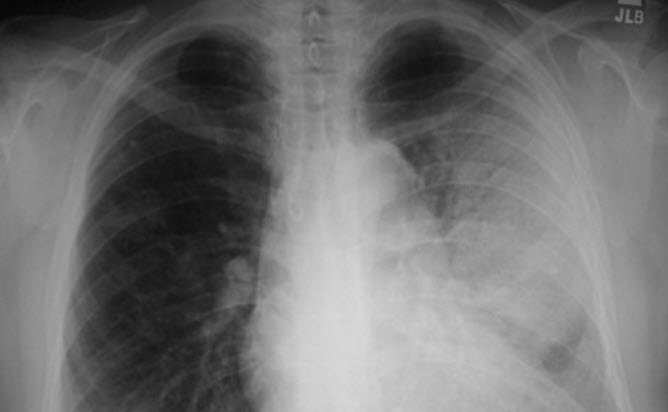
Arterial Blood Gas Analysis
| pH | 7.33 |
| PaCO2 | 48 torr |
| PaO2 | 64 torr |
| HCO3 | 24 mEq/L |
| BE | +/- 0 mEq/L |
Which of the following would be an appropriate recommendation?
(A): instruct patient to lay with his right side down
(B): increase to 12 L/min the flow on the simple mask
(C): perform a V/Q scan
(D): administer heliox 80/20
(Correct): A
(Points): 1
(Explanation): Honestly, this patient probably needs to be intubated (or at least placed on high-flow), but you aren't given that option because, yeah, we can do that. This is a left-sided severe pneumonia with significant white-out. Let's look at the options:
- Right-Side Down: the way I remember this is BLUE GOLD (BLU GLD) = Bad Lung Up, Good Lung Down. Ensure that's what this answer option does, but then consider it as a definite possibility. Let's see if there's something better ...
- Increase Simple Mask to 12 L/min. Nope. By design simple masks should be run between 5-10 L/min. Increasing to 12 would be beyond the mask's design (and good luck getting the O2 tubing to stay on the oxygen adaptor)
- V/Q scan: this would provide helpful (although mostly predictable) information. This is an example of one of those times when it just isn't necessary - spending patient money and hospital resources without a clear indication. By the way, V/Q is seldom a correct answer, so if in doubt, rule it out!
- Heliox: used for its lighter density for airway obstructions. There's no indication of that here.
It sounds like patient positioning is the best possible answer. As we have seen with the pandemic sometimes patient positioning is an undervalued bedside tool!
Question 23
(Type): application
(Random answers): 0
(Question): Which of the following is most indicated for an adult patient with a BMI of 26 with a history of asthma who is scheduled for an exploratory laparotomy later in the day?
(A): incentive spirometry
(B): IPPB
(C): vibratory PEP
(D): albuterol nebulizer every 4-hours
(Correct): A
(Points): 1
(Explanation): The key here, if we reword it a little is: a patient is scheduled for upper abdominal surgery and so will be at risk of post-surgical atelectasis. The usual answer for this is incentive spirometry (IS). Now ask: is there any reason not to use IS? There's nothing that jumps out as a contraindication.
- IPPB: While this might serve the same purpose of preventing atelectasis, there's no indication for using it over an IS (an IS is less expensive, patient-driven, and effective for most)
- PEP: This is used as an airway clearance device. There's no indication in the question that the patient has abnormal secretions or many secretions.
- Albuterol: While albuterol as-needed would be an appropriate order for a patient with asthma, it is not usually needed on a scheduled basis (does it get ordered that way? That's another whole conversation).
Question 24
(Type): analysis
(Random answers): 0
(Question): The physician is preparing to perform an endobronchial intubation due to massive hemoptysis in the left lung. Which of the following is most appropriate?
(A): cricothyroidotomy
(B): endotracheal tube exchanger
(C): video-assisted laryngoscope
(D): bougie with angled tip
(Correct): D
(Points): 1
(Explanation): This is highly technical intubation not performed often in which the ET tube is advanced into the left bronchus (instead of the trachea). A better option, if given, would be to use a dual-lumen endotracheal tube which allows for independent lung ventilation (you can isolate that bad lung from the good lung).
Let's look at our options:
- crich: Yes, it sounds fun, unless you're the patient. There's really no need for a cricothyroidotomy for this patient (really the only indication is an absolute inability to intubate despite multiple attempts with multiple tools, and the patient is crashing. In other words, it is a last resort. In other words, you won't see it every day, some people never see it).
- ET tube exchanger: we're not exchanging a tube; we are inserting one, so this wouldn't be appropriate.
- video-assisted laryngoscope: while this will help view the vocal cords better, it will not view down into the trachea and the bronchi
- bougie with angled tip: a bougie tube is used to guide an endotracheal tube into place. The angled tip makes it more likely (though not guaranteed) to get into the left bronchus (the right bronchus has less of an angle so the tube "wants" to go that way naturally). The bougie may also be referred to as a "gum elastic bougie" or "tracheal tube introducer"
Question 25
(Type): analysis
(Random answers): 1
(Question): The respiratory therapist is suctioning the tracheostomy tube of an 8-year old child who is in respiratory distress. The therapist sets the suction pressure to -100 mmHg, then gently inserts the 10 FR suction catheter but it is met with resistance. Which of the following should the therapist do next?
(A): increase suction pressure by 10%
(B): remove the tracheostomy tube
(C): increase to 14 FR the suction catheter
(D): instill 10 mL of sterile water into the airway
(Correct): B
(Points): 1
(Explanation): Because this child is in respiratory distress, action needs to occur rapidly. The suction catheter won't advance which suggests an obstruction (either airway tissue or clogged thick secretions). The correct answer, regardless of what you may or may not have seen clinically (some quick troubleshooting with normal saline), is to remove the airway. The NBRC favors this approach (a non-patent airway is a useless airway).
Other options:
- increase suction pressure. The normal pressure for a child is -80 to -100 mmHg. Don't go beyond this, no matter what. Increasing suction pressure is seldom the correct answer.
- increasing the suction catheter size would not likely work. An 8-year-old's artificial airway should hold somewhere around an 8-10 FR suction catheter.
- instilling sterile water is never indicated. Because it is hypotonic (and not isotonic at 0.9%) it can cause irritation to the airway, assuming that the instilled solution can get by whatever the obstruction is.
Question 26
(Type): recall
(Random answers): 1
(Question): Which of the following devices produces a mechanical cough for patients without an adequate ability to cough?
(A): high-frequency chest wall oscillation
(B): insufflator/exsufflator
(C): intrapulmonary percussive ventilation
(D): chest cuirass
(Correct): B
(Points): 1
(Explanation): This is a recall level question on airway clearance. The options:
- insufflator/exsufflator is also called the cough assist. It does produce a cough (negative pressure) for patients with inadequate spontaneous coughs. Neuromuscular patients, including quadriplegia, are common recipients.
- high freq. chest wall oscillation (HFCWO) is also called the vest. It helps mobilize secretions but does not produce a mechanical cough
- intrapulmonary percussive ventilation is usually referred to as IPV. It is "chest PT from the inside out" so it is helpful with airway clearance, but does not produce a mechanical cough
- chest cuirass is used for negative pressure ventilation (it is a ventilator but mimics the body's normal mechanism of ventilation by applying negative pressure to the chest wall instead of positive pressure to the airway), usually saved for disorders like polio.
Question 27
(Type): recall
(Random answers): 1
(Question): A leukotriene inhibitor works by:
(A): preventing the release of chemicals responsible for inflammation
(B): actively causing the relaxation of smooth airway muscles
(C): breaking down mucous bonds
(D): increasing the motility of the mucociliary cells
(Correct): A
(Points): 1
(Explanation): Because this is an inhibitor (that really is our key word here), we know this type of drug prevents (or inhibits) a receptor from being triggered. If you use that thinking to look at the answer choices, there's really only one good option, the prevention of the release of chemicals responsible for inflammation.
Other options:
- causing the relaxation of smooth muscles: short-acting beta-agonists do this by activating those beta-2 receptors
- breaking down mucous bonds: acetylcysteine does this, helping break thick, tenacious secretions down by interfering with the disulfide bonds
- increasing motility: a number of drugs may increase motility (methylxanthines, hypertonic, cholinergics)
Question 28
(Type): analysis
(Random answers): 1
(Question): A neck radiograph for a child who is in respiratory distress displays the following:
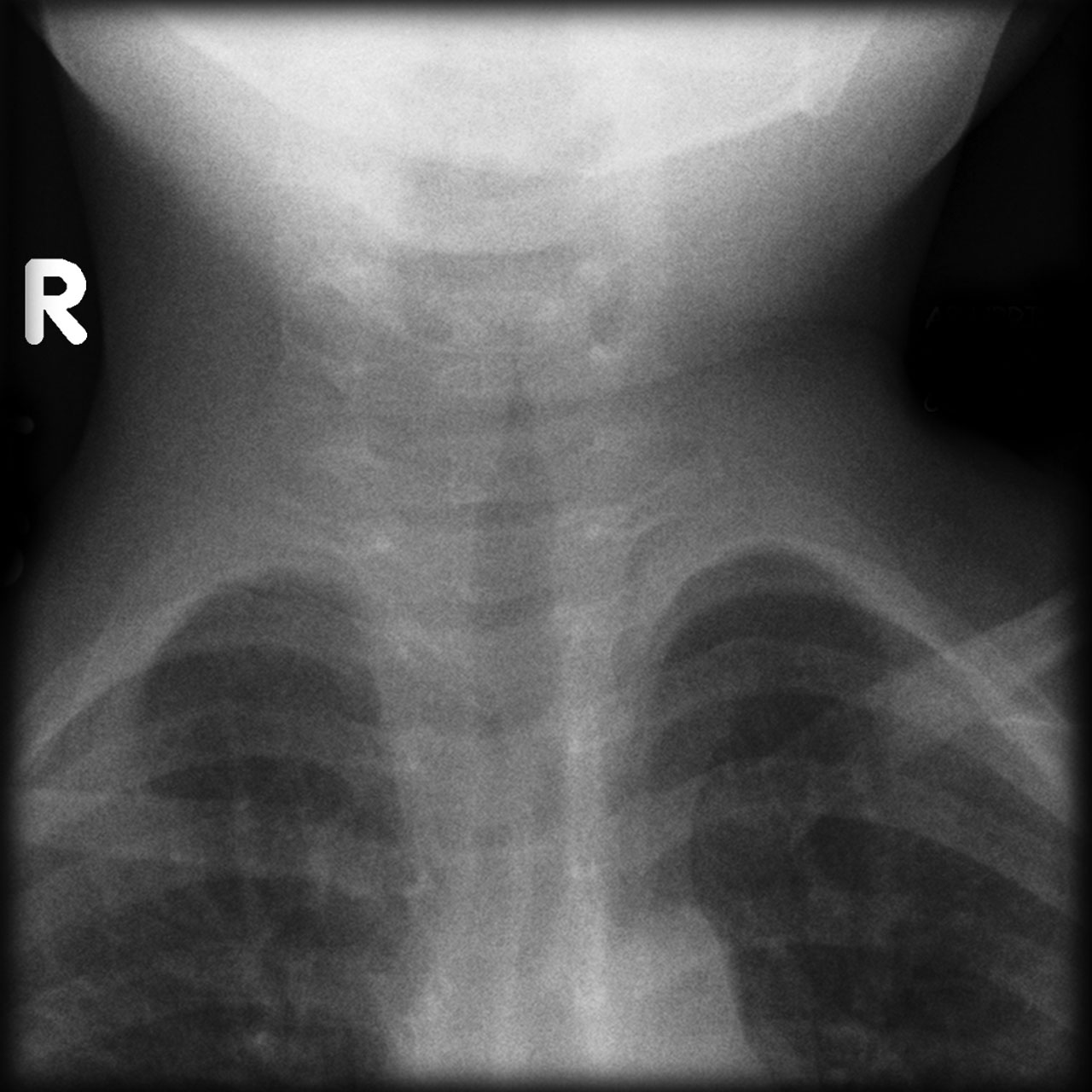
The respiratory therapist should anticipate the need for:
(A): a cricothyroidotomy
(B): emergent intubation
(C): continuous albuterol by nebulization
(D): cool mist aerosol
(Correct): D
(Points): 1
(Explanation): This is a classic finding called the "steeple sign" which you should be prepared to identify. It will be clear, much as this one is. If you prefer you can also think of it as the "wine bottle sign," a more modern term for the same thing. You should associate this finding (in addition to clinical assessment which you're not given here) with croup. You're then asked to anticipate a treatment, which in this case would be cool mist aerosol.
Other options:
- cricothyroidotomy: this is unlikely in any scenario, even though it probably sounds kind of exciting. The only neck situation we can think of where it might be indicated is a foreign-body airway obstruction that completely blocks the airway and must be surgically removed.
- intubation: this would be the right answer if you instead saw the "thumb sign" (swollen vocal cords) which is associated with acute epiglottitis, a somewhat rare airway emergency.
- albuterol: contrary to popular belief the albuterol itself is unlikely to help, although the cool mist from the nebulizer probably would!
Question 29
(Type): recall
(Random answers): 1
(Question): Which of the following macronutrients will increase the respiratory quotient?
(A): proteins
(B): fats
(C): vitamins
(D): carbohydrates
(Correct): D
(Points): 1
(Explanation): Nutrition plays a role in respiratory therapy, especially with disease states where an excess of CO2 is produced, such as COPD. Altering the respiratory quotient by increasing or decreasing macronutrients will also alter the amount of CO2 being produced (which decreases or increases work of breathing!).
Remember this chart:
Increase RQ: Carbs
Maintain RQ: Proteins
Decrease RQ: Fats
What about vitamins? They're important, but they're not macronutrients. We just needed a fourth answer option!
Question 30
(Type): recall
(Random answers): 1
(Question): Which of the following can not be obtained through bedside spirometry?
(A): FVC
(B): RV
(C): FEV1
(D): VT
(Correct): B
(Points): 1
(Explanation): It's important to keep the different aspects of PFTs a little separate in your mind:
- spirometry (usually the FVC): measures FVC (VC), FEV1, and VT
- lung volumes: RV requires a specific lung volume measurement in a lab (through helium dilution, nitrogen washout, or body plethysmography)
- diffusing capacity: nothing in their answer choices match up with diffusing capacity (DLCO)
Question 31
(Type): analysis
(Random answers): 1
(Question): The respiratory therapist works in a pulmonology office and is performing an initial assessment. The patient discloses during the history and physical that they experience exertional dyspnea with chest pain several times a week. An ECG in the office is performed: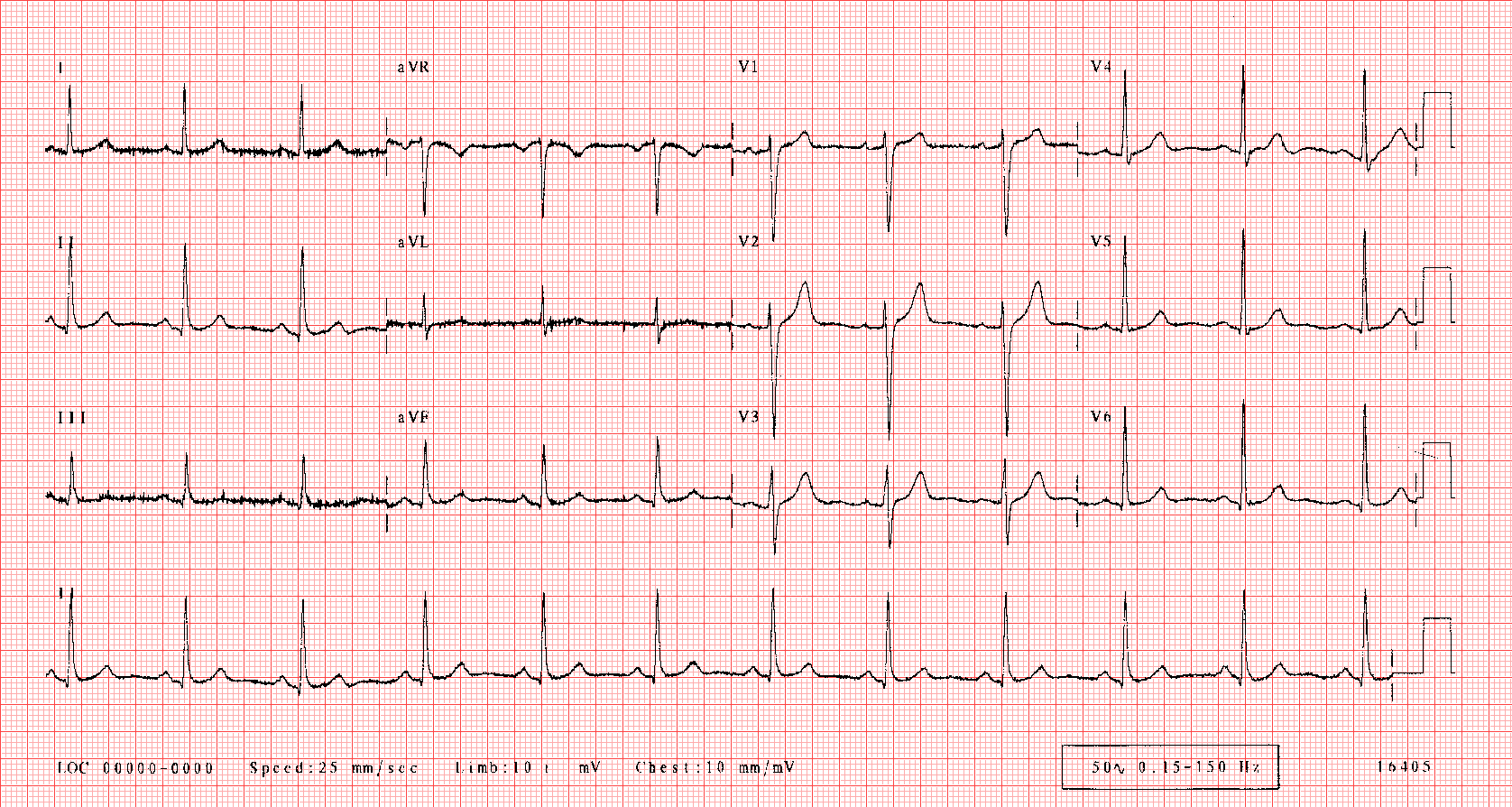
Which of the following would be an appropriate recommendation?
(A): cath lab for further investigation of ECG results
(B): reperform ECG at a paper speed of 50 mm/sec
(C): schedule a cardiac stress test
(D): administration of amiodarone
(Correct): C
(Points): 1
(Explanation): This 12-lead ECG appears to be normal sinus rhythm - the best way to interpret this is to look at each element separately and rule out anything abnormal (in this case each p wave is followed by a QRS, p waves are normal, rate is normal, QRS is normal, PR interval is normal, QT is normal, ST is normal, T wave is normal)
We recommend using Lead II (bottom left of the 12-lead, one of the inferior leads-a good quick view of the heart) when first learning ECGs (and Lead II is usually what you see on a 6-second rhythm strip). This is usually sufficient for NBRC testing. The 12-lead gives almost a 360-degree view of the heart.
Because this patient is complaining of chest pain and dyspnea when exerting (a different way of just saying dyspnea on exertion), a cardiac stress test is indicated.
Other options:
- cath lab would be indicated if a significant abnormality (such as ST-elevation) was noted on the ECG
- amiodarone is used to treat and manage arrhythmias, but that's noted on this ECG
- changing the ECG paper speed to 50 mm/sec (normal is 25 mm/sec). It can be helpful in looking at tachycardia (everything widens out, helping to locate the p wave, flutter, etc.). This patient has a normal rate, the p wave is clearly visible, so this isn't necessary.
Question 32
(Type): recall
(Random answers): 1
(Question): Which of the following is a potentially serious side effect associated with administering iNO?
(A): hypercarbia
(B): COHgb
(C): polycythemia
(D): NO2
(Correct): D
(Points): 1
(Explanation): Inhaled nitric oxide is a gas given to lower the blood pressure within the lungs. It does have several potential side effects, but the most potentially serious is NO2 (nitric dioxide), which occurs when iNO is mixed with O2. It is important to purge the circuit, squeeze the manual resuscitator, and monitor NO2 levels when running iNO.
Other options:
- hypercarbia: iNO doesn't result in high CO2
- COHgb: this abnormal hemoglobin occurs when exposed to carbon monoxide (CO)
- polycythemia: increased RBCs is not an adverse effect of using iNO
Question 33
(Type): recall
(Random answers): 1
(Question): The respiratory therapist is administering continuous albuterol at 15 mg/hr to a child with acute asthma. Which of the following should the therapist closely monitor for?
(A): tachycardia
(B): hyperkalemia
(C): pitting edema
(D): bradypnea
(Correct): A
(Points): 1
(Explanation): Tachycardia and tremors are possible adverse effects of albuterol, especially in higher doses.
Other options:
- hyperkalemia: administering albuterol will lower potassium, not increase it (10-20 mg albuterol will reduce K+ by 0.3-0.6 mEq/L within about 30 minutes)
- pitting edema: this is not an adverse effect of albuterol (but more a sign of fluid overload, CHF)
- bradypnea: this is not an adverse effect of albuterol
Question 34
(Type): recall
(Random answers): 1
(Question): A patient without health insurance is advised by his primary care physician that he may be at risk for obstructive sleep apnea. He is concerned about the cost of a sleep study. Which of the following would be an appropriate recommendation?
(A): cardiac stress test
(B): arterial blood gas analysis
(C): overnight oximetry
(D): CPAP titration study
(Correct): A
(Points): 1
(Explanation): An appropriate screening tool for the need for a sleep study (polysomnography) is overnight oximetry, an inexpensive method. If the results are concerning, the respiratory therapist could work with social work to explore options for having polysomnography completed.
Other options:
- stress test: is indicated for dyspnea on exertion and chest pain, neither of which are evident here
- ABG: An ABG is often normal for a patient with OSA
- CPAP Titration: this is done as part of a sleep study. It can reduce cost by reducing the visit to one night (half of the night is for testing, half is for CPAP titration).
Question 35
(Type): analysis
(Random answers): 0
(Question): The respiratory analyzes the chest radiograph: 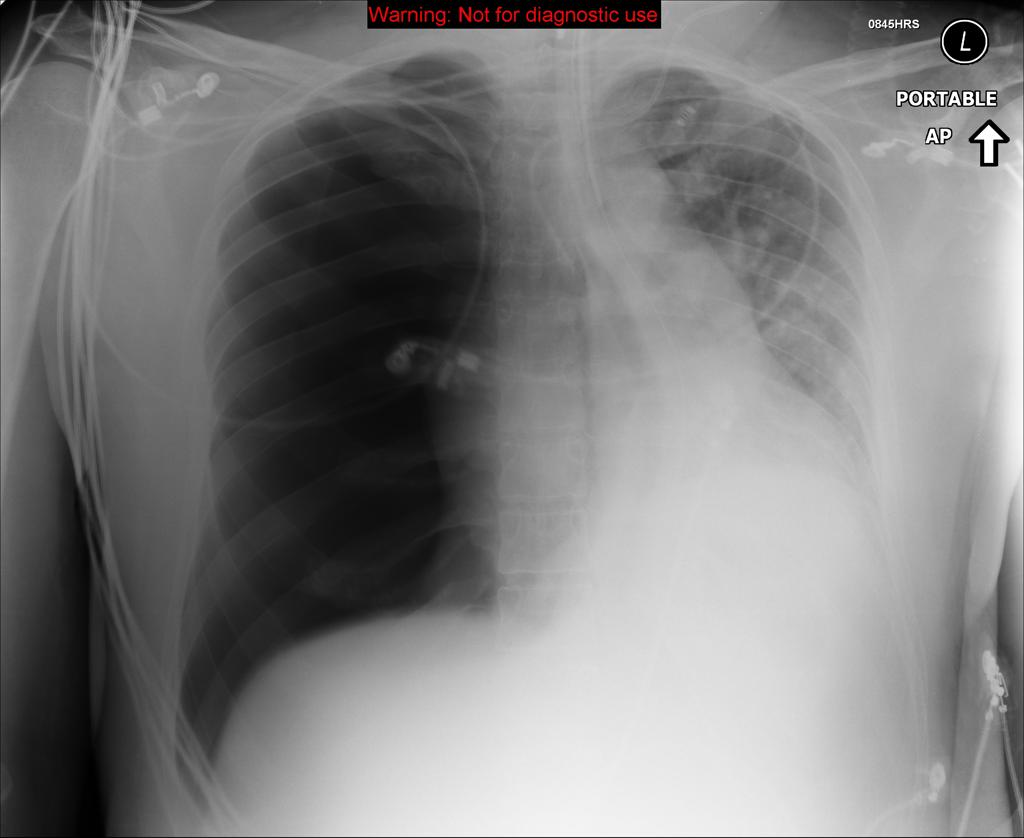
Which of the following is evident?
(A): ECG leads with ARDS
(B): central venous catheter with pneumonia
(C): left chest tube with pleural effusion
(D): ET tube with a tension pneumothorax
(Correct): D
(Points): 1
(Explanation): This is a rather pronounced case of a tension pneumothorax in an intubated patient. Note the large area of black (there are no vascular markings evident - the black just looks too black, like a night sky without stars), as well as the mediastinum and ET tube, all of which are shifted away from the pneumo. This case was likely caused by the ventilator.
Other options:
- central venous catheter (yes, that's there) with pneumonia (no evidence of that: infiltrates in one area/side)
- left chest tube (not there) with pleural effusion (no evidence of that: loss of costrophrenic, loss of cardiac silhouette/border)
- ECG leads (yes, they're there) with ARDS (no evidence of that: diffuse bilateral infiltrates)
Question 36
(Type): application
(Random answers): 1
(Question): Which of the following drugs is most indicated to bring relief to dyspnea during a severe acute exacerbation of COPD?
(A): short-acting beta agonist by nebulizer
(B): long-acting beta agonist by metered dose inhaler
(C): corticosteroids by dry powder inhaler
(D): antibiotics by intravenous administration
(Correct): A
(Points): 1
(Explanation): In these types of questions you need to pay attention to the type of drug (and its indications) as well as the delivery method (and how appropriate it is). The correct answer is a short-acting beta agonist (hello, albuterol) by nebulizer. This is the foundation of the therapy that most patients receive.
Other options:
- LABA by MDI: while a LABA is not contraindicated, it is not helpful for short-term relief (albuterol is indicated for that)
- Corticosteroids by DPI: steroids are probably indicated, but systemically, and not by DPI (the patient is unlikely to have the inspiratory flow for the drug to deposit in the lungs)
- Antibiotics may be indicated if the secretions are abnormal, if NPPV or ventilation is being required, or if a culture and sensitivity show growth
Question 37
(Type): application
(Random answers): 1
(Question): The respiratory therapist is caring for a patient who was intubated 3-days ago for respiratory failure with GBS. The patient has now developed a fever, with leukocytosis and evidence of banding. The respiratory therapist should NEXT recommend:
(A): lung ultrasound
(B): sputum culture and sensitivity
(C): arterial blood gas analysis
(D): removing the endotracheal tube
(Correct): B
(Points): 1
(Explanation): This is a fairly classic presentation of a potential infection (WBC increased, bands present which represents immature neutrophils, commonly found during an active infection, and fever). This came a few days after intubating (no other lines or catheters are listed in the question, but they would be suspect for sources of infection as well), so VAP should be suspected. A culture and sensitivity is appropriate--it shows what pathogens are growing and what antibiotics they'll respond to).
Other options:
- lung ultrasound: indicated for verifying the presence of a pleural effusion. No indication for that here.
- ABG: this could be helpful information, but won't verify the presence of an infection
- removing ET tube: while we often do remove lines and catheters suspected of causing infection, the ET tube is not removed unless something is wrong (or it is time to extubate!)
Question 38
(Type): recall
(Random answers): 1
(Question): Which of the following respiratory drugs should be monitored with serum levels?
(A): iloprost
(B): theophylline
(C): tiotropium
(D): montelukast
(Correct): B
(Points): 1
(Explanation): Theophylline is more of an old-school respiratory drug (it isn't given frequently today) that has toxicity levels which vary by individual, not necessarily by specific drug amount. Monitoring serum (blood) levels is a critical step.
Iloprost (inhaled prostaglandin), tiotropium (Spiriva, an anticholinergic), and montelukast (Singulair, a leukotriene inhibitor) do not require serum level monitoring. This question is one of those that you know or you don't know!
Question 39
(Type): application
(Random answers): 1
(Question): An area of atelectasis in the lungs will cause:
(A): adequate ventilation with poor perfusion
(B): inadequate ventilation with good perfusion
(C): adequate ventilation with good perfusion
(D): inadequate ventilation with poor perfusion
(Correct): B
(Points): 1
(Explanation):
Atelectasis:
Lungs/alveoli are collapsed, so they are not participating in ventilation
The blood flow around the alveoli (perfusion) should be normal
This creates a V/Q imbalance.
Question 40
(Type): application
(Random answers): 1
(Question): A patient in the emergency department is receiving oxygen by nonrebreather mask after being rescued from a house fire.
Vital Signs
SpO2 100%
BP 88/48 mmHg
HR 102/min
RR 18/min
Which of the following should the respiratory therapist recommend?
(A): switch oxygen delivery device to a nasal cannula
(B): intubate and place on mechanical ventilation
(C): order hemoximetry
(D): discontinue supplemental oxygen
(Correct): C
(Points): 1
(Explanation):
This patient is at-risk of carbon monoxide poisoning which creates carboxyhemoglobin, an abnormal and nonfunctional form of hemoglobin that pulse oximetry measures with normal hemoglobin. Don't trust the SpO2 when weaning! Request hemoximetry to directly measure carboxyhemoglobin.
(Type): Analysis
(Random answers): 1
(Question): The respiratory therapist is asked to assess and treat a patient in the emergency department. A chest radiograph has been ordered. Coarse crackles are auscultated over the right lower lobe. The patient is sitting upright on the stretcher and is noted to have mild accessory muscle use.
Vital Signs
BP 132/88 mm Hg
HR 112/min
RR 22/min
SpO2 89% on room air
Which of the following is the most appropriate option?
| oxygen device | oxygen flow to device | humidity | |
| A | nonrebreather mask | 12 L/min | simple passover |
| B | nasal cannula | 5 L/min | bubble humidifier |
| C | partial rebreather mask | 4 L/min | none |
| D | nasal cannula | 2 L/min | none |
(A): nonrebreather mask at 12 L/min via a simple
(B): nasal cannula at 5 L/min via a bubble humidifier
(C): partial rebreather mask at 5 L/min with no humidity
(D): nasal cannula at 2 L/min with no humidity
(Correct): B
(Points): 1
(Explanation): This question is testing your ability to choose between a number of choices. The first step is to look at each device and ensure it is set up correctly. For example, a nonrebreather mask should not be put on a humidifier, so we can cross that one off without even knowing anything else.
A. eliminate this option
nonrebreather @ 12 L/min is appropriate
X humidity should be none
B.this is the correct option
nasal cannula @ 4 L/min is appropriate (treats the hypoxemia, within range of device)
bubble humidifier is appropriate for flow > 2 L/min on nasal cannula
C. eliminate this option
X partial rebreather @ 5 L/min is wrong - it should be 10-15 L/min
no humidity is appropriate
D. eliminate this option
X nasal cannula @ 2 L/min is too low of a flow for this patient
no humidity would be appropriate at this flow rate
(Type): analysis
(Random answers): 0
(Question): A patient with COPD is receiving noninvasive positive pressure ventilation with the following settings:
IPAP 10 cm H2O
EPAP 5 cm H2O
FIO2 0.50
Arterial Blood Gas
pH 7.25
PaCO2 56 torr
PaO2 84 torr
HCO3 25 mEq/L
Which of the following is the MOST appropriate change?
(A): decrease EPAP
(B): increase EPAP
(C): decrease IPAP
(D): increase IPAP
(Correct): D
(Points): 1
(Explanation):
For these types of questions (an ABG with some type of settings), we recommend a two-step process:
| Step 1: Interpret the ABG | Respiratory Acidosis with Normal Oxygenation Increase Ventilation to fix |
| Step 2: Change Your Settings |
Increase Ventilation on NPPV: *Remember: don't touch EPAP unless you are changing the oxygenation. |
(Type): analysis
(Random answers): 0
(Question): A patient in acute respiratory failure is receiving noninvasive positive pressure ventilation with the following settings:
IPAP 12 cm H2O
EPAP 6 cm H2O
FIO2 0.50
Arterial Blood Gas
pH 7.36
PaCO2 44 torr
PaO2 62 torr
HCO3 24 mEq/L
Which of the following is the MOST appropriate change?
| IPAP | EPAP | |
| A | 10 | 4 |
| B | 12 | 8 |
| C | 14 | 6 |
| D | 14 | 8 |
(Correct): D
(Points): 1
(Explanation):
This is the same question as the last - presented in a slightly different format - but we created an oxygenation issue instead of a ventilation one
| Step 1: Interpret the ABG | Normal Acid-Base with mild hypoxemia Increase Oxygenation to fix |
||||||||||||||||||||||||||||
| Step 2: Change Your Settings |
Increase Oxygenation on NPPV: *Remember: you need to increase your IPAP by whatever you increase your EPAP by (don't change the delta-P) Don't be afraid to do the math:
|
(Type): analysis
(Random answers): 0
(A): transition to PC, A/C ventilation
(B): place
(C): increase to 1.1 sec the inspiratory time
(D):increase to 18/min the set rate
(Correct): B
(Points): 1
(Explanation):
| Remember: you will have use of a basic calculator on the NBRC exam. Feel free to calculate things like ideal body weight, total cycle time (to get your I:E ratio, etc.) |
(Type): analysis
(Random answers): 1
(Question): A 40-year-old male is receiving oxygen therapy via a 50% Venturi mask. During a diagnostic bronchoscopy, purulent secretions are noted in the area of consolidation. The following radiograph is available.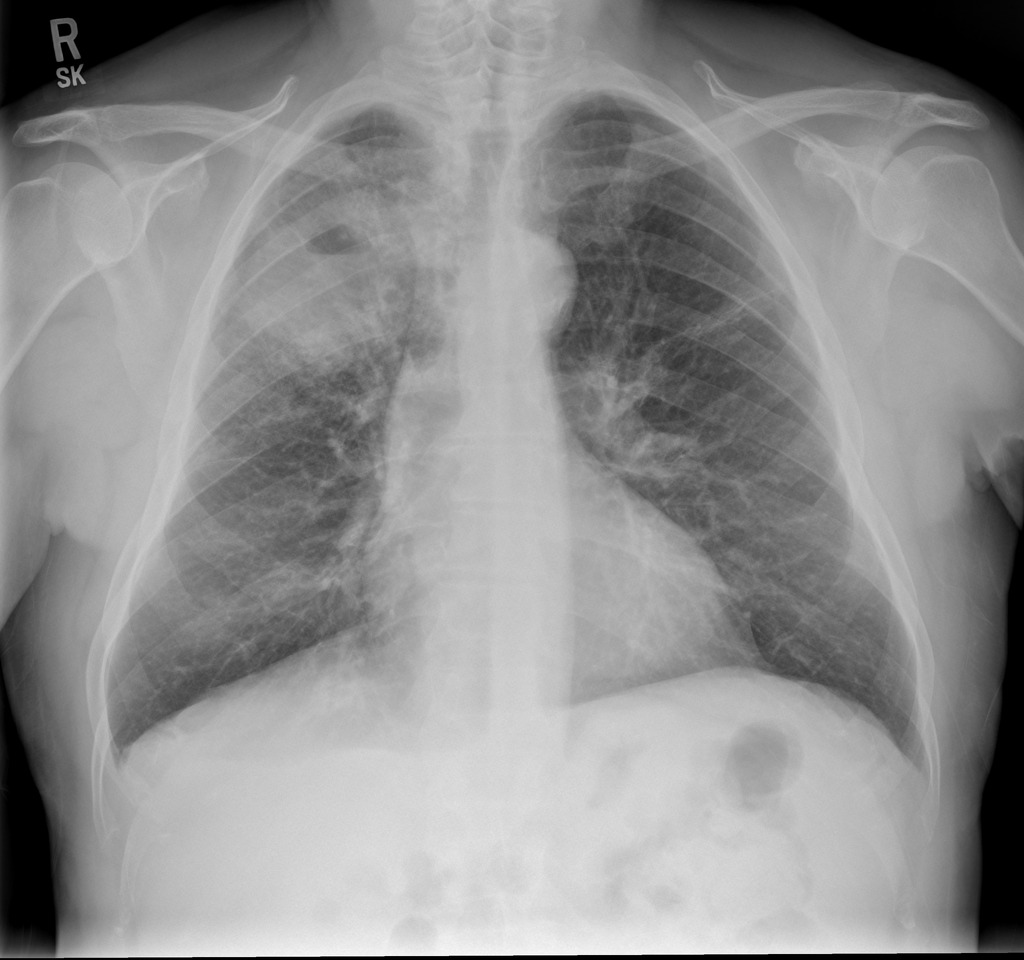
Acid-Base Analysis
PH 7.30
PaCO2 52 torr
PaO2 44 torr
HCO3 22 mEq/L
After significant discussion with the patient he has indicated he wishes to not be intubated. Which of the following would be an appropriate recommendation?
(A): perform nasotracheal suctioning every 2 hours
(B): position the patient on his right side
(C): perform insufflation/exsufflation therapy
(D): intubate and place on mechanical ventilation
(Correct): B
(Points): 1
(Explanation): This is a higher-level analysis question. It requires you to focus on the information you are being given, analyze it, and then make a decision about the best plan for the patient.
| Key strategy: read the answer choices first. Otherwise, you're going to waste time guessing what you should do with this patient and that option won't even be available. This isn't the real world. This is an exam. Next, read through the question stem and pick out the words that seem to matter most in summary. |
For this question, we have a patient with purulent secretions ... on a 50% venti mask but still bad O2 (ABG) and doesn't want to be intubated.
Now, let's consider our options and try to exclude or qualify each:
A. Nasotracheal suction: I guess yeah, maybe, you could make an argument. BUT (and you can rest assured this BUT is always the case), it is listed as every 2 hours. NEVER (never, never, never!) choose an option where suctioning is scheduled. It should always be as needed ... when indicated.
B. Position on right side: I remember the mnemonic blue gold (BLU GLD): Bad Lung Up, Good Lung Down. Not the case here. Oh, wait a minute! There's an exception: infecious/purulent secretions/blood. Then you do the OPPOSITE. On CXR his right lung looks affected, we know there are secretions from the bronch, so being Bad Lung DOWN makes sense. We don't want the secretions to travel from sick lung to healthy lung.
C. Insufflation/Exsufflation: Sounds so fancy you sometimes just want to pick it. Save it for patients who can't cough (quadriplegia is the classic one).
D. Intubate: The patient indicated he didn't want to be intubated. Easy one to cross off the list of possibilities!
(Type): analysis
(Random answers): 1
(Question): A patient is receiving mechanical ventilation. The following waveform graphic is observed:
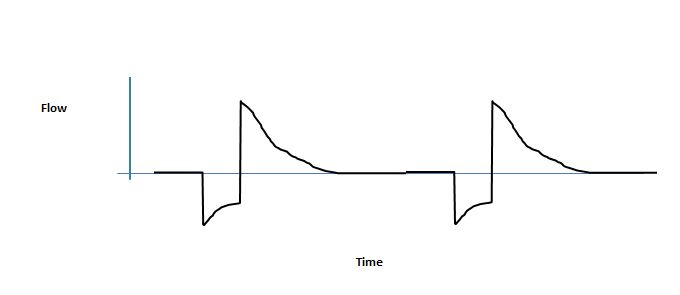
Which of the following is appropriate?
(A): increase PEEP
(B): check all ventilator connections
(C): decrease
(D): increase sedation
(Correct): C
(Points): 1
(Explanation): This graphic is consistent with air-trapping ... flow exhalation doesn't return all the way to baseline. That sounds fancy. What we're really saying is that the patient doesn't have enough time to exhale. We can address this by decreasing inspiratory time, decreasing the set rate if the patient's total rate is less than the set rate (which gives more TOTAL cycle time, more time for exhalation each breath!), or by addressing the cause of the air-trapping (albuterol for bronchospasm, for example)
Other options:
- Check vent connections: this would be appropriate if there was an indication of a leak (volume scalar doesn't return to baseline ... this question is about flow scalar)
- Increasing PEEP: that won't address this issue. It's here because PEEP is known to help some patients who are having trouble triggering the ventilator (assuming a pressure trigger) because of auto-PEEP. Nothing about that is happening here.
- Increasing sedation: there's not enough information to choose this one, but also remember this for exam purposes: choosing sedation is not often a first line response. Be cautious about choosing it.
What you are looking for: The red arrow shows where expiratory flow ends and inspiratory flow begins. This *should* occur up at the baseline - see the one we drew in red with the purple circle as to what normal should kind of look like. 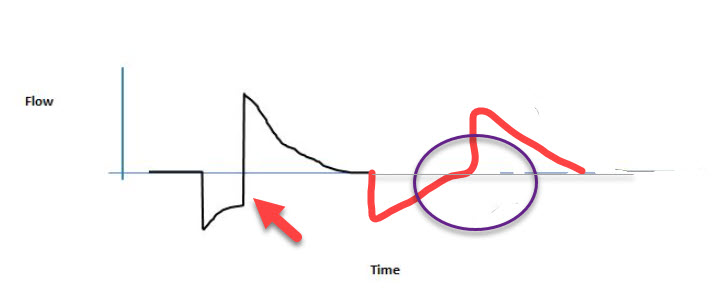
(Type): Analysis
(Random answers): 1
(Question): The following ventilator graphic is observed in a patient receiving PC, A/C ventilation.
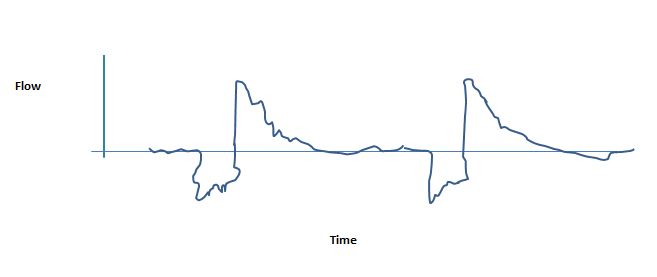
Which of the following should the respiratory therapist do in response to analyzing the graphics?
(A): increase the sensitivity of the trigger
(B): perform an expiratory-hold maneuver
(C): inflate the endotracheal tube cuff until graphics improve
(D): perform endotracheal suctioning
(Correct): D
(Points): 1
(Explanation): Squiggles (or more formally referred to as a "sawtooth pattern) during any part of the breath cycle might indicate airway secretions (choose an option to suction the patient. The graphics should improve if secretions). Note this can also happen with water in the corrugated tubing (recommend emptying circuit, adding a water trap), sometimes with bronchoconstriction (I always think of this as the airways "vibrating" as they clench down).
Other options:
- expiratory hold maneuver = measure air-trapping
air-trapping will appear best on your flow-volume loop or flow-time scalar. Under normal conditions the flow should return to baseline. With air trapping the expiratory fails to return all the way to baseline. Recommend decreasing inspiratory time, decreasing set rate (if the patient is driving the rate) - insert air into cuff = address a cuff leak
cuff leak shows best in the flow-volume loop, pressure-volume loop, or volume-time scalar. I always think of this as climbing a mountain - the distance down the mountain should be the same as the distance up the mountain. If the downslope of the mountain suddenly falls off like a cliff, there's like air-trapping (remember, you can measure this with an auto-PEEP measure) - increase sensitivity of trigger = missed triggers (patient is trying to trigger ventilator but it isn't responding)
trigger asynchrony will show best in pressure-time scalar - look for little negative deflections (potholes) in the pressure, but with no breath following. Remember: every patient effort (negative deflection) should result in a ventilator breath.
(Type): analysis
(Random answers): 1
(Question): A respiratory therapist is responding to a
(A): administer a short-acting beta agonist
(B): suction using a closed-system catheter
(C): check for leaks in the ventilator circuit
(D): transilluminate the chest wall
(Correct): A
(Points): 1
(Explanation): These findings (high PIP, exp wheezes) are consistent with bronchospasm which is best treated with a bronchodilator.
Note that coarse crackles (rhonchi) are more common with secretions. A high PIP is consistent with this.
A ventilator leak would result in a low-pressure alarm.
Finally, transillumination is not used on adults due to the boney structure of the chest wall. It is more common and helpful in infants (the chest wall is more cartilage at that stage).
(Type):
(Category): 0
(Random answers): 0
(Question): A high-frequency oscillation ventilator (HFOV) is running at 6
(A): 12
(B): 36
(C): 360
(D): 600
(Correct): C
(Points): 1
(CF): To calculate cycles using hertz, multiply by 60 ...
6 x 60 = 360 cycles/minute
(WF): To calculate cycles using hertz, multiply by 60 ...
6 x 60 = 360 cycles/minute
(Type): application
(Random answers): 0
(Question): Which of the following is a proper method for performing a recruitment maneuver?
(A): place the patient on CPAP of 20 cm H2O for 20 seconds, then return to previous settings
(B): increase PEEP to 30 cm H2O for 1-2 minutes, then return to 2-5 cm H2O above previously set PEEP
(C): increase tidal volume to 12-15 cm H2O for 30 minutes, then return to previous VT
(D): place the patient on CPAP of 30 cm H2O 5 minutes, then monitor for over-distension using ventilator graphics before setting final PEEP
(Correct): A
(Points): 1
(Explanation): There are a few correct ways to perform a recruitment maneuver, the most common being a CPAP of 20 for 20 seconds or a CPAP of 30 for 30 seconds. It is also acceptable to increase PEEP incrementally (in steps of 2 cm H2O). You can review what you need to know about recruitment on our RM page
(Type): Analysis
(Question): A 56-year-old, 60-kg female has been receiving mechanical ventilation with a right-sided pneumonia. The chest radiograph shows some infiltrates but with improvement. The ventilator is on minimum settings, and the decision is made to perform a spontaneous breathing trial. After 30 minutes on PS 10/5 with no sedation, the following data is collected:
RSBI 95
NIF -24 cm H2O
Vital Capacity 0.500 L
Which of the following should the respiratory therapist recommend?
(A): return
(B): extend SBT for another 30 minutes, then recollect weaning parameters
(C): extubate and place on supplemental oxygen and humidity
(D): Increase to 15/5 the PS settings
(Correct): A
(Points): 1
(Explanation): The first step in these questions is to interpret the data you have been given.
√ Reason for intubation improving (chest radiograph is better, minimal vent settings)
X RSBI 115 (RSBI < 105 is considered passing)
√ NIF -24 cm H2O (NIF -20 or less is considered passing)
X Vital Capacity 0.500 L (at least 10 mL/kg is considered passing)
So this patient has failed 2 out of 3 criteria on minimum settings. This patient is not ready to extubate (for testing purposes). Now the question is ... what is the right path to take from there? The NBRC is pretty clear: you rest the patient for 24-hours, then perform another SBT (an SBT should be performed each day. If a patient fails the SBT they should be allowed to rest on full settings as anything else is more likely to increase the risk of extubation failure)
(Type): analysis
(Random answers): 1
(Question): QID 6061
The respiratory therapist is called urgently to a patient's room for difficulty breathing. The patient started an IV antibiotic about 20-minutes ago and is now complaining of increasing dyspnea.
Vital Signs
BP 74/34 mm Hg
HR 128/min
RR 26/min
SpO2 86%
During auscultation, the therapist notes mild inspiratory stridor over the throat and slightly diminished breath sounds throughout all lung fields. In addition to giving oxygen which of the following should the respiratory therapist recommend?
Which of the following is MOST appropriate?
(A): prepare for immediate intubation
(B): request a neck radiograph
(C): IM epinephrine administration
(D): provide bag-mask ventilation
(Correct): C
(Points): 1
(Explanation): The exam (and real life, for that matter) expects you to quickly recognize and respond to an anaphylactic reaction. There will be some type of tip-off in the question to suggest a reaction, and the presentation will include hypotension (nearly always), but could also involve tachycardia (early on) or bradycardia (later on), dyspnea, airway swelling, etc.
THE KEYS to managing anaphylaxis are as follows:
- STOP the suspected cause (the drug, in this case)
- Give epinephrine (IM or IV) as quickly as possible
- Support the underlying symptoms.
- Supplemental Oxygen - use a nonrebreather if SpO2 < normal
- If "marked" stridor or severe distress, intubate immediately
- If unable to intubate, may need emergency cricothyroidotomy, but this is rare so don't consider it first!
- Support blood pressure through "fluid resuscitation," also called "volume resuscitation."
This all happens quickly, with cardiac/respiratory arrest occurring in as little as 5 minutes after the first symptom. 5 minutes to intervene meaningfully! Keep that in mind ... don't delay by doing things like getting a chest radiograph, arterial blood gas, etc.
Other options:
- bag-mask ventilator, or intubation: either may become necessary, but it is reasonable to give epi right away as it works quickly and may reverse this
- neck radiograph: this would delay care in a way that might cause injury to the patient
(Type): analysis
(Random answers): 1
(Question):
A 66-year-old, 5-ft-6-in female with bullous emphysema is receiving mechanical ventilation for respiratory failure associated with pneumonia. The respiratory therapist notes a high-pressure alarm on the ventilator.
Vital Signs
BP 86/46 mmHg
HR 122/min
SpO2 84%
Ventilator Settings
VT 500 mL
Set Rate 16/min
PEEP +5 cmH2O
FIO2 1.0
Breath sounds are diminished on the right side of the chest. Substantial tracheal deviation to the left is palpated. Which of the following should the respiratory therapist recommend NEXT?
(A): insert a large bore needle into the right second intercostal space, midclavicular line
(B): decrease to 450 mL the tidal volume
(C): increase to +8 cmH2O the PEEP level
(D): obtain a chest radiograph
(Correct): A
(Points): 1
(Explanation): First things, first, we assess the patient. What does the assessment find? Things that stand out include bullous emphysema on a vent, then a sudden alarm with changes in clinical status (hypotension, hypoxemia, tracheal shift to the left with decreased breath sounds on the opposite side - so tracheal shift AWAY). We know we need to do something right away, especially with hypoxemia and hypotension.
This is very likely a tension pneumothorax (the hypotension with trachea shift is a big clue), a medical emergency. The correct action is to needle decompress-just verify that the needle compression is acceptable (2nd intercostal, midclavicular ... is correct). Failure to do this will further compress the heart and its vessels and the patient will go into cardiac arrest.
Other options:
- Decrease VT: yes this would be appropriate. Changing to pressure mode of ventilation might also be an okay option. This patient has bullous emphysema (making uneven pressure delivery dangerous). However, we need to decompress FIRST.
- Increase PEEP: there's no indication to do that here, especially with a tension pneumo.
- A chest radiograph may provide confirmation, but a tension pneumo is a medical emergency and harm can come to the patient if there is any delay in care.
(Type): analysis
(Random answers): 1
(Question):
The medical emergency team is called to the room of a patient having difficulty breathing. The respiratory therapist observes accessory muscle use with paradoxical motion of the abdomen. Inspiratory and expiratory wheezes, with pronounced coarse crackles, are auscultated.
A review of the patient chart reveals that the patient is fluid positive by about 6 liters since admission a day ago.
What is the MOST appropriate next step?
(A): administration of albuterol
(B): administration of furesomide (Lasix)
(C): initiation of hemodialysis
(D): intubation and initiation of mechanical ventilation
(Correct): B
(Points): 1
(CF): For scenarios involving a medical emergency team (MET) ... often referred to as a rapid response team, emergency response team, etc., the correct answer is usually to perform an action immediately.
This particular question notes that we have a patient who is fluid overloaded, and evidence that it is affecting the lungs (coarse crackles is a key finding, wheezing is common, respiratory distress is likely). Strategies in managing fluid overload is to diurese the patient (give a diuretic like Lasix if kidney function is reasonable, otherwise hemodialysis) and support them clinically until relief (often this can include CPAP or NPPV, neither of which is offered as a solution here).
Other options:
- intubate: if the patient is truly crashing (poor mentation, inability to protect airway, code or pre-code) this might be appropriate. Otherwise, it is appropriate to attempt to stabilize the patient before resorting to that.
- Albuterol: not contraindicated (if there's wheezing, it is a fair option on the exam, but Lasix is going to treat the core of the problem - fluid overload - so this is not the best answer.
(Type): analysis
(Random answers): 1
(Question): The respiratory therapist is giving airway clearance therapy by high-frequency chest wall oscillation to a patient with cystic fibrosis. The patient is having a conversation with the therapist but then goes quiet. The patient doesn't respond to multiple verbal cues.
HR 42/min
RR 6/min
SpO2 92%
Which of the following should the therapist do NEXT?
(A): perform endotracheal intubation
(B): obtain an arterial blood gas for further analysis
(C): begin chest compressions
(D): request activation of the medical emergency team
(Correct): D
(Points): 1
(Explanation): The NBRC will test your ability to react quickly and appropriately in urgent situations. In this case, we have a patient receiving a therapy go unresponsive. The correct answer always is to 1) stop the therapy, 2) call for assistance (the medical emergency team - maybe known as the rapid response team or something similar depending on the facility), and 3) render appropriate support until the team's arrival (chest compression, bag-mask ventilation, supplemental oxygen, etc.).
That makes the correct answer in this case alerting the medical emergency team
Other options:
- intubate. This may be necessary, but that assessment needs to occur once the emergency team arrives (equipment will need to be gathered, etc.)
- chest compressions. There is no need for chest compressions (there is a HR). Providing bag-mask ventilation would be appropriate at a RR of 6 - if that option had been given.
- notify physician: this will absolutely be necessary once the team arrives, but is not the primary concern of the moment (getting the right people to the bedside as quickly as possible).
(Type): application
(Random answers): 0
(Question): How many milligrams of active drug are in 2 mL of a 2% solution?
(A): 10
(B): 20
(C): 40
(D): 100
(Correct): C
(Points): 1
(Explanation):You can figure this out without much math if you'd like:
2% means there's 2 g of drug per 100 mL of solution
this is equal to 0.02 g per 1 mL (nothing fancy, we just divided out)
So how much is in 2 mL? 0.04 grams ... but the answer needs to be in milligrams, so we have to convert (0.04 grams = 40 mg)
The math way:
1. Set Up
Decimal % = Grams/Milliliters
0.02 = X
2 mL
2. Match Units
Already matched in this case ...
3. Solve the algebra (cross multiply is how we do it - multiply the left side by the bottom of the right side).
x = 2 (0.02)
x = 0.04 gm
4. Fix Units
Then, final step is to put this into mg (as the question asks)
0.04 gm = 40 mg (3 decimals to the right)
(Type): recall
(Random answers): 1
(Question): Which of the following classes of drugs is MOST indicated for the acute management of bronchoconstriction?
(A): short-acting beta agonist
(B): anticholinergic
(C): methylxanthine
(D): long-acting beta agonist
(Correct): A
(Points): 1
(Explanation): The real keys in this question are that we are looking for a drug that causes bronchodilation quickly (for an acute situation):
Short-acting beta agonists work to relax smooth muscle found in the airways, directly resulting in bronchodilation (these smooth muscles are clamped down in bronchospasm, causing the airways to narrow as they're squeezed). These are attack bronchodilators, directly attacking bronchospasm.
Anticholinergics are considered "prevent" bronchodilators in that they prevent bronchospasm, so indirectly cause bronchodilation.
Methylxanthines are sometimes called "backup" bronchodilators ... they do cause weak bronchodilation but do so by affecting the cAMP in smooth muscle, a less direct approach.
Long-Acting Beta Agonists would help induce bronchodilation but are meant to be longer-term solutions, so they should not be used for immediate relief (albuterol does that better)
Review: Categories of Respiratory Drugs
(Type): recall
(Random answers): 1
(Question): Which of the following drugs is available in a dry-powdered inhaler?
(A): tiotropium
(B): tobramycin
(C): racemic epinephrine
(D): arformoterol
(Correct): A
(Points): 1
(Explanation): This is a recall question to ensure you know your respiratory drugs:
- tobramycin is available as a nebulized drug
- tiotropium (Spiriva) is available as a DPI or MDI (soft mist inhaler)
- arforomoteral (Brovana) is available as a nebulized drug
- racemic epinephrine is available as a nebulized drug
(Type): recall
(Random answers): 0
(Question): Which of the following can be instilled into an endotracheal tube?
1. albuterol
2. cold saline
3. atropine
4. surfactant
5. epinephrine
(A): 1, 2, 3, and 4
(B): 1, 2, 4, and 5
(C): 2, 3, 4, and 5
(D): 1, 2, 3, 4, and 5
(Correct): D
(Points): 1
(Explanation): You may not instill drugs every day but you should be aware of the drugs that are approved to be instilled. All of the drugs on this list can be instilled.
Review Routes of Administration
(Type): Analysis
(Random answers): 1
(Question): A 66-year-old male with a 7.0-mm ID ET tube with COPD has performed a 30-minute spontaneous breathing trial after being weaned to minimum settings. He is indicating that he wants the endotracheal tube out.
NIF -22 cmH2O
VC 0.500 L
RR 22/min
pH 7.37
PaCO2 56 torr
PaO2 82 torr
HCO3 31 mEq/L
The chest radiograph is noted to be at baseline. Which of the following should the respiratory therapist recommend?
(A): return to full ventilator support mode
(B): extubate directly to NPPV by mask
(C): request tracheostomy placement consult
(D): exchange endotracheal tube for a 8.0-mm ID
(Correct): B
(Points): 1
(Explanation): This patient with COPD is failing his SBT by normal standards. However, there are two things to note here: 1) that is a small ET tube for a typical male, especially someone with obstructive lung disease; and 2) this patient has COPD so his baseline may not be normal (see ABG!) and there is a level of urgency in getting patients with COPD off the ventilator.
With those being considered, the correct answer is to extubate this patient directly to NPPV (BiPAP) and then wean further from there. This will nearly always be the case with scenarios with COPD.
- What about exchanging the ET tube? That is not a *wrong* answer - it will decrease work of breathing potentially, but it is probably an unnecessary step in this patient that is at baseline.
- Full ventilator support is the correct answer for a patient that fails an SBT who doesn't have COPD
- Trach consult may become necessary if he fails extubation and ends up back on the ventilator. It's not uncommon for people with chronic lung diseases to struggle or fail extubation (especially if deconditioning of accessory muscles of breathing occurs) and then need a trach to better facilitate the weaning process.
(Type): recall
(Random answers): 1
(Question): Two drugs that are given together to increase the effect beyond what either could contribute individually is called drug:
(A): antagonism
(B): catabolism
(C): synergism
(D): optimization
(Correct): C
(Points): 1
(Explanation): While a little wordy, this question is testing your basic knowledge of drug effects: drug synergism is the effect where two drugs, when given together, result in a greater effect (an enhanced effect). This is why some cough medicines are often sold together. It's also why we give drugs like Duoneb with albuterol and ipratropium bromide working together (this likely has to do with muscarinic and Beta-2 receptors)
(Type): Application
(Random answers): 1
(Question): Which of the following is an evidence-based approach to asthma management?
(A): the prophylactic use of antibiotics to prevent infections
(B): use the least number of drugs to adequately manage symptoms
(C): perform pulmonary function testing on a specific schedule to monitor disease progression
(D): use advanced modes of ventilation to decrease time on a ventilator
(Correct): B
(Points): 1
(Explanation):
(Type): Application
(Random answers): 1
(Question): Which of the following is a critical strategy in the management of acute respiratory distress syndrome?
(A): the use of advanced modes of ventilation to provide lung protection
(B): close monitoring of hemodynamics using a pulmonary artery catheter
(C): use of tidal volumes at or below 6 mL/kg IBW
(D): maintaining the plateau pressure under 30 cm H2O
(Correct): D
(Points): 1
(Explanation): This is a question that tests your knowledge of evidence-based practice (ARDSnet in this case)
The correct answer is to maintain safe plateau pressures in order to avoid lung injury. This *might* include low tidal volumes, but might not, and might not mean as low as 6 mL (the guidelines start at 8 mL, and then drop based upon the plateau pressure).
The use of a PA catheter is seldom recommended (and not as often used anymore). It is an invasive procedure, so guidelines may make mention that in some cases it can be helpful.
Finally, as with another question you answer this week, the use of advanced ventilator strategies is simply not recommended in guidelines today. Instead, the proper use of whatever mode you are using (setting of VT, PEEP, etc.) is prioritized.
(Type): analysis
(Category): 0
(Random answers): 1
(Question): The respiratory therapist is assessing an adult female in the emergency department who was intubated by EMS on the way to the hospital. The therapist observes that chest rise from manual ventilations are minimal.
BP 100/78 mmHg
HR 118/min
SpO2 80%
ETCO2 0 mmHg
The endotracheal tube is secured at the 17-cm marking at the teeth. Which of the following is the MOST appropriate next step?
(A): withdraw endotracheal tube several centimeters and reassess
(B): advance a suction catheter to verify patency of the tube
(C): needle decompression using a 12-gauge needle
(D): remove endotracheal tube and reintubate
(Correct): C
(Points): 1
(CF): This patient has just been transported, then moved from the EMS stretcher to the ED stretcher. Tube placement should always be confirmed. In this case we have some "red flags" regarding tube placement: lack of chest rise, quickly deteriorating oxygenation, no ETCO2, and a shallow depth marking.
Removing the endotracheal tube and reintubating is the safest answer, even if you've seen various people try advancing the tube and assessing (if it is right at the vocal cords this might work, but is otherwise very unlikely to end up in the trachea).
Other options:
- needle decompression: this would be indicated for a pneumothorax. A key in this question that quickly suggests it is not a pneumo is that chest rise seems to be poor but symmetrical (the question would state asymmetrical)
- advancing a suction catheter: would be to verify patency if an obstruction was suspected (expect the question to say that the patient couldn't be bagged - the bag wouldn't squeeze)
(Type): application
(Category): 0
(Random answers): 1
(Question): The respiratory therapy department is preparing to order equipment to be ready for future disasters. Which of the following is a priority?
(A): critical care ventilators that can operate advanced modes of ventilation
(B): portable ventilators with basic modes and a battery back-up
(C): a bulk oxygen system contained within the hospital walls
(D): extra inventory of reusable respiratory oxygen delivery devices
(Correct): B
(Points): 1
(Explanation): The most important thing to have on this list are ventilators that will do basic ventilation, pretty much all we'll have time to manage, with alarms and as much battery life as is reasonable. Advanced mode options are not necessary.
(Type): application
(Category): 0
(Random answers): 0
(Question): A patient is receiving epoprostenol (Flolan). Which of the following would BEST help monitor the patient's status and progress?
(A): arterial line placement
(B): PA catheter placement
(C): arterial blood gas analysis
(D): capnography
(Correct): B
(Points): 1
(Explanation): Flolan is a pulmonary vasodilator (it dilates the blood vessels around the lungs, which drops the blood pressure but increases the space blood has to occupy, decreasing the pressure of the lungs). A pulmonary artery catheter (PA catheter) would enable the monitoring of PAP - pulmonary artery pressure. Note that PA catheters are increasingly rare!
Other options:
- arterial line would provide invasive information about the systemic blood pressure. We need to monitor the pressures of the lungs.
- arterial blood gas may provide helpful information about oxygenation, but will not provide information directly regarding the pulmonary pressures
- capnography measures exhaled CO2, a good measure of ventilation adequacy, but this doesn't provide the information we need about lung pressures either.
(Type): analysis
(Category): 0
(Random answers): 1
(Question): A 50-year-old woman with cystic fibrosis has been hospitalized and is now receiving mechanical ventilation. The sputum culture and sensitivity is positive for Burkholderia cepacia complex which is not responding to antibiotics. The patient is currently unresponsive but does have a signed "do not resuscitate" order on file. The current BP is 70/30 mmHg and there is concern the patient is at risk for going into cardiac arrest.
Which of the following is the MOST appropriate plan if the patient does go into cardiac arrest without a pulse?
(A): do not perform any life-saving measures, including compressions or drugs
(B): perform full resuscitation measures as this is a potentially reversible infection
(C): perform basic CPR but do not administer life-saving drugs like epinephrine
(D): administer life-saving drugs like epinephrine, but do not give compressions or defibrillate the patient
(Correct): A
(Points): 1
(Explanation): Because this patient has designated her status as "Do Not "Resuscitate," the only correct answer is to honor her wishes and avoid providing any life-extending measures, including CPR and/or resuscitation drugs. The ethics involved can be complex, but this scenario is clear.
(Type): application
(Random answers): 1
(Question): The respiratory therapist is assisting with the placement of a thoracostomy tube. Which of the following represents an appropriate location for the tube?
(A): 4th-5th intercostal space, midaxillary line
(B): 4th-5th intercostal space, midclavicular line
(C): 2nd intercostal space, midclavicular line
(D): 2nd intercostal space, midaxillary line
(Correct): A
(Points): 1
(Explanation): Ideal placement is somewhere around the 4th-5th intercostal (a fancy way of saying between the ribs) space, midaxillary line (an imaginary line we draw from the armpit down along a patient's side).
The other option was the 2nd intercostal space (midclavicular) which is a location of needle decompression.
(Type): analysis
(Random answers): 1
(Question): Which of the following would be consistent with an established “DNR/DNI” order?
(A): pain management is critical with no further clinical interventions indicated
(B): patients should be rapidly transferred from acute to palliative care after a DNR order
(C): clinical interventions may be utilized when they alleviate distress or discomfort
(D): a DNR order is legally binding and can only be revoked by the patient
(Correct): C
(Points): 1
(Explanation):
- Management of pain is appropriate, but there's no set "rule" or expectation that further interventions are withheld. IN general, interventions tend to center on quality of life instead of extending life.
- Transferring the patient out of acute care is a decision made by the team, depending on the therapies the patient is currently receiving, the needs of the facility, etc.
- The final option - the revoking by a patient only - seems like it should be the case, but the truth is that the power of a DNR and revoking it varies from place to place (state, province, etc.). In some cases family members can revoke a DNR order despite a patient's stated wishes. Ethics committees get involved at this point.
(Type): analysis
(Random answers): 0
(Question): The respiratory therapist is preparing to assist a patient receiving procedural sedation. Which of the following would be appropriate to monitor during the procedure?
1. ETCO2
2. 12-lead ECG
3. SpO2
4. TCO2
5. HR
(A): 1, 2, and 3
(B): 1, 3, and 5
(C): 1, 2, 3, and 5
(D): 2, 3, 4, and 5
(Correct): B
(Points): 1
(Explanation):
√ 1. ETCO2: yes, monitoring CO2 noninvasively is a critical thing to monitor during procedural sedation. If ETCO2 decreases it may indicate the patient is anxious and uncomfortable (they're hyperventilating). If ETCO2 increases it may indicate the patient has respiratory Depression related to the drugs being given (and airway management or other interventions are indicated)
X 2. 12-lead ECG: No, while an ECG rhythm should be monitored, it is not necessary to monitor a complete 12-lead ECG during the procedure
√ 3. SpO2: yes, monitoring oxygenation noninvasively is another critical thing to monitor. A decrease in SpO2 may indicate an inadequate drive to breathe, common with pain drugs that cause respiratory depression.
X 4. TcO2: monitoring oxygen transcutaneously is not necessary with the availability of SpO2. SpO2 is easier to maintain. TcCO2 requires calibration, set up, and then correlated with an arterial blood gas.
√ 5. HR: yes, monitoring the heart rate is another critical thing to monitor during a procedure. Tachycardia may indicate anxiety or pain that needs to be addressed. Bradycardia often indicates respiratory depression and accompanies hemodynamic concerns.
(Type): analysis
(Random answers): 1
(Question):
(A): continue testing, note the tachycardia in the medical record
(B): transfer the patient to the emergency department for evaluation
(C): stop the test, perform a 12-lead ECG, and monitor closely
(D): decrease the incline to 16% and continue the test
(Correct): C
(Points): 1
(Explanation):
(Type): application
(Random answers): 1
(Question):
Which of the following pulmonary function test results would be MOST consistent with a diagnosis of severe COPD?
(A): FEV1 decreased, RV decreased
(B): FEV1 decreased, RV increased
(C): FEV1 increased, RV decreased
(D): FEV increased, RV increased
(Correct): B
(Points): 1
(Explanation): Technically pulmonary function results should not be interpreted without looking at accompanying symptoms (in this case all you have are the PFT results), but here we are!
The results MOST consistent with COPD is a decreased FEV1, FEV 1%, FEV1/FVC with either a normal or increased RV (normal without air trapping, increased with air trapping). Just as a reminder:
- FEV1 is the amount of forced air that can be exhaled in the first second. Patients with COPD may have collapsible airways that prevent a normal of air from being exhaled during that second (one of the reasons we teach pursed lip breathing!).
- RV (Residual Volume) is the amount of air left in the lungs after exhaling fully (so it is air "trapped") ... patients with air trapping tend to have a higher residual volume. Remember, not all COPD patients have air trapping, but many do.
(Type): application
(Random answers): 1
(Question):
Which of the following is appropriate prior to a laparotomy procedure?
(A): pulmonary rehab consult
(B): pulmonary function testing
(C): chest radiograph
(D): incentive spirometry
(Correct): D
(Points): 1
(Explanation): Patients undergoing abdominal/upper abdominal/thoracic surgeries are at increased risk of atelectasis. Recommend incentive spirometry unless there's a reason not to (the patient can't do it for some reason). Also remember that IS is one of the therapies best taught prior to a procedure (the patient is able to practice and build some muscle memory which can be more challenging to teach once groggy with pain meds).
(Type): analysis
(Random answers): 0
(Question):
A 28-year-old female with a history of poorly controlled asthma is being assessed in the emergency department with respiratory distress. Breath sounds are diminished with expiratory wheezes. The patient is observed using accessory muscles of breathing. The current SpO2 is 88% on 2 L/min nasal cannula, with a HR of 114/min.
Which of the following pharmacologic interventions are MOST appropriate at this time?
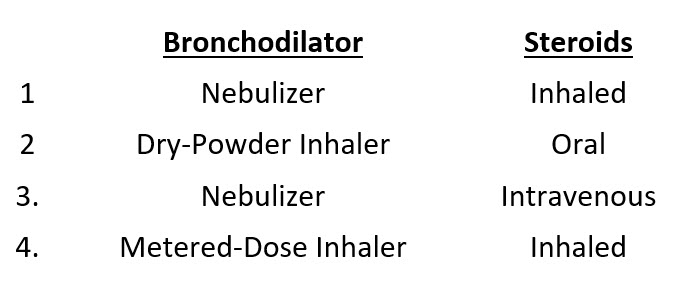
(A): 1
(B): 2
(C): 3
(D): 4
(Correct): C
(Points): 1
(CF):
One of the things you'll be asked to do is to consider not just the correct drugs but the correct forms of drugs based upon patient condition. in this case we have a patient in distress ... so the best options are to give:
1. bronchodilators by nebulizer (it would be difficult to ensure proper technique with an MDI, and a DPI is certainly out of the question).
2. steroids: recommend IV administration of steroids for someone in respiratory distress. An inhaled steroid will result in a lower dosage delivered, especially with distress (inadequate ability to inhale and hold).
(Type): analysis
(Random answers): 0
(Question): A patient is being discharged home with a new diagnosis of bronchiectasis. The patient has large amounts of secretions, and is wondering what could help keep the secretions managed while maintaining as normal a life as possible. Which of the following could the respiratory therapist recommend?
(A): vibratory PEP therapy
(B): postural drainage and percussion
(C): pursed lip breathing exercises
(D): weekly outpatient clinic at the hospital for pulmonary hygiene
(Correct): A
(Points): 1
(Explanation): Vibratory PEP is easily taught and performed independently for patients like this. The other options require unecessary resources (postural drainage/percussion or coming to a clinic weekly if not necessary), or do not address the issue (pursed lip breathing is more for COPD/air trapping, not bronchial hygiene)
(Type): application
(Category): 0
(Random answers): 1
(Question): Which of the following is appropriate to a patient about to undergo a laparotomy banding procedure?
(A): pulmonary rehab consult
(B): arterial blood gas analysis
(C): chest radiograph
(D): incentive spirometry instruct
(Correct): D
(Points): 1
(Explanation): Patients undergoing abdominal/upper abdominal/thoracic surgeries are at increased risk of atelectasis. Incentive spirometry is indicated in this situation; instructing before the patient has surgery (and before pain meds have been started) is more effective than waiting until after.
The other options are either invasive (ABG), or unnecessary (CXR, Rehab).
(WF): Patients undergoing abdominal/upper abdominal/thoracic surgeries are at increased risk of atelectasis. Incentive spirometry is indicated in this situation; instructing before the patient has surgery (and before pain meds have been started) is more effective than waiting until after.
The other options are either invasive (ABG), or unnecessary (CXR, Rehab).
(Type): analysis
(Random answers): 1
(Question): The homecare respiratory therapist is performing patient and family education for a quadriplegic patient receiving multiple new respiratory therapies. Which of the following is a critical aspect of the education plan?
(A): therapy titration with daily lung function testing
(B): documentation of therapies is thorough and in writing
(C): thorough hand-washing before and after each therapy
(D): nebulizer cups are disinfected with sodium hypochlorite before each use
(Correct): C
(Points): 1
(Explanation):
Handwashing is a critical step in care: every setting, every therapy, every time. Hands are a quick source of infection and studies have shown that of all the things we do to protect against infection, handwashing is perhaps the most effective.
Other options:
- documentation - while some documentation might be helpful, thorough record-keeping is more critical in professional settings and may hinder care in a home (which should be integrated, as much as possible, into day-to-day routines)
- nebulizer cups - may be disinfected with bleach (diluted with water) but then must be rinsed (this answer choice leaves that out) and is not generally done before each treatment
- therapy titration is not usually a part of a home-based education program. Patients generally are clinically stable with therapy titrations being completed in a formal setting. Teaching how to titrate oxygen, etc., during signs of distress would be important.
(Type): application
(Random answers): 1
(Question): A 66-year-old male is being assessed for progressive dyspnea over the last year. Pulmonary function testing results include the following:
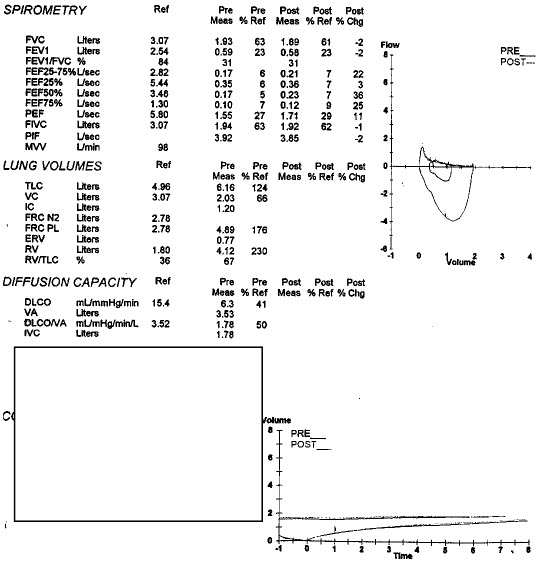
Which of the following is the most likely diagnosis?
(A): mild asthma
(B): severe COPD
(C): normal results
(D): mild COPD
(Correct): B
(Points): 1
(Explanation):
(Type): application
(Random answers): 1
(Question): A patient with pulmonary arterial hypertension is assessed by an echocardiogram. Significant right ventricular hypertrophy is observed. Which of the following is likely?
(A): left-sided heart failure
(B): congestive heart failure
(C): cor pulmonale
(D): cardiac tamponade
(Correct): C
(Points): 1
(Explanation):
This question tests your knowledge of terminology. The appropriate term for right ventricular hypertrophy (a sign of right-sided heart failure) due to a chronic respiratory condition (COPD, CF, bronchiectasis, pulmonary hypertension, etc.) is cor pulmonale.
Did you know? cor pulmonale means "pulmonary heart" (latin)? This might be a way to remember it. As you decide whether something is cor pulmonale, remember that there are two qualifying conditions that have to be met:
- evidence of right-sided heart failure
- the cause of the failure is respiratory (note! failure of the left side of the heart can result in failure of the right side ... that's different than cor pulmonale)
(Type): analysis
(Random answers): 1
(Question): A 34-year old woman is pregnant with an EGA of 22-weeks. She goes into cardiac arrest while receiving care for an infection. ROSC is attained after 15-minutes. She is currently unresponsive, a 7.0-mm ID endotracheal tube has been placed successfully, and she is receiving A/C, VC with an FIO2 of 0.6 on the ventilator.
Vital Signs
BP 100/70 mmHg
HR 90/min
SpO2 98%
ETCO2 45 torr
Which of the following is MOST appropriate at this time?
(A): targeted temperature management
(B): immediate caesarian section delivery
(C): exchange endotracheal tube to 7.5-mm ID
(D): wean to 0.5 the FIO2
(Correct): A
(Points): 1
(Explanation):
These questions usually have a couple things to think about. First, you need to decide which answer options are appropriate and which are not. Then, if there's more than one appropriate option, prioritize the MOST important one.
- targeted temperature management, also sometimes referred to as therapeutic hypothermia. This is appropriate in a post-ROSC patient who is unresponsive. Pregnancy doesn't exclude the option.
exchange endotracheal tube. This option might be helpful (a larger tube may help decrease RAW and improve weaning). However, this one should have you immediately feeling like, "there's really no reason to do this right away, no indication for it." And you would be correct! - wean O2 - SpO2 is 98, yeah, but there's a bigger priority right now: neurological function.
- C-section delivery - there's no indication at this time. Because of the baby's age it is advisable to maintain the baby (unless in fetal distress, but there's no sign of that in this question) in the uterus.
(Type): application
(Random answers): 1
(Question): The following ABG is drawn:
pH 7.28
PaCO2 68 torr
PaO2 46 torr
HCO3 32 mEq/L
This blood gas would be most consistent with which patient?
(A): 78-year-old female with COPD and pneumonia
(B): 30-year-old male with ARDS
(C): 56-year-old female found unresponsive with severe dehydration
(D): 16-year-old male with diabetes
(Correct): A
(Points): 1
(Explanation):
You will need to be comfortable with analyzing ABGs on the exam. Most will be pretty simple (respiratory or metabolic, acidosis or alkalosis). A few will test you a little deeper. What should jump out about this ABG is that the CO2 is really high, especially for the pH AND the HCO3 is high (bringing the pH upward, suggesting compensation). This is a classic acute exacerbation of COPD (retainer) ABG.
- ARDS: would present as an acute respiratory acidosis (low pH, high CO2, poor oxygenation)
- Diabetes: look for a very low pH with a low HCO3 (metabolic acidosis) and a very low CO2 (the lungs are trying to compensate)
Dehydration: This is likely to cause a metabolic acidosis (depends on cause, but either way this would be primarily metabolic)
(Type): analysis
(Random answers): 1
(Question): The following ABG is drawn:
The respiratory therapist responds to the room of a patient experiencing sudden pleuritic chest pain. The patient is noted to be diaphoretic. An ECG was performed just prior to arrival:
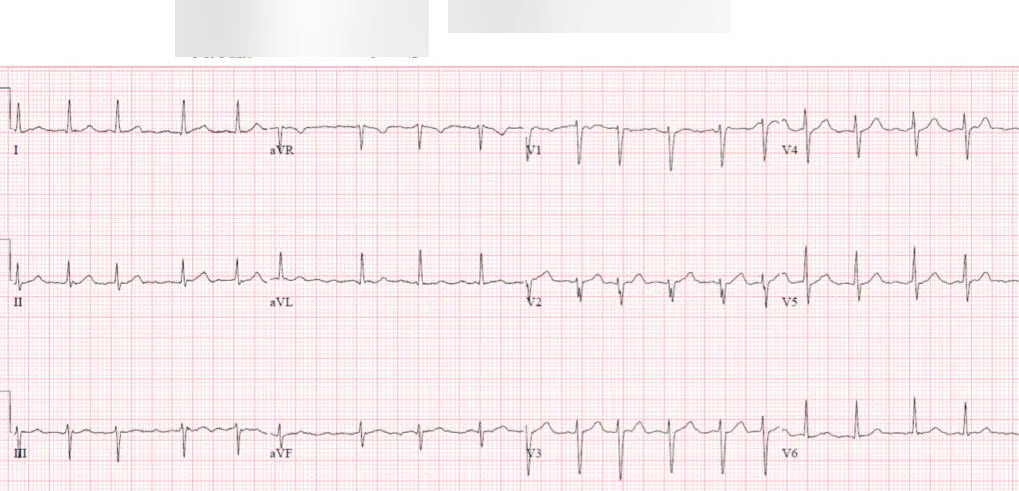
Which of the following should the respiratory therapist do FIRST?
(A): request a d-dimer test
(B): initiate continuous positive airway pressure therapy
(C): give oxygen by nonrebreather mask
(D): recommend transcutaneous pacing
(Correct): C
(Points): 1
(Explanation):
Did you recognize that this patient might be having a pulmonary embolus (PE)? Whenever a patient presents with symptoms consistent with a PE you should choose clinical options to first support the patient (100% oxygen immediately), and then test for it (it should be ruled out as a potentially fatal cause of an arrhythmia with chest pain)
Other options:
- d-dimer is inconclusive. While it can rule out a PE (a negative d-dimer always means there's no PE), it can't confirm one (a positive d-dimer has multiple causes).
- CPAP: is not indicated for this patient but is put here for the possibility that you might lean towards CHF being a cause of the issues.
- pacing: indicated for severe bradycardia (symptomatic)
(Random answers): 1
(Question):
Which of the following could be used to determine the severity of respiratory distress in a neonate who is 2 days old?
(A): Apgar score
(B): Ballard score
(C): Silverman score
(D): Finnegan Score
(Correct): B
(Points): 1
(Explanation): The correct answer is the Silverman Score, which ranges from 0 (no distress) to 10 (severe distress) and is based on assessment findings including retractions, nasal flaring, and grunting.
The Ballard score is used to determine physical maturity
The Apgar score is used at birth to determine the need for intervention (though you should never delay intervention waiting to calculate the Apgar!)
The Finnegan score is used to determine the severity of neonatal withdrawal from opioids. It's okay if you didn't know this one, but it is an example of a good test philosophy: if you have never heard of it, it is unlikely to be correct! .
(Type): analysis
(Random answers): 1
(Question): A 3-year-old child with bronchopulmonary dysplasia is admitted to the pediatric intensive care unit with a right lower lobe pneumonia. She is observed to have severe retractions despite being on home ventilator settings.
Current Ventilator Settings
SIMV, PC
IP 14 cm H2O
Set Rate 10/min
Tot Rate 40/min
PEEP 4 cm H2O
PS 8 cm H2O
FIO2 2 L/min bled into the circuit
Which of the following should the respiratory therapist do next?
(A): administer cisatracurium
(B): increase to 10 cmH2O the pressure support
(C): increase to 20/min the mandatory rate
(D): increase to 6 cmH2O the PEEP
(Correct): C
(Points): 1
(Explanation): This child is receiving mechanical ventilation as part of a chronic disease (BPD). The vent settings are set for a baseline condition, but now the child has respiratory distress with an underlying pneumonia. Without having a blood gas, without having a return VT, whatever, we know we should probably increase the amount of support being received. It isn't uncommon to even have to transition from a home vent to a critical care vent, depending on the situation.
The best and most common way to do this with SIMV is to increase the number of mandatory (fully supported) breaths being received, in this case from 10 to 20/min. What about our other options? Increasing PEEP may help if there is a V/Q mismatch (we just don't know this info). Pressure support could help those spontaneous breaths, but the amount being proposed is probably inadequate (exam hint: increase mandatory rate before increasing pressure support in this type of scenario). Administering a paralytic would result in inadequate ventilation at the current settings and is probably "overkill" initially.
(Type): analysis
(Random answers): 1
(Question): A 12-year-old boy with cystic fibrosis has been hospitalized several times with lung infections. The respiratory therapist is asked to consult and provide input on a homecare plan for the child. Which of the following would be an optimal plan to meet his needs?
(A): aggressive chest physiotherapy with postural drainage with percussion and vibration
(B): use of an insufflator-exsufflator once daily with nasotracheal suction as needed
(C): administration of a cough suppressant via intrapulmonary percussive ventilation with a mouthpiece
(D): use of high frequency chest wall oscillations several times per day while taking required nebulized medications
(Correct): D
(Points): 1
(Explanation): Okay, there are two things to balance for this patient:
1. What possible therapies would be an effective means of bronchial hygiene (and can be performed at home)
2. What therapies that meet #1 will the patient be MOST likely compliant with? Remember, a therapy is only as good if it's being used.
In this case, the vest (high frequency chest wall oscillations) would both meet the needs of the patient AND is likely to be integrated into their lifestyle as a young teenager (not sure? check out youtube for videos of actual CFers doing vest treatments while living life, talking on the phone, watching TV, heck even lifting weights).
Chest physiotherapy might be what we do in the hospital - it meets #1 above, but is unlikely to be convenient enough, plus requires a trained person to perform it (which could be a family member ...). Not optimal.
IPV would be acceptable and helpful but the cough suppressant is the opposite of what we're trying to do. Using mucoactives and mucolytics is more appropriate.
Finally, the use of a cough-assist is not needed here (the patient is able to cough), but is more appropriate with patients with respiratory muscle weakness or paralysis (so neuromuscular disorders, quadriplegia).
(Type): analysis
(Random answers): 1
(Question): A respiratory therapist walks by a waiting room and is called in by a panicking caregiver. A 2-year-old child was playing with a bottlecap in their mouth and suddenly started struggling with their breathing. The therapist notes no airflow, and the child is now unresponsive. The therapist should NEXT:
(A): begin CPR with chest compressions, checking for a visible obstruction in the mouth when managing the airway
(B): perform 5 firm blows against the back while prone against hand, then flip to supine and perform 5 chest thrusts
(C): perform repeated abdominal thrusts until the bottlecap is expelled
(D): call a code blue and closely monitor the child
(Correct): A
(Points): 1
(Explanation): BLS guidelines state that once a choking person has gone unconscious, you should begin chest compressions and CPR but can look in the airway and perform a finger sweep if the object is visible.
(Type): recall
(Random answers): 1
(Question): Which of the following congenital heart disorders will result in a preductal SpO2 that is at least 3% higher than the postductal SpO2?
(A): ventricular septal defect
(B): coarctation of the aorta
(C): transposition of the great arteries
(D): patent ductus arteriosus
(Correct): C
(Points): 1
(Explanation): transposition of the great arteries is an anatomical abnormality that results in the aorta coming off the right ventricle and the pulmonary artery off the left ventricle (so exactly opposite of what it should be). Review the disorders and types of resulting shunts on the neonatal disorders page.
(Type): analysis
(Random answers): 1
(Question): A 26-week gestational age neonate is delivered emergently after a placental abruption. The baby is receiving +6 cmH2O nasal CPAP with an FIO2 of 0.30. The respiratory therapist notes the SpO2 drop from 92% to 70% several times, each time with the neonate becoming significantly cyanotic. Which of the following is most likely?
(A): coarctation of the aorta
(B): transient tachypnea of the newborn
(C): respiratory distress syndrome
(D): persistent pulmonary hypertension of the newborn
(Correct): D
(Points): 1
(Explanation): Watch for these symptoms! Sudden drops in SpO2 with cyanosis can indicate pulmonary hypertension of the newborn, a condition where the pulmonary system becomes high pressure again (it should be low pressure after birth), causing the ductus arteriosus, ductus venosus (sometimes) and the foramen ovale to all reopen, resulting in shunting.
(Type): application
(Random answers): 1
(Question): Which of the following is true of administering procedural sedation?
(A): a maximum dosage is given, and then quickly weaned until the patient becomes alert
(B): a minimum therapeutic dosage is given, then slowly titrated based upon patient response
(C): singles doses are given only if the patient is noted to be in pain or discomfort
(D): an analgesic is administered initially, then a sedative added if clinically necessary
(Correct): B
(Points): 1
(Explanation): Typically a minimum therapeutic dose is given, then titrated up if the patient shows discomfort or pain. Giving the max dose can result in unnecessary respiratory compromise (and we are giving drug that isn't necessary ... remember drugs administered always risks harm to the patient, so we need to balance it with some benefit).
(Type): analysis
(Random answers): 1
(Question): A 7-year-old male is admitted to the pediatric unit after an allergic reaction to oral antibiotics results in difficulty breathing. The patient begins to show signs of respiratory distress. Inspiratory and expiratory stridor are auscultated over the throat area.
Vital Signs
HR 118/min
RR 32/min
SpO2 87%
Which of the following should be FIRST attempted?
(A): administer inhaled corticosteroids
(B): initiate noninvasive positive pressure ventilation by mask
(C): intubate using fiberoptic intubation equipment
(D): perform arterial blood gas analysis
(Correct): C
(Points): 1
(Explanation): There is a question of airway patency here, marked by stridor and increasing respiratory distress, including hypoxemia. The most appropriate action is to assume we are about to lose this airway and so establish it by inserting an endotracheal tube.
Performing an ABG may provide additional information, but would delay care,. Honestly, it is most likely to confirm what we already know (we would expect PaO2 to be low and there to either be a respiratory alkalosis (tachypnea, depending on the amount of air getting into the lungs) or respiratory acidosis (if the patient is in impending or actual failure). Our final option choice was to start NPPV by mask, but this does not address airway patency.
(Type): application
(Random answers): 1
(Question): Which of the following results in a left-to-right shunt?
(A): patent ductus arteriosus
(B): tetralogy of Fallot
(C): transposition of the great arteries
(D): hypoplastic left heart syndrome
(Correct): A
(Points): 1
(Explanation):
- Right side of heart = vena cava, right atrium/ventricle, then leading to the pulmonary artery (PA)
- Left side of the heart = left atrium/ventricle, then aorta
In a PDA blood flows from the aorta (LEFT) to the pulmonary artery (RIGHT). This is a LEFT to RIGHT shunt.
Tetralogy of Fallot primarily results in shunting of blood from the deoxygenated right ventricle (RIGHT) to the left ventricle (LEFT) - through a defect or hole in the wall that separates the two ventricles. This is a RIGHT to LEFT shunt.
Transposition of the great arteries occurs when the aorta comes from right ventricle and the pulmonary artery from the left. Blood that enters the right ventricle (RIGHT) leaves by that defective pathway through the aorta (LEFT) and out to the systemic circulation
Hypoplastic Left Heart Syndrome (HLHS) is a disorder where the left side of the heart isn't fully functional requiring the use instead of the ductus arteriosus (a blood vessel that allows blood from the (RIGHT) side of the heart to flow to the aorta (LEFT), much of it skipping the lungs.
Note: if you need this test scheduled for your students, please just reach out to us. It is a full-length (140 questions), timed exam.
Explanations are not provided here due to the length/complexity but can be released to students as with other quizzes and tests.
ARCHIVED GRADES
The students take the NBRC test this lesson - this is not our test so scores can't be reported
Link name:
Rockingham Quiz 02
Test name:
TMC Lesson 02 Quiz
First name
Last name
email
Percentage
Points received
Points available
Minutes
Seconds
Date started
Date finished
Requires grading
Gabrielle
Crosby
[email protected]
100%
10
10
13
29
Tue 7th Feb 2023 10:44pm
Tue 7th Feb 2023 10:58pm
Completed
Gabrielle
Crosby
[email protected]
70%
7
10
9
48
Tue 7th Feb 2023 10:23pm
Tue 7th Feb 2023 10:33pm
Completed
Mackenzie
DeLapp
[email protected]
80%
8
10
4
13
Thu 9th Feb 2023 2:37pm
Thu 9th Feb 2023 2:41pm
Completed
Edsel
Guevara
[email protected]
100%
10
10
19
30
Tue 7th Feb 2023 3:44pm
Tue 7th Feb 2023 4:03pm
Completed
Edsel
Guevara
[email protected]
70%
7
10
19
28
Tue 7th Feb 2023 3:04pm
Tue 7th Feb 2023 3:23pm
Completed
Vennesa
Lawson
[email protected]
80%
8
10
10
29
Sun 5th Feb 2023 11:46am
Sun 5th Feb 2023 11:56am
Completed
Vennesa
Lawson
[email protected]
70%
7
10
5
58
Sun 5th Feb 2023 11:38am
Sun 5th Feb 2023 11:44am
Completed
Megan
Tippett
[email protected]
70%
7
10
2
10
Tue 7th Feb 2023 4:10pm
Tue 7th Feb 2023 4:12pm
Completed
Megan
Tippett
[email protected]
60%
6
10
4
37
Tue 7th Feb 2023 4:04pm
Tue 7th Feb 2023 4:09pm
Completed
Kristy
Varner
[email protected]
100%
10
10
1
32
Wed 8th Feb 2023 9:50pm
Wed 8th Feb 2023 9:51pm
Completed
Kristy
Varner
[email protected]
90%
9
10
13
33
Wed 8th Feb 2023 9:29pm
Wed 8th Feb 2023 9:42pm
Completed
michael
wahba
[email protected]
100%
10
10
5
54
Wed 8th Feb 2023 8:32pm
Wed 8th Feb 2023 8:37pm
Completed
michael
Wahba
[email protected]
40%
4
10
19
41
Tue 7th Feb 2023 6:48pm
Tue 7th Feb 2023 7:08pm
Completed
Brianna
Waller
[email protected]
100%
10
10
8
55
Mon 6th Feb 2023 9:18pm
Mon 6th Feb 2023 9:27pm
Completed
Brianna
Waller
[email protected]
80%
8
10
12
37
Mon 6th Feb 2023 8:57pm
Mon 6th Feb 2023 9:09pm
Completed
Average percentage:
80.70%
Average points scored:
8.1
Link name:
Rockingham Lesson 03 Quiz
Test name:
TMC Lesson 03 Quiz
First name
Last name
email
Percentage
Points received
Points available
Minutes
Seconds
Date started
Date finished
Requires grading
Gabrielle
Crosby
[email protected]
100%
10
10
11
42
Wed 15th Feb 2023 11:00pm
Wed 15th Feb 2023 11:12pm
Completed
Gabrielle
Crosby
[email protected]
60%
6
10
17
49
Tue 14th Feb 2023 8:32pm
Tue 14th Feb 2023 8:50pm
Completed
Mackenzie
DeLapp
[email protected]
40%
4
10
3
43
Sun 12th Feb 2023 6:40pm
Sun 12th Feb 2023 6:44pm
Completed
Mackenzie
DeLapp
[email protected]
80%
8
10
4
9
Sun 12th Feb 2023 6:34pm
Sun 12th Feb 2023 6:38pm
Completed
Edsel
Guevara
[email protected]
100%
10
10
3
0
Wed 15th Feb 2023 7:29pm
Wed 15th Feb 2023 7:32pm
Completed
Edsel
Guevara
[email protected]
40%
4
10
20
0
Sun 12th Feb 2023 5:16pm
Sun 12th Feb 2023 5:36pm
Completed
Vennesa
Lawson
[email protected]
70%
7
10
9
19
Wed 15th Feb 2023 4:40pm
Wed 15th Feb 2023 4:50pm
Completed
vennesa
lawson
[email protected]
70%
7
10
4
7
Wed 15th Feb 2023 4:05pm
Wed 15th Feb 2023 4:09pm
Completed
Vennesa
Lawson
[email protected]
70%
7
10
2
0
Sun 12th Feb 2023 11:25am
Sun 12th Feb 2023 11:27am
Completed
Vennesa
Lawson
[email protected]
80%
8
10
7
4
Sun 12th Feb 2023 11:17am
Sun 12th Feb 2023 11:24am
Completed
megan
tippett
[email protected]
70%
7
10
1
29
Tue 14th Feb 2023 11:17am
Tue 14th Feb 2023 11:18am
Completed
Megan
Tippett
[email protected]
80%
8
10
4
38
Tue 14th Feb 2023 11:11am
Tue 14th Feb 2023 11:16am
Completed
Kristy
Varner
[email protected]
20%
2
10
1
21
Wed 15th Feb 2023 10:47pm
Wed 15th Feb 2023 10:48pm
Completed
Kristy
Varner
[email protected]
30%
3
10
15
33
Wed 15th Feb 2023 10:01pm
Wed 15th Feb 2023 10:17pm
Completed
Michael
Wahba
[email protected]
100%
10
10
5
28
Wed 15th Feb 2023 9:54pm
Wed 15th Feb 2023 9:59pm
Completed
Michael
Wahba
[email protected]
60%
6
10
15
24
Tue 14th Feb 2023 9:05pm
Tue 14th Feb 2023 9:20pm
Completed
Brianna
Waller
[email protected]
100%
10
10
7
52
Wed 15th Feb 2023 7:55pm
Wed 15th Feb 2023 8:02pm
Completed
Brianna
Waller
[email protected]
60%
6
10
3
37
Wed 15th Feb 2023 4:16pm
Wed 15th Feb 2023 4:19pm
Completed
Average percentage:
68.30%
Average points scored:
6.8
Link name:
Rockingham Lesson 04 Quiz
Test name:
TMC Lesson 04 Quiz
First name
Last name
email
Percentage
Points received
Points available
Minutes
Seconds
Date started
Date finished
Requires grading
Gabrielle
Crosby
[email protected]
80%
8
10
3
7
Wed 22nd Feb 2023 9:52pm
Wed 22nd Feb 2023 9:55pm
Completed
Gabrielle
Crosby
[email protected]
70%
7
10
13
29
Wed 22nd Feb 2023 5:21pm
Wed 22nd Feb 2023 5:34pm
Completed
Mackenzie
DeLapp
[email protected]
20%
2
10
1
38
Thu 23rd Feb 2023 9:07am
Thu 23rd Feb 2023 9:08am
Completed
Mackenzie
DeLapp
[email protected]
40%
4
10
2
22
Thu 23rd Feb 2023 9:04am
Thu 23rd Feb 2023 9:06am
Completed
Edsel
Guevara
[email protected]
60%
6
10
1
19
Wed 22nd Feb 2023 8:50pm
Wed 22nd Feb 2023 8:52pm
Completed
Edsel
Guevara
[email protected]
80%
8
10
17
28
Wed 22nd Feb 2023 8:32pm
Wed 22nd Feb 2023 8:50pm
Completed
Edsel
Guevara
[email protected]
50%
5
10
19
45
Tue 21st Feb 2023 8:05pm
Tue 21st Feb 2023 8:24pm
Completed
Vennesa
Lawson
[email protected]
70%
7
10
18
10
Tue 21st Feb 2023 1:45pm
Tue 21st Feb 2023 2:04pm
Completed
Vennesa
Lawson
[email protected]
40%
4
10
10
6
Tue 21st Feb 2023 1:35pm
Tue 21st Feb 2023 1:45pm
Completed
Megan
Tippett
[email protected]
50%
5
10
1
12
Tue 21st Feb 2023 11:55am
Tue 21st Feb 2023 11:56am
Completed
Megan
Tippett
[email protected]
40%
4
10
2
38
Tue 21st Feb 2023 11:51am
Tue 21st Feb 2023 11:54am
Completed
Kristy
Varner
[email protected]
80%
8
10
4
20
Wed 22nd Feb 2023 10:05pm
Wed 22nd Feb 2023 10:09pm
Completed
Kristy
Varner
[email protected]
70%
7
10
13
41
Sun 19th Feb 2023 4:18pm
Sun 19th Feb 2023 4:32pm
Completed
michael
wahba
[email protected]
70%
7
10
5
45
Wed 22nd Feb 2023 8:20pm
Wed 22nd Feb 2023 8:25pm
Completed
Michael
Wahba
[email protected]
50%
5
10
17
26
Tue 21st Feb 2023 7:12pm
Tue 21st Feb 2023 7:30pm
Completed
Brianna
Waller
[email protected]
80%
8
10
2
57
Wed 22nd Feb 2023 10:39pm
Wed 22nd Feb 2023 10:42pm
Completed
Brianna
Waller
[email protected]
50%
5
10
8
11
Wed 22nd Feb 2023 2:46pm
Wed 22nd Feb 2023 2:55pm
Completed
Average percentage:
58.80%
Average points scored:
5.9
Link name:
Rockingham Lesson 05 Quiz
Test name:
TMC Lesson 05 Quiz
First name
Last name
email
Percentage
Points received
Points available
Minutes
Seconds
Date started
Date finished
Requires grading
Edsel
Bonilla Guevara
[email protected]
80%
8
10
1
13
Wed 1st Mar 2023 8:02pm
Wed 1st Mar 2023 8:03pm
Completed
Gabrielle
Crosby
[email protected]
80%
8
10
8
11
Wed 1st Mar 2023 10:42pm
Wed 1st Mar 2023 10:50pm
Completed
Gabrielle
Crosby
[email protected]
80%
8
10
4
29
Mon 27th Feb 2023 9:18pm
Mon 27th Feb 2023 9:23pm
Completed
Mackenzie
DeLapp
[email protected]
100%
10
10
1
33
Sun 26th Feb 2023 12:38pm
Sun 26th Feb 2023 12:40pm
Completed
Mackenzie
DeLapp
[email protected]
30%
3
10
6
23
Sun 26th Feb 2023 12:17pm
Sun 26th Feb 2023 12:24pm
Completed
Edsel
Guevara
[email protected]
90%
9
10
10
37
Wed 1st Mar 2023 7:51pm
Wed 1st Mar 2023 8:01pm
Completed
Edsel
Guevara
[email protected]
80%
8
10
19
47
Sat 25th Feb 2023 5:30pm
Sat 25th Feb 2023 5:50pm
Completed
Vennesa
Lawson
[email protected]
70%
7
10
0
51
Wed 1st Mar 2023 5:10pm
Wed 1st Mar 2023 5:11pm
Completed
Vennesa
Lawson
[email protected]
80%
8
10
2
3
Wed 1st Mar 2023 5:08pm
Wed 1st Mar 2023 5:10pm
Completed
vennesa
lawson
[email protected]
70%
7
10
3
45
Wed 1st Mar 2023 9:57am
Wed 1st Mar 2023 10:00am
Completed
megan
tippett
[email protected]
80%
8
10
1
41
Wed 1st Mar 2023 2:35pm
Wed 1st Mar 2023 2:37pm
Completed
megan
tippett
[email protected]
80%
8
10
4
45
Wed 1st Mar 2023 2:30pm
Wed 1st Mar 2023 2:34pm
Completed
Kristy
Varner
[email protected]
70%
7
10
5
8
Wed 1st Mar 2023 10:16pm
Wed 1st Mar 2023 10:22pm
Completed
Kristy
Varner
[email protected]
40%
4
10
17
26
Wed 1st Mar 2023 3:53pm
Wed 1st Mar 2023 4:10pm
Completed
Michael
Wahba
[email protected]
70%
7
10
2
45
Wed 1st Mar 2023 9:48pm
Wed 1st Mar 2023 9:51pm
Completed
michael
wahba
[email protected]
80%
8
10
12
37
Wed 1st Mar 2023 9:35pm
Wed 1st Mar 2023 9:48pm
Completed
brianna
waller
[email protected]
70%
7
10
2
55
Wed 1st Mar 2023 2:35pm
Wed 1st Mar 2023 2:38pm
Completed
Brianna
Waller
[email protected]
60%
6
10
3
48
Wed 1st Mar 2023 2:20pm
Wed 1st Mar 2023 2:24pm
Completed
Brianna
Waller
[email protected]
70%
7
10
6
20
Tue 28th Feb 2023 8:40pm
Tue 28th Feb 2023 8:46pm
Completed
Average percentage:
72.60%
Average points scored:
7.3
Link name:
Rockingham Lesson 06 Midterm
Test name:
TMC Lesson 06 Midterm
First name
Last name
email
Percentage
Points received
Points available
Minutes
Seconds
Date started
Date finished
Requires grading
Brianna
Waller
[email protected]
82.50%
33
40
45
44
Wed 8th Mar 2023 11:04pm
Wed 8th Mar 2023 11:50pm
Completed
Gabrielle
Crosby
[email protected]
80%
32
40
52
6
Wed 8th Mar 2023 10:14pm
Wed 8th Mar 2023 11:06pm
Completed
Mackenzie
DeLapp
[email protected]
80%
32
40
7
22
Sun 5th Mar 2023 4:43pm
Sun 5th Mar 2023 4:50pm
Completed
Mackenzie
DeLapp
[email protected]
65%
26
40
16
45
Sun 5th Mar 2023 3:41pm
Sun 5th Mar 2023 3:58pm
Completed
Edsel
Guevara
[email protected]
70%
28
40
59
37
Wed 8th Mar 2023 12:03am
Wed 8th Mar 2023 1:03am
Completed
Edsel
Guevara
[email protected]
62.50%
25
40
60
0
Tue 7th Mar 2023 10:36pm
Tue 7th Mar 2023 11:36pm
Completed
Vennesa
Lawson
[email protected]
62.50%
25
40
56
37
Wed 8th Mar 2023 6:33pm
Wed 8th Mar 2023 7:29pm
Completed
megan
tippett
[email protected]
72.50%
29
40
21
24
Tue 7th Mar 2023 8:29pm
Tue 7th Mar 2023 8:50pm
Completed
megan
tippett
[email protected]
72.50%
29
40
30
3
Tue 7th Mar 2023 7:58pm
Tue 7th Mar 2023 8:28pm
Completed
Kristy
Varner
[email protected]
67.50%
27
40
58
36
Wed 8th Mar 2023 4:54pm
Wed 8th Mar 2023 5:53pm
Completed
Michael
Wahba
[email protected]
55%
22
40
59
20
Wed 8th Mar 2023 7:58pm
Wed 8th Mar 2023 8:57pm
Completed
Average percentage:
70%
Average points scored:
28
Link name:
Rockingham Lesson 07 Quiz
Test name:
TMC Lesson 07 Quiz
First name
Last name
email
Percentage
Points received
Points available
Minutes
Seconds
Date started
Date finished
Requires grading
Gabrielle
Crosby
[email protected]
100%
10
10
3
18
Tue 21st Mar 2023 7:22pm
Tue 21st Mar 2023 7:25pm
Completed
Gabrielle
Crosby
[email protected]
100%
10
10
7
14
Tue 14th Mar 2023 11:12pm
Tue 14th Mar 2023 11:19pm
Completed
Gabrielle
Crosby
[email protected]
90%
9
10
12
35
Mon 13th Mar 2023 9:51pm
Mon 13th Mar 2023 10:04pm
Completed
Mackenzie
DeLapp
[email protected]
70%
7
10
3
14
Thu 9th Mar 2023 8:08pm
Thu 9th Mar 2023 8:11pm
Completed
Mackenzie
DeLapp
[email protected]
50%
5
10
6
56
Thu 9th Mar 2023 7:50pm
Thu 9th Mar 2023 7:57pm
Completed
Edsel
Guevara
[email protected]
100%
10
10
16
25
Mon 13th Mar 2023 10:49pm
Mon 13th Mar 2023 11:06pm
Completed
Vennesa
Lawson
[email protected]
100%
10
10
2
23
Sat 18th Mar 2023 1:04pm
Sat 18th Mar 2023 1:06pm
Completed
Megan
Tippett
[email protected]
90%
9
10
6
52
Wed 15th Mar 2023 8:31pm
Wed 15th Mar 2023 8:38pm
Completed
Megan
Tippett
[email protected]
50%
5
10
4
9
Wed 15th Mar 2023 8:27pm
Wed 15th Mar 2023 8:31pm
Completed
Kristy
Varner
[email protected]
70%
7
10
11
5
Wed 22nd Mar 2023 10:01pm
Wed 22nd Mar 2023 10:12pm
Completed
Kristy
Varner
[email protected]
40%
4
10
15
9
Tue 21st Mar 2023 8:23pm
Tue 21st Mar 2023 8:38pm
Completed
Michael
Wahba
[email protected]
100%
10
10
4
0
Fri 17th Mar 2023 9:43pm
Fri 17th Mar 2023 9:47pm
Completed
michael
wahba
[email protected]
40%
4
10
10
43
Wed 1st Mar 2023 3:47pm
Wed 1st Mar 2023 3:57pm
Completed
Brianna
Waller
[email protected]
100%
10
10
1
25
Tue 21st Mar 2023 8:58am
Tue 21st Mar 2023 8:59am
Completed
Brianna
Waller
[email protected]
80%
8
10
19
34
Mon 13th Mar 2023 6:19pm
Mon 13th Mar 2023 6:38pm
Completed
Average percentage:
78.70%
Average points scored:
7.9
Link name:
Rockingham Lesson 08 Quiz
Test name:
TMC Lesson 08 Quiz
First name
Last name
email
Percentage
Points received
Points available
Minutes
Seconds
Date started
Date finished
Requires grading
Gabrielle
Crosby
[email protected]
100%
10
10
7
29
Wed 22nd Mar 2023 9:18pm
Wed 22nd Mar 2023 9:26pm
Completed
Gabrielle
Crosby
[email protected]
60%
6
10
9
27
Tue 21st Mar 2023 7:26pm
Tue 21st Mar 2023 7:35pm
Completed
Mackenzie
DeLapp
[email protected]
90%
9
10
1
48
Tue 21st Mar 2023 10:52pm
Tue 21st Mar 2023 10:53pm
Completed
Mackenzie
DeLapp
[email protected]
50%
5
10
7
19
Tue 21st Mar 2023 10:31pm
Tue 21st Mar 2023 10:39pm
Completed
Edsel
Guevara
[email protected]
100%
10
10
1
0
Tue 21st Mar 2023 1:18pm
Tue 21st Mar 2023 1:19pm
Completed
Edsel
Guevara
[email protected]
100%
10
10
1
27
Mon 20th Mar 2023 2:12pm
Mon 20th Mar 2023 2:13pm
Completed
Edsel
Guevara
[email protected]
70%
7
10
19
59
Mon 20th Mar 2023 1:49pm
Mon 20th Mar 2023 2:09pm
Completed
Vennesa
Lawson
[email protected]
100%
10
10
3
34
Wed 22nd Mar 2023 9:43am
Wed 22nd Mar 2023 9:46am
Completed
megan
tippett
[email protected]
100%
10
10
2
41
Tue 21st Mar 2023 3:13pm
Tue 21st Mar 2023 3:16pm
Completed
Kristy
Varner
[email protected]
60%
6
10
13
55
Wed 22nd Mar 2023 10:40pm
Wed 22nd Mar 2023 10:54pm
Completed
Kristy
Varner
[email protected]
60%
6
10
11
17
Wed 22nd Mar 2023 10:14pm
Wed 22nd Mar 2023 10:26pm
Completed
michael
wahba
[email protected]
100%
10
10
2
19
Tue 21st Mar 2023 6:09pm
Tue 21st Mar 2023 6:11pm
Completed
Brianna
Waller
[email protected]
100%
10
10
10
24
Wed 22nd Mar 2023 12:17pm
Wed 22nd Mar 2023 12:27pm
Completed
Average percentage:
83.50%
Average points scored:
8.4
Link name:
Rockingham Lesson 09 Quiz
Test name:
TMC Lesson 09 Quiz
First name
Last name
email
Percentage
Points received
Points available
Minutes
Seconds
Date started
Date finished
Requires grading
Gabrielle
Crosby
[email protected]
100%
10
10
1
27
Wed 29th Mar 2023 5:55pm
Wed 29th Mar 2023 5:56pm
Completed
Gabrielle
Crosby
[email protected]
60%
6
10
6
48
Wed 29th Mar 2023 1:10pm
Wed 29th Mar 2023 1:17pm
Completed
Mackenzie
DeLapp
[email protected]
90%
9
10
2
58
Tue 28th Mar 2023 9:27pm
Tue 28th Mar 2023 9:30pm
Completed
Mackenzie
DeLapp
[email protected]
40%
4
10
5
2
Tue 28th Mar 2023 9:02pm
Tue 28th Mar 2023 9:07pm
Completed
Edsel
Guevara
[email protected]
100%
10
10
1
9
Wed 29th Mar 2023 5:44pm
Wed 29th Mar 2023 5:45pm
Completed
Edsel
Guevara
[email protected]
80%
8
10
16
40
Tue 28th Mar 2023 2:10pm
Tue 28th Mar 2023 2:27pm
Completed
vennesa
lawson
[email protected]
70%
7
10
5
20
Wed 29th Mar 2023 2:18pm
Wed 29th Mar 2023 2:23pm
Completed
vennesa
lawson
[email protected]
100%
10
10
4
24
Wed 29th Mar 2023 4:02pm
Wed 29th Mar 2023 4:06pm
Completed
Megan
Tippett
[email protected]
90%
9
10
2
26
Wed 29th Mar 2023 1:11pm
Wed 29th Mar 2023 1:13pm
Completed
Megan
Tippett
[email protected]
60%
6
10
9
29
Wed 29th Mar 2023 12:50pm
Wed 29th Mar 2023 1:00pm
Completed
Kristy
Varner
[email protected]
90%
9
10
19
31
Wed 29th Mar 2023 2:46pm
Wed 29th Mar 2023 3:06pm
Completed
Michael
Wahba
[email protected]
100%
10
10
2
2
Wed 29th Mar 2023 3:44pm
Wed 29th Mar 2023 3:46pm
Completed
Brianna
Waller
[email protected]
100%
10
10
1
32
Wed 29th Mar 2023 3:58pm
Wed 29th Mar 2023 4:00pm
Completed
Brianna
Waller
[email protected]
70%
7
10
13
36
Wed 29th Mar 2023 1:30pm
Wed 29th Mar 2023 1:44pm
Completed
Average percentage:
82.10%
Average points scored:
8.2
Link name:
Rockingam Lesson 10 Quiz
Test name:
TMC Lesson 10 Quiz
First name
Last name
email
Percentage
Points received
Points available
Minutes
Seconds
Date started
Date finished
Requires grading
Gabrielle
Crosby
[email protected]
100%
10
10
1
42
Thu 6th Apr 2023 5:14pm
Thu 6th Apr 2023 5:15pm
Completed
Gabrielle
Crosby
[email protected]
90%
9
10
1
21
Mon 3rd Apr 2023 12:55pm
Mon 3rd Apr 2023 12:57pm
Completed
Mackenzie
DeLapp
[email protected]
100%
10
10
1
33
Tue 4th Apr 2023 5:57pm
Tue 4th Apr 2023 5:58pm
Completed
Mackenzie
DeLapp
[email protected]
60%
6
10
7
9
Sun 2nd Apr 2023 4:17pm
Sun 2nd Apr 2023 4:24pm
Completed
Edsel
Guevara
[email protected]
100%
10
10
8
8
Mon 3rd Apr 2023 2:46pm
Mon 3rd Apr 2023 2:54pm
Completed
Edsel
Guevara
[email protected]
80%
8
10
1
41
Mon 3rd Apr 2023 1:34pm
Mon 3rd Apr 2023 1:35pm
Completed
vennesa
Lawson
[email protected]
100%
10
10
1
44
Mon 3rd Apr 2023 2:57pm
Mon 3rd Apr 2023 2:59pm
Completed
vennesa
lawson
[email protected]
80%
8
10
1
11
Mon 3rd Apr 2023 12:58pm
Mon 3rd Apr 2023 12:59pm
Completed
Megan
Tippett
[email protected]
100%
10
10
2
21
Mon 3rd Apr 2023 2:56pm
Mon 3rd Apr 2023 2:58pm
Completed
Megan
Tippett
[email protected]
90%
9
10
1
34
Mon 3rd Apr 2023 2:42pm
Mon 3rd Apr 2023 2:43pm
Completed
Kristy
Varner
[email protected]
100%
10
10
3
18
Mon 3rd Apr 2023 5:48pm
Mon 3rd Apr 2023 5:51pm
Completed
Michael
Wahba
[email protected]
100%
10
10
1
25
Tue 4th Apr 2023 6:13pm
Tue 4th Apr 2023 6:14pm
Completed
Michael
wahba
[email protected]
90%
9
10
3
41
Mon 3rd Apr 2023 2:18pm
Mon 3rd Apr 2023 2:22pm
Completed
Brianna
Waller
[email protected]
100%
10
10
1
0
Mon 3rd Apr 2023 6:02pm
Mon 3rd Apr 2023 6:03pm
Completed
Brianna
Waller
[email protected]
70%
7
10
3
44
Mon 3rd Apr 2023 12:38pm
Mon 3rd Apr 2023 12:42pm
Completed
Average percentage:
90.70%
Average points scored:
9.1
Link name:
Rockingham Lesson 11 Quiz
Test name:
TMC Lesson 11 Quiz
First name
Last name
email
Percentage
Points received
Points available
Minutes
Seconds
Date started
Date finished
Requires grading
Gabrielle
Crosby
[email protected]
100%
10
10
2
16
Tue 11th Apr 2023 9:27am
Tue 11th Apr 2023 9:29am
Completed
Gabrielle
Crosby
[email protected]
70%
7
10
1
13
Mon 10th Apr 2023 2:24pm
Mon 10th Apr 2023 2:25pm
Completed
Mackenzie
DeLapp
[email protected]
100%
10
10
1
58
Tue 11th Apr 2023 9:22am
Tue 11th Apr 2023 9:24am
Completed
Mackenzie
DeLapp
[email protected]
80%
8
10
3
6
Mon 10th Apr 2023 5:12pm
Mon 10th Apr 2023 5:15pm
Completed
Edsel
Guevara
[email protected]
100%
10
10
3
58
Mon 10th Apr 2023 9:13pm
Mon 10th Apr 2023 9:17pm
Completed
Edsel
Guevara
[email protected]
50%
5
10
19
39
Thu 6th Apr 2023 1:56pm
Thu 6th Apr 2023 2:15pm
Completed
vennesa
lawson
[email protected]
70%
7
10
3
48
Mon 10th Apr 2023 2:47pm
Mon 10th Apr 2023 2:51pm
Completed
vennesa
lawson
[email protected]
100%
10
10
1
6
Mon 10th Apr 2023 5:59pm
Mon 10th Apr 2023 6:00pm
Completed
Megan
Tippett
[email protected]
100%
10
10
2
53
Tue 11th Apr 2023 11:16am
Tue 11th Apr 2023 11:19am
Completed
Kristy
Varner
[email protected]
100%
10
10
3
31
Mon 10th Apr 2023 5:40pm
Mon 10th Apr 2023 5:44pm
Completed
Kristy
Varner
[email protected]
60%
6
10
18
20
Mon 10th Apr 2023 3:59pm
Mon 10th Apr 2023 4:18pm
Completed
MICHAEL
Wahba
[email protected]
100%
10
10
3
35
Mon 10th Apr 2023 5:27pm
Mon 10th Apr 2023 5:31pm
Completed
Brianna
Waller
[email protected]
80%
8
10
4
25
Mon 10th Apr 2023 2:16pm
Mon 10th Apr 2023 2:20pm
Completed
Average percentage:
85.40%
Average points scored:
8.5
Link name:
Rockingham Timed Final
Test name:
TMC Timed Practice Exam
First name
Last name
email
Percentage
Points received
Points available
Minutes
Seconds
Date started
Date finished
Vennesa
Lawson
[email protected]
70%
98
140
155
6
Wed 19th Apr 2023 7:25am
Wed 19th Apr 2023 10:00am
Gabrielle
Crosby
[email protected]
61.40%
86
140
175
55
Tue 18th Apr 2023 9:20pm
Wed 19th Apr 2023 12:16am
Mackenzie
DeLapp
[email protected]
62.90%
88
140
87
30
Mon 17th Apr 2023 4:06pm
Mon 17th Apr 2023 5:33pm
Edsel
Guevara
[email protected]
65%
91
140
175
18
Tue 18th Apr 2023 8:53pm
Tue 18th Apr 2023 11:48pm
Megan
Tippett
[email protected]
69.30%
97
140
74
17
Fri 14th Apr 2023 10:55am
Fri 14th Apr 2023 12:09pm
Brianna
Waller
[email protected]
71.40%
100
140
172
40
Tue 18th Apr 2023 9:20pm
Wed 19th Apr 2023 12:13am
Average percentage:
66.70%
Average points scored:
93.3

